Here is the whole puzzle: ⁊. It is small enough to pass unnoticed in a line of text. Depending on the font, it may resemble a hooked mark or a relative of the number seven. It is neither a damaged numeral nor an ornamental mistake. It is the Tironian sign for “and.”
The sign offers an unusual route into the history of writing. We can begin with a single surviving form, follow it into a dictionary of shorthand and return to the practical question of how to reproduce it accurately today.
A narrow manuscript full of compressed language
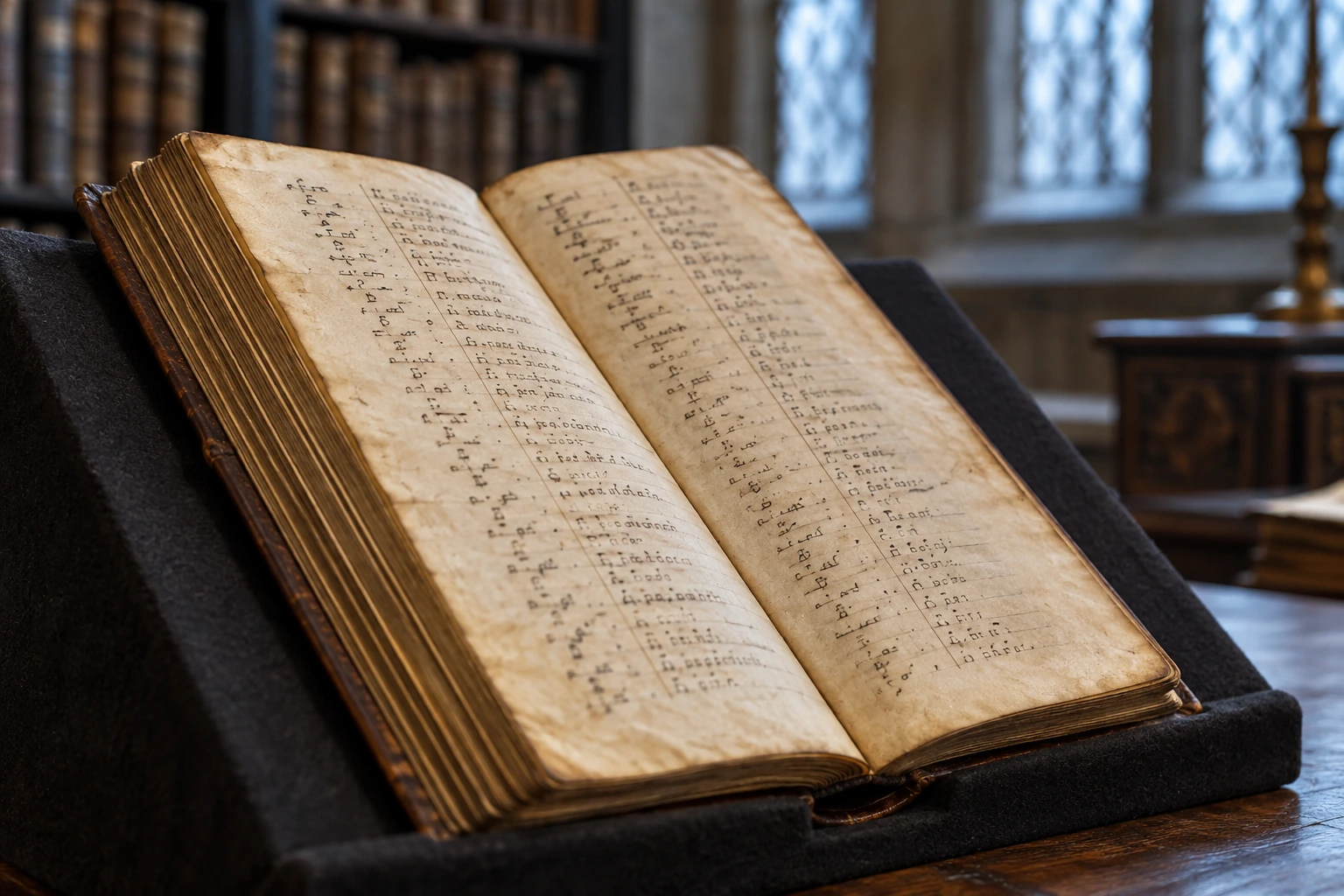
The Bibliothèque de Genève's manuscript Ms. lat. 85, available through e-codices, is a ninth-century dictionary of Tironian notes. Its record describes lists of signs accompanied by Latin meanings. The parchment manuscript is strikingly narrow: about 25 by 6.5 centimeters.
Open a facsimile page and look at its rhythm before trying to identify anything. Small signs alternate with fuller explanations. The page does not merely display attractive symbols. It supplies a relationship between a compressed notation and words a reader is expected to know.
Try covering the explanatory side of a few entries with a blank piece of paper held beside your screen. The remaining signs can look like an undeciphered visual pattern. Reveal the explanations, and the page becomes a learning instrument. Context changes what kind of object you think you are looking at.
The sign is not the whole system
Shorthand systems can contain large repertoires of signs and conventions. The survival of one useful sign does not mean that everybody using it knows the wider system. We do something comparable whenever a specialized abbreviation becomes ordinary enough to travel outside its original setting.
In Irish-language typography, the sign can stand for agus, “and.” A discussion among rare-book cataloguers makes this practical issue explicit: expanding every occurrence into Latin et can misrepresent the language of an Irish text. The discussion is professional correspondence, not a universal cataloguing rule, but it identifies a real decision a transcriber must make.
That is a useful reason to resist calling the sign simply “the old ampersand.” Both can do the work of joining words, yet their shapes and histories are distinct. Replacing one with the other can preserve a sentence's broad meaning while losing information about how it was printed.
Three almost-right copies
Compare these: ⁊, 7 and &. Say aloud what you would call each one, then imagine searching a digital archive for only the first. A photograph can make them look similar in a poor reproduction. A typed transcription has to choose an actual character.
The Unicode Standard identifies U+204A as TIRONIAN SIGN ET. It also describes a separate capital sign, U+2E52, and notes that the two are not case-mapped. Their existence in the standard does not guarantee that every font or application will display both well.
For an original experiment, paste the three comparison marks into a document, enlarge them and change the font. Which differences survive? Now return to the default font and try searching for the hooked sign. If you replaced it with a seven because it looked close enough, a literal search for the original will miss it.
A survival story without a straight line
It would be tempting to imagine an unchanged mark traveling directly from ancient Rome into a modern street sign. Actual transmission includes copying, teaching, typography, regional habits and later digital decisions. The Geneva manuscript is evidence for one historical stage, not a complete film of that journey.
The 1998 standards document discussing its encoding shows another stage. Its authors cite evidence and debate where the sign belongs in a character set. Even a tiny symbol needs a record that helps software preserve it consistently.
A close-looking challenge
Find the sign in a source that supplies an actual image, such as a manuscript or Irish imprint. Record whether it joins two words, appears in an abbreviation or occupies another role. Use the surrounding language to interpret it. Do not infer the entire history of the sign from one occurrence.
Small writing forms can survive because they remain useful. The Tironian ⁊ is compelling precisely because it does so much with so little visible material. Following it carefully takes us from a narrow parchment page to the ordinary decisions that determine whether a digital copy preserves what a reader really saw.
Sources and further exploration: e-codices: Geneva Ms.lat.85; Unicode Standard: Tironian et; Rare-book cataloguers: Tironian et revisited; Unicode 1998 encoding discussion.
Explore all 50 new articles · Browse the complete illustrated collection
Explore more art, ideas, and independent projects at Incoprea.