You have reached the right neighborhood. The map says the building is nearby. Yet the numbers in the address do not behave like the steadily increasing house numbers you expected along a road. The problem may be your mental map rather than the address.
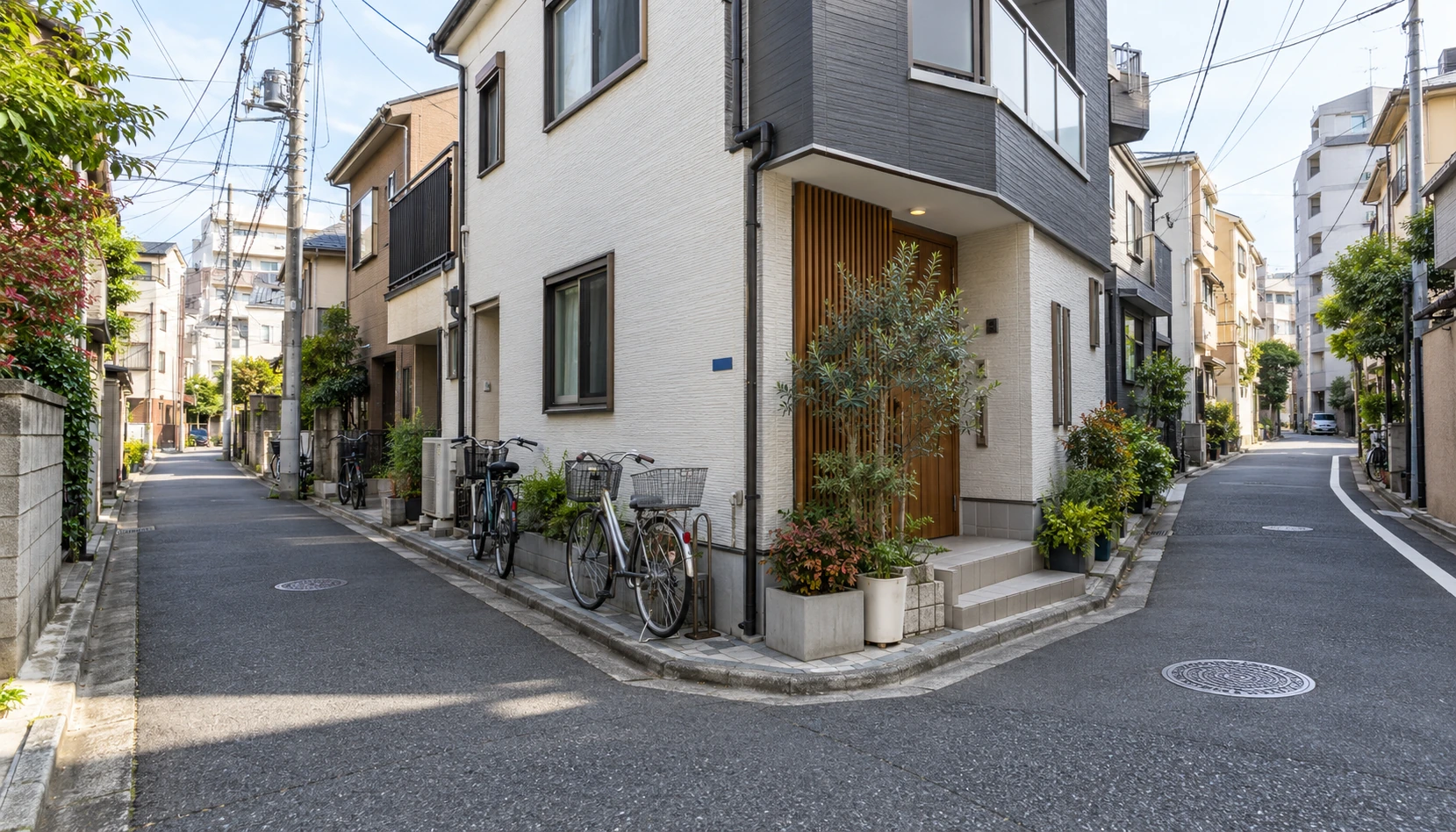
Many Japanese urban addresses identify nested areas and local blocks. Reading one is often a process of narrowing the search, rather than finding a named street and walking until a single house number appears. There are local variations, so the actual destination's published address remains the best starting point.
Unpack the small numbers slowly
Japan Post Bank's English guide illustrates the distinction among district, block and house identifiers. A compact string can hide that hierarchy when its separators are reduced to hyphens. The same three numerals do not mean “walk this many buildings from the corner.”
Use the invented example “Hikari 2-3-1” only as a learning model. Here we define 2 as the local district subdivision, 3 as the block and 1 as the building identifier. Those roles are stipulated for this exercise. They are not a claim that every Japanese address can be parsed by splitting its final three numbers in exactly that way.
First locate the larger area. Then locate subdivision 2. Then look for block 3. Only inside that block do you search for building 1. Jumping straight to the last digit throws away the information that gives it a location.
Find an address in a fictional neighborhood
A keyboard-accessible block and building hunt demonstrates nested identifiers.
Open find an address in a fictional neighborhood in its own window.
The address hunt provides a fictional neighborhood with numbered blocks and buildings. Its buttons work by mouse, touch or keyboard. Try finding the target in the correct order. Then change the target and see which parts of your previous route are still useful.
A route and an address solve different problems
An address identifies a destination. A route explains how to approach it from somewhere else. The entrance might face a small lane, while the most recognizable landmark lies on a larger road. Finding the correct block is therefore a major success, but it may not finish the walk.
The Shinjuku City guide's branch-office maps make this distinction tangible. Its entries pair addresses with nearby stations, roads and local landmarks. For example, the Totsuka Branch Office entry gives an address at 2-18-1 Takadanobaba and a map of the approach. The map contributes information that the address alone does not supply.
Open one of those office maps and choose a station as your starting point. Before tracing a route, identify the office symbol, the north arrow and one landmark that could confirm you have arrived in the right area. This is a wayfinding exercise on a published map, not a recommendation to visit a government counter unnecessarily.
Writing the address for another reader
Japan Post's English addressing instructions put a recipient's name first, include the building and room when applicable, and place the larger geographic information on later lines. The service's international format reverses the broad-to-small order familiar in Japanese writing.
Reordering is different from dropping information. An apartment name, room number, postal code or locality may be essential to distinguishing the destination. A short string copied from a map pin can omit details that a postal label needs.
For a useful desk exercise, take a public institution's complete published address and highlight the pieces: recipient or institution, building information, local numeric identifiers, locality, wider region and postal code. Do not use a private person's address. Then compare how the institution presents it in Japanese and English, if both are supplied.
What the numbers do not promise
A nearby number does not always imply the next building on your walking route. A short straight-line distance does not tell you which entrance is accessible. A postal code narrows an area but does not identify a room. These limitations are easier to handle once each piece of information has its own job.
If the final turn still feels confusing
Return to the destination's own directions. Check the building name and entrance description, not just a map pin. If asking for help, show the complete address rather than a remembered fragment of numbers. The full hierarchy gives another person more to work with.
There is an enjoyable shift when the system clicks. The address stops looking like a scrambled sequence and becomes a set of nested instructions for attention. First the area, then the block, then the door: a different organization of space, with its own logic.
Sources and further exploration: Japan Post Bank: English guide to form details; Shinjuku City: branch-office maps; Japan Post: writing an address and name.
Explore all 50 new articles · Browse the complete illustrated collection
Explore more art, ideas, and independent projects at Incoprea.