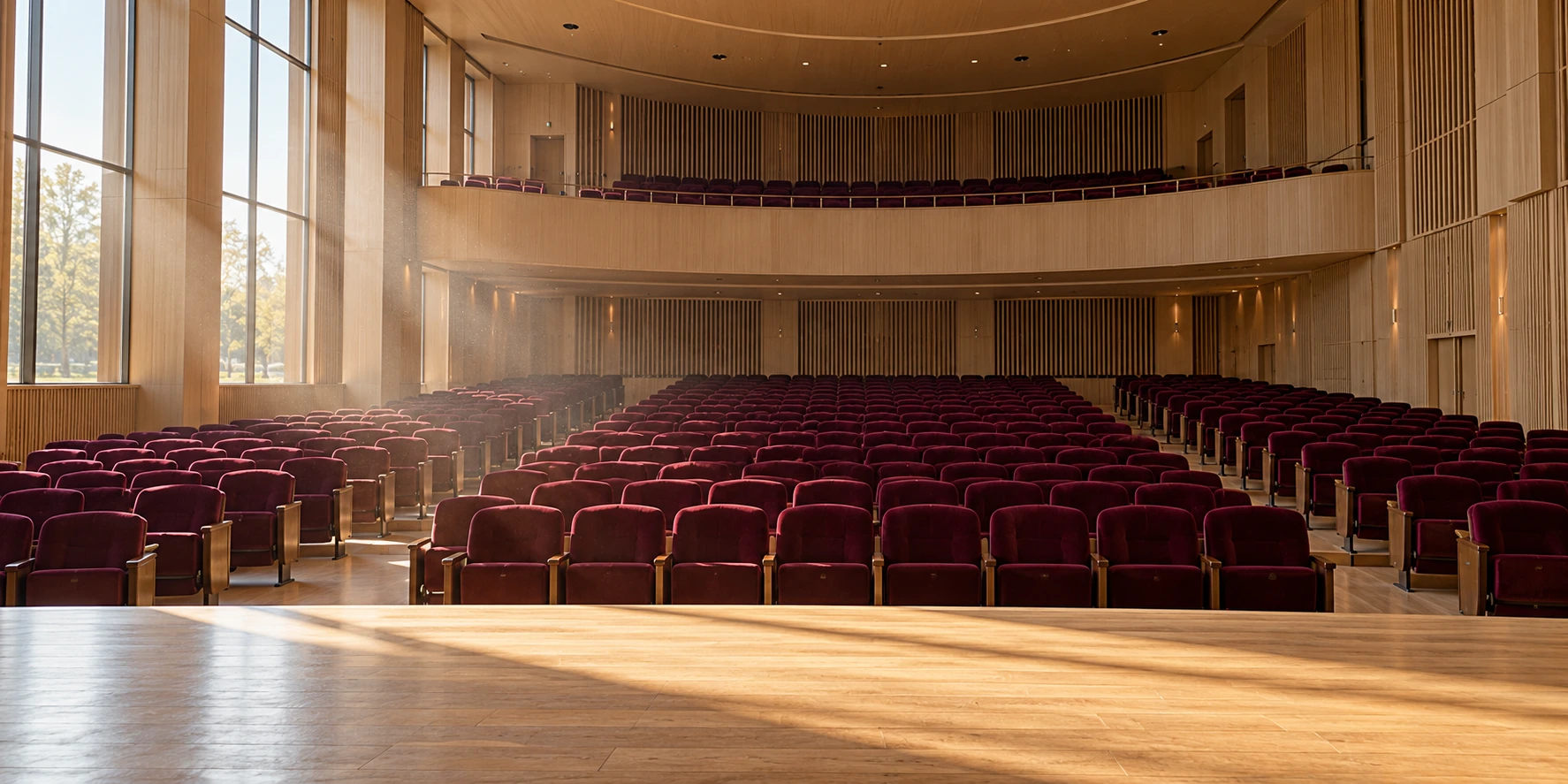
The sheet is small, translucent and covered with tiny rectangles. Hold it at reading distance and most of its contents vanish into a gray pattern. Put it into the right viewer, and one rectangle becomes a page. A library has been compressed, but it has not become self-explanatory.
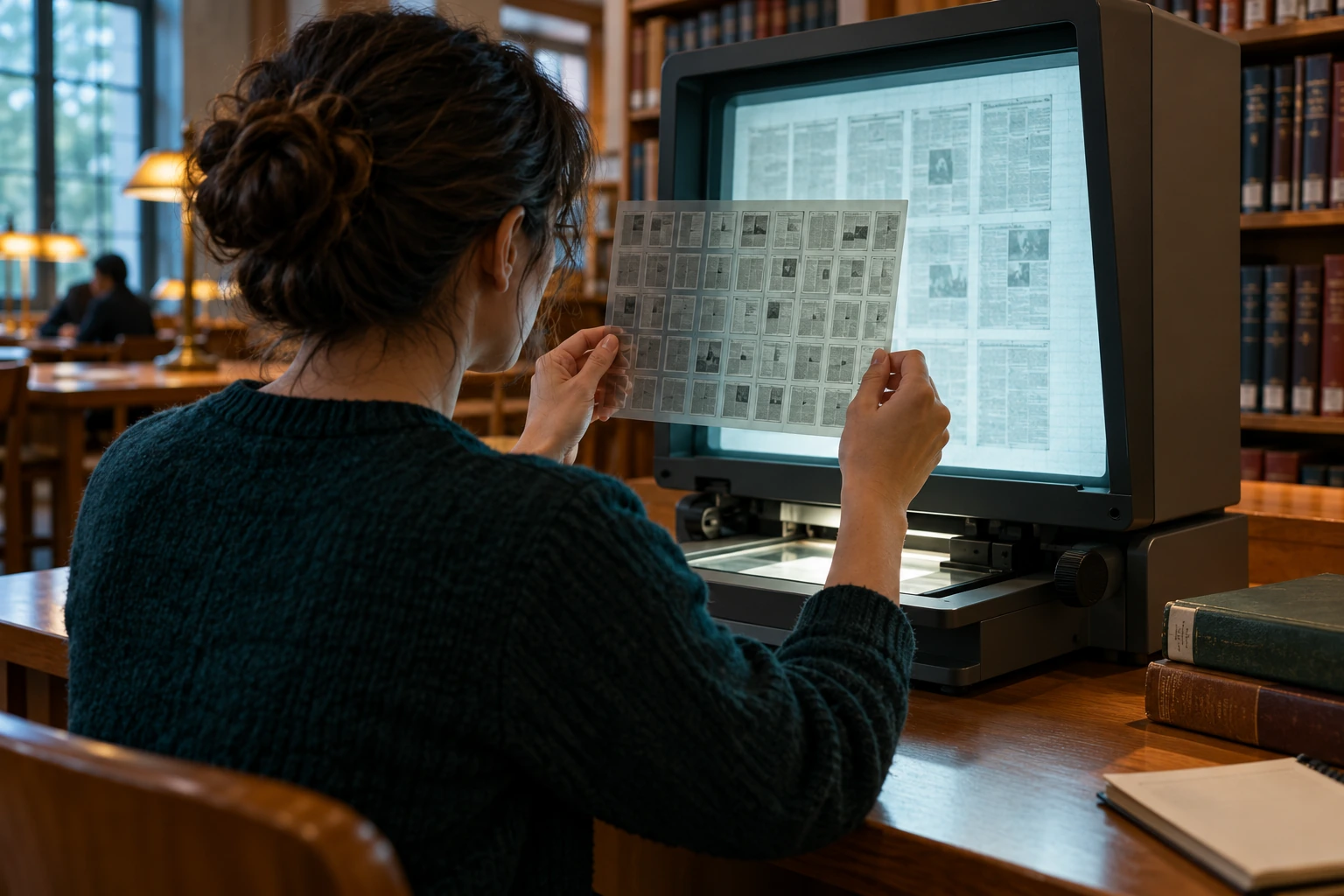
Microfiche is a flat sheet of photographic film containing reduced images in a grid. The Library of Congress's microform description distinguishes it from rolls, cartridges and other carriers. That physical distinction affects how a reader moves through the material.
A grid is an interface
The Library of Congress describes a common 105-by-148-millimeter fiche format with approximately 24:1 reduction and a grid that can hold 98 images of suitably sized documents. These are common specifications, not dimensions or capacities shared by every fiche. Other reduction ratios and arrangements exist.
Twenty-four to one is a linear reduction. A line 24 millimeters long in the original would be about one millimeter long in that simplified comparison. Area changes more dramatically because two dimensions are being reduced. That is the source of the storage advantage—and the need for magnification.
But fitting many pages on one sheet introduces another problem. Which rectangle contains page 43? Does numbering run across the rows, down columns or according to a supplied index? Does an image include a cover or a blank page? The physical grid and the document's page numbering need not be identical systems.
Navigate a miniature fiche
Find invented pages by grid coordinate or document page number.
The fictional fiche finder lets you move among 24 frames. One task asks for a document page; another asks for a frame coordinate. Switch between them and notice which information each instruction supplies. The tool is a navigation model, not a reproduction of a specific historical fiche.
Before using any real fiche, check its own guide. The toy model makes an offset easy to see; a real collection may have multiple covers, supplements or missing pages that require a different index.
The heading has a different audience
On a fiche, a larger heading can remain readable without magnification while the pages require a machine. That creates two scales of access. A person can identify the sheet before selecting an image to enlarge.
Imagine a drawer full of fiche sheets without headings. The reduced pages might all be preserved beautifully, yet finding the right sheet would become difficult. Storage density is useful only when identification and retrieval keep pace with it.
The National Archives' media descriptions similarly identify a fiche as a transparent sheet with microimages arranged in a grid. That concise definition tells a cataloguer what carrier is present. It does not substitute for the title, sequence or access information a researcher needs.
Reading involves movement as well as enlargement
At a traditional reader, moving the carrier changes which image sits in the optical path. Enlarging a page can make its text comfortable to read while placing neighboring pages outside the visible area. The reader must continually connect a local view with an overall arrangement.
Try this with an ordinary printed page. Cover it with another sheet containing a small rectangular window. Move the window across the lines. You can still recover the words, but keeping your place becomes a separate task. Magnification solves the size of the letters; it does not automatically solve navigation.
The surviving reader matters
The University of Illinois Preservation Self-Assessment Program treats microforms as photographic materials with particular identification and preservation concerns. Film type, condition and storage affect what remains available. A stable-looking sheet should not be assumed indestructible.
Access also depends on a suitable reader or scanning equipment. The object can survive while the means of convenient reading becomes scarce. That is a familiar preservation problem in a particularly visible form: the contents are plainly present, but their scale keeps them out of reach.
A useful question for any compressed archive
What has been preserved: the page images, their order, their identifying labels, a searchable transcription, or all of these? A scan can be excellent while its OCR is poor. A catalogue can identify a document without exposing its contents. Ask which layer supports the task you want to perform.
Microfiche is more than a quaint predecessor to a website. It is a compact lesson in information design. Small images, clear headings, stable order and usable viewing tools have to cooperate. The wonder lies in fitting a shelf into a hand; the achievement lies in helping someone find the right page again.
Sources and further exploration: Library of Congress MARC21: microform; National Archives: media types; University of Illinois PSAP: microforms.
Explore all 50 new articles · Browse the complete illustrated collection
Explore more art, ideas, and independent projects at Incoprea.