The camera ejects a print. At first it offers very little to look at. You wait, and a chair, a window or a friend's face gradually becomes recognizable. It feels as if the picture has traveled out of the camera unfinished. In a useful sense, it has: the film unit still has work to do.
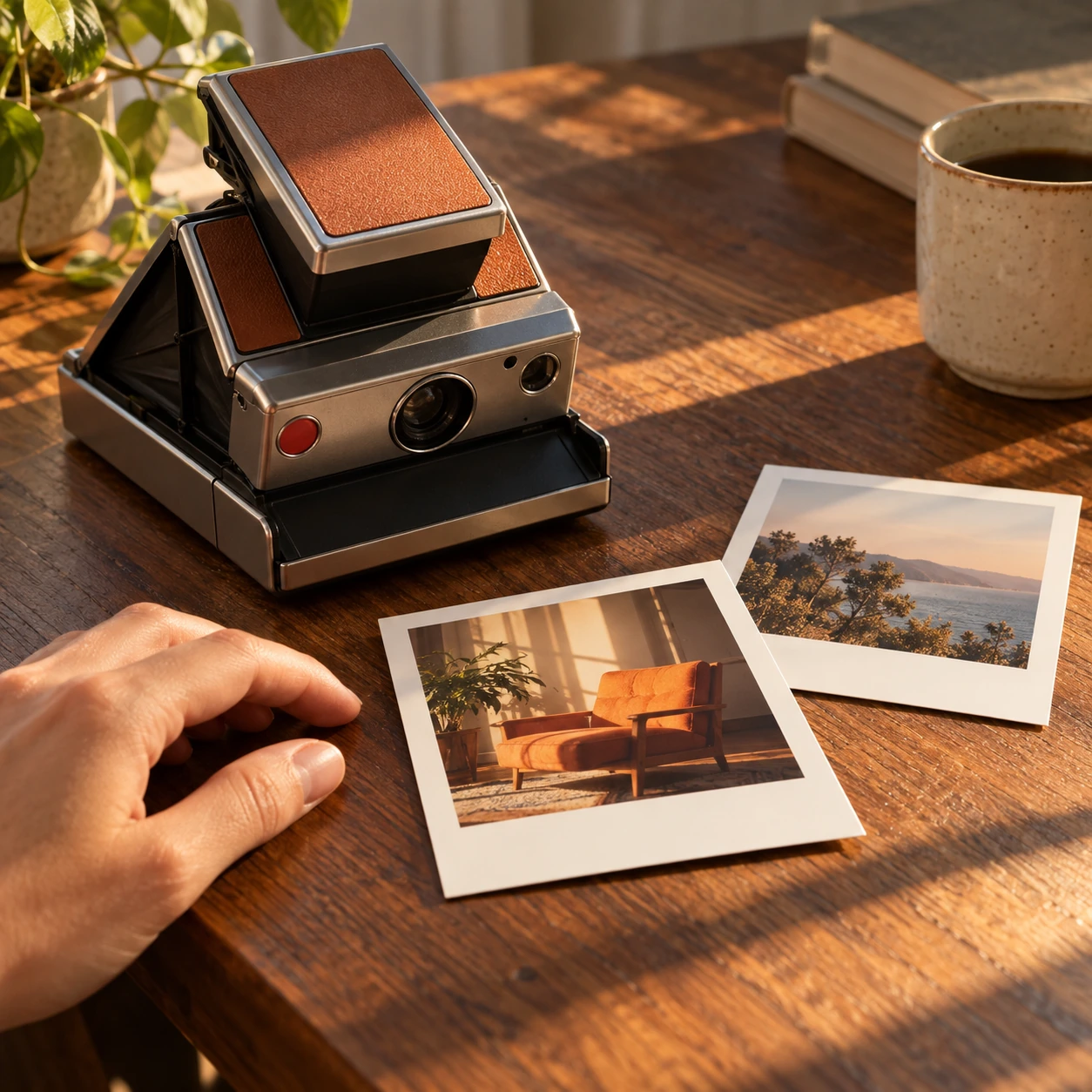
Instant photography compresses a sequence of photographic processes into a portable package. The dry object in your hand can contain liquid chemistry inside. The visible simplicity belongs to the user's experience, not to the number of events taking place within the print.
The rollers do more than push
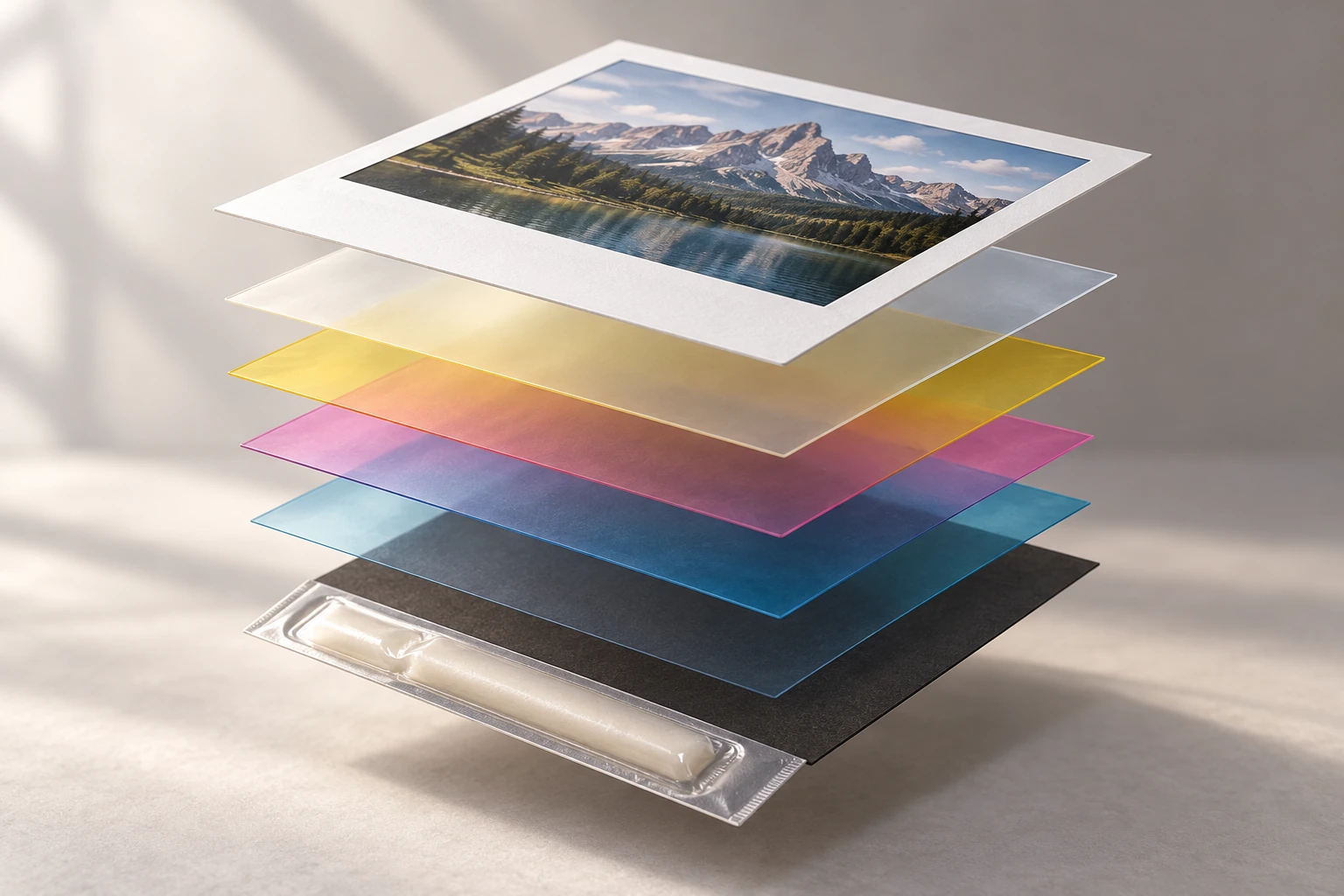
Polaroid's account of its Lab device describes light forming a latent image in the film, followed by ejection through rollers. Those rollers rupture a reagent pod in the film border and spread its contents between layers. The device is a particular example, but it exposes the principle unusually clearly.
Notice the order. Exposure records information in a light-sensitive material. Spreading reagent begins a later stage. An image can therefore exist in a form that is not yet a finished visible print. “I cannot see it” and “nothing has happened” are different statements.
The broader border on an integral instant print is consequently not just graphic styling. It helps accommodate the film unit's structure. The exact arrangement depends on the product, so an attractive cutaway illustration should not be mistaken for a complete layer map of every instant film.
A history of controlling when things happen
The American Chemical Society's history of Edwin Land and instant photography describes the coordinated chemistry behind the process. It also identifies Meroë Morse's work on black-and-white film and Howard Rogers's contribution to color dye developers. The achievement was a team effort in materials and timing.
Making a reaction happen is only one requirement. The materials also need to remain usable before exposure, develop in the intended sequence and stop changing enough to leave a useful photograph. A system that works once under ideal conditions is a different achievement from a film unit someone can carry and use.
Think of the problem as choreography. Each participant needs the right place and a useful moment to act. If everything acts immediately, or keeps acting indefinitely, a final image does not follow merely because all the necessary ingredients are present.
Observe the wait without disturbing the print
If you already use an instant camera, choose an ordinary scene with a bright area, a middle tone and a dark object. Follow the instructions for that particular film. Keep the print intact and still while it develops, and note when each region becomes distinguishable. A simple clock and a few written observations are enough.
This is an observation exercise, not a test of competing film brands. Lighting, temperature, film age and exposure can all differ. A single print cannot tell you which factor caused a particular color or patch.
The Polaroid Now user manual describes the film shield and placing the ejected photograph face down to continue development. Use the maker's guidance for your own camera and film rather than a universal timetable copied from someone else's system.
What a mistake can reveal
A stripe, uneven patch or badly exposed picture is disappointing, but it can also prompt a better question. Did the problem arise when light reached the film, when material spread, during storage or during development? Those are different stages, even if the final defect appears in one small rectangle.
Do not open a print to investigate its chemistry. The useful comparison is between intact prints and the manufacturer's troubleshooting information. A sealed film unit makes the process convenient precisely by keeping its working materials contained.
Compare an instant print with a phone image
Write down when each becomes visible, where it is stored, how it can be duplicated and what object another person receives. Neither list needs a winner. The comparison shows that “taking a picture” can bundle together very different recording, processing and sharing steps.
An instant photograph is unusually good at making time part of looking. The click is not the ending. There is a pause in which the photographer must trust an invisible sequence, then an object that can pass directly into another person's hand.
The next developing print is worth watching closely. Inside its modest border, materials have turned a brief pattern of light into something persistent. The real magic is not the absence of a darkroom. It is the work required to make the darkroom small enough to travel with the picture.
Sources and further exploration: Polaroid: how the Lab works; American Chemical Society: Land and instant photography; Polaroid Now: official user manual.
Explore all 50 new articles · Browse the complete illustrated collection
Explore more art, ideas, and independent projects at Incoprea.