30 stories · 30 original illustrations · An Incoprea long read
A village hires a musician and loses its children. A woman discovers that her beautiful new husband is a skull wearing borrowed body parts. A woman goes into the marsh to investigate its monsters, and the monsters bury her: unfortunately for everyone, she is the Moon. These are the kinds of stories that make modern horror look restrained.
These thirty retellings range from place-bound legends and old folktales to modern urban legends and a living Māori ancestral tradition. Each follows an identified version, with sources close at hand. The interpretations offer one reading of the stories rather than a single meaning for an entire culture.
The companion collection: 30 Almost Unbelievable True Stories: Survival Against the Odds.
Watch the illustrated film
15:55 · All 30 stories · Narration and an original Suno score
AI-generated interpretive illustrations and synthetic narration. Watch on YouTube for chapters and captions.
Browse all 30 stories
- The Pied Piper: the town that lost its future
- The Bell Witch: a haunting that learned to talk
- La Llorona: the cry that travels along the river
- Mothman: the shape in the headlights
- Black Shuck: the storm with a dog inside it
- The Nuckelavee: escape between salt water and fresh
- The Kelpie: the beautiful horse with a claim to collect
- The Changeling: an ancient voice from the cradle
- Tailypo: the thing that wants its tail back
- The Golden Arm: the inheritance that would not stay buried
- Mr. Fox: the bride who brought her own evidence
- The Manananggal: the monster with something left to lose
- Kuchisake-onna: the question with no comfortable answer
- The Kappa: the river thief that had to make a promise
- Baba Yaga: the light that comes home in a skull
- Koschei the Deathless: his death is somewhere else
- The Draugr: winning the fight and keeping the curse
- The Juniper Tree: a murdered child returns as a song
- The Singing Bone: the witness nobody remembered burying
- Tatterhood: the princess who arrived riding a goat
- The Dead Moon: the night the sky needed rescuing
- The Three Snake Leaves: resurrection does not finish the story
- The Tiger, the Brahman and the Jackal: the rescue needs a demonstration
- The Girl Who Married a Skull: beauty bought on credit
- Anansi: buying the right to tell a story
- Urashima Tarō: the holiday that outlived everyone at home
- The Crane Wife: the cloth that costs the weaver herself
- The Sea Tsar and Vasilisa: the princess who keeps changing the escape route
- The Hobyahs: the danger that survived every ignored warning
- Māui: the fisherman whose catch became the land
1. The Pied Piper: the town that lost its future
Hamelin, Germany · civic legend; Grimm version published 1816
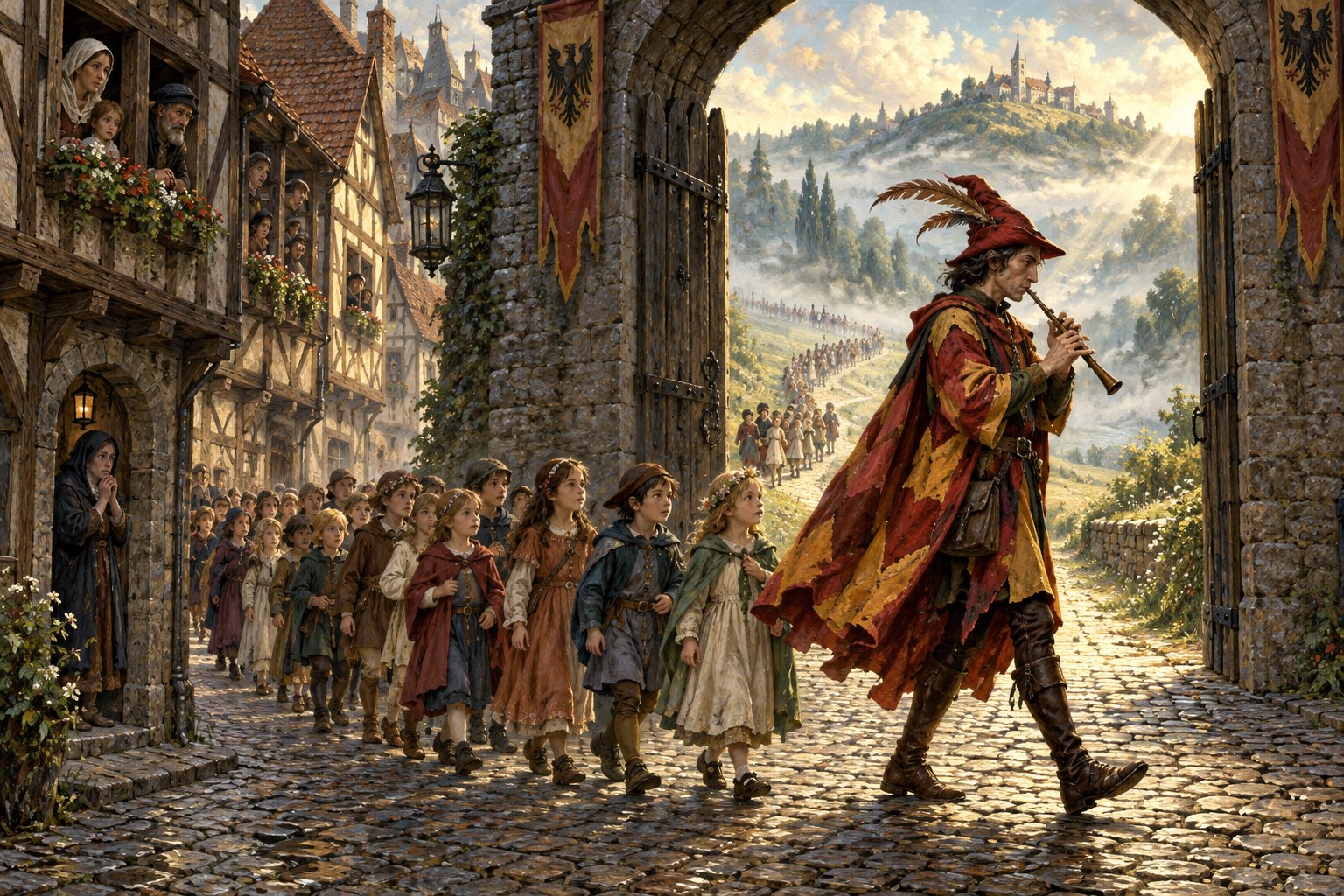
The bargain looks almost embarrassingly simple. Hamelin has rats; a stranger has a pipe. He promises to remove the infestation for an agreed payment, plays a tune, and leads the animals into the Weser. Then the townspeople decide that a finished job no longer needs paying for. The musician leaves, carrying away his instrument and their apparently harmless broken promise.
When he returns, the tune has a different audience. Children come out of the houses and follow him beyond the town. In the Grimms' version, 130 disappear into a mountain. A few who cannot complete the journey remain behind, turning the absence into a story someone can tell. The frightening transaction is complete: the town has saved its money and lost its children.
Hamelin's own museum separates the old tradition of missing children from the later, developed rat-catching narrative. Early inscriptions and images preserve the piper and an exodus associated with 1284; they do not establish that the supernatural story happened. No proposed explanation has settled the mystery. The legend’s most disturbing invention may be its scale of payment. A disputed fee becomes an entire generation. The final cost cannot be measured in the currency with which the argument began.
Sources and further reading: City of Hamelin: the Grimms’ version · Museum Hameln: origins and surviving evidence
2. The Bell Witch: a haunting that learned to talk
Tennessee, United States · legend set in 1817–1821; major account published 1894
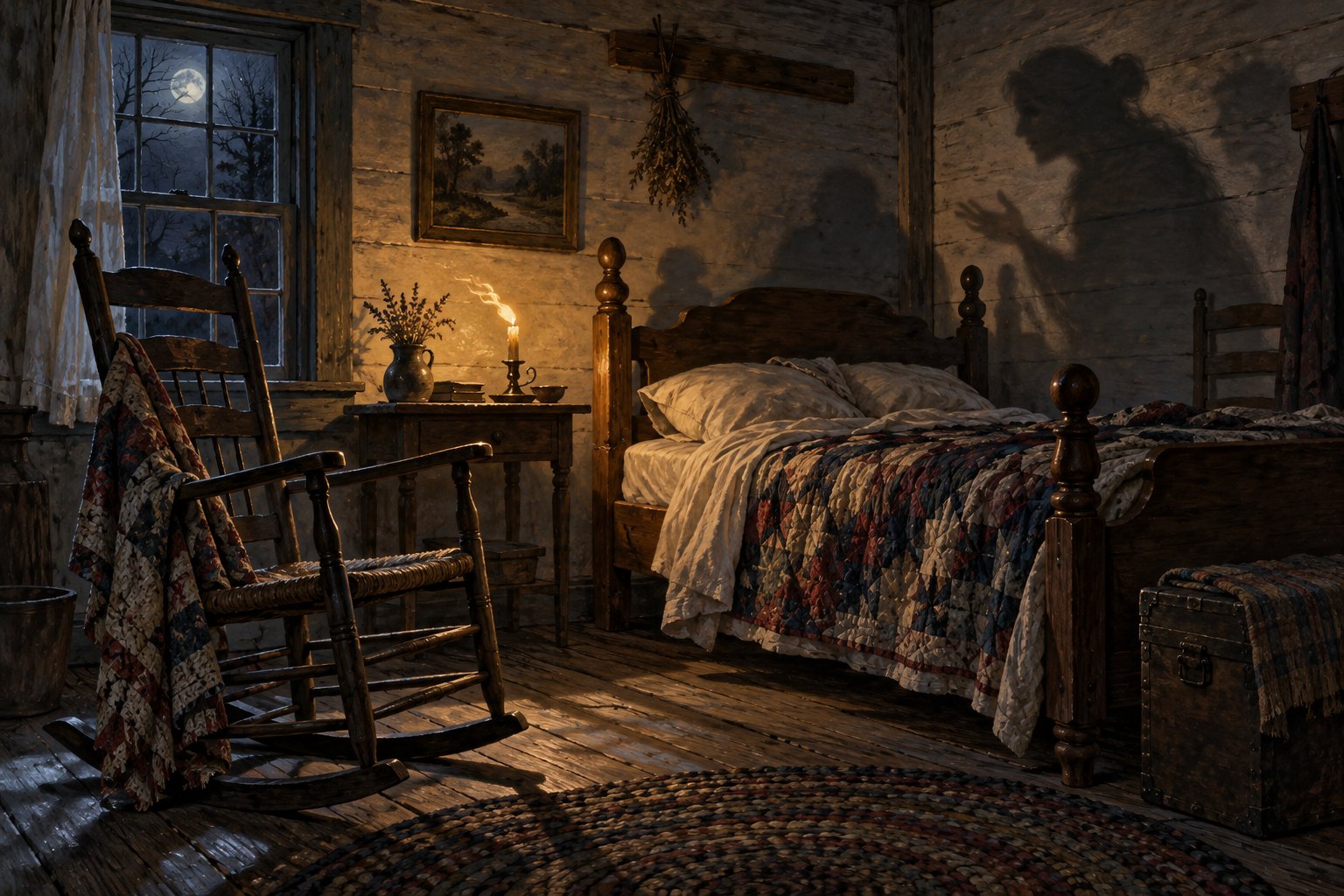
At first, the Bell household supposedly hears the sorts of noises that a worried person could explain away: scratching, knocking, something moving where no one is standing. Then the disturbance becomes articulate. The invisible visitor answers questions, makes remarks, and seems to know exactly whom it wants to torment. A haunted house is bad enough; this one has acquired an opinionated resident who refuses to leave.
In the developed legend, the spirit singles out John Bell and his daughter, disrupts sleep, and mocks attempts to control it. Its climax is a mysterious bottle and the claim that the entity has poisoned Bell. Even a funeral cannot make it behave. Some versions give it the nickname Kate, as if a personality might make this inexplicable intruder easier to discuss across a kitchen table.
The documentary boundary matters. John Bell was real and died in 1820, but North Carolina's Department of Natural and Cultural Resources notes the absence of contemporary sources for the haunting. The influential full account appeared decades later in M. V. Ingram's 1894 book. Tennessee's archives likewise describe early evidence as dubious. The haunting’s peculiar power comes from intimacy: the threat knows the family, joins their conversations, and turns the safest domestic space into an audience for its cruelty.
Sources and further reading: Tennessee State Library and Archives: Bell Witch · North Carolina DNCR: the evidence problem
3. La Llorona: the cry that travels along the river
Mexico, Latin America and the American Southwest · living legend with many variants
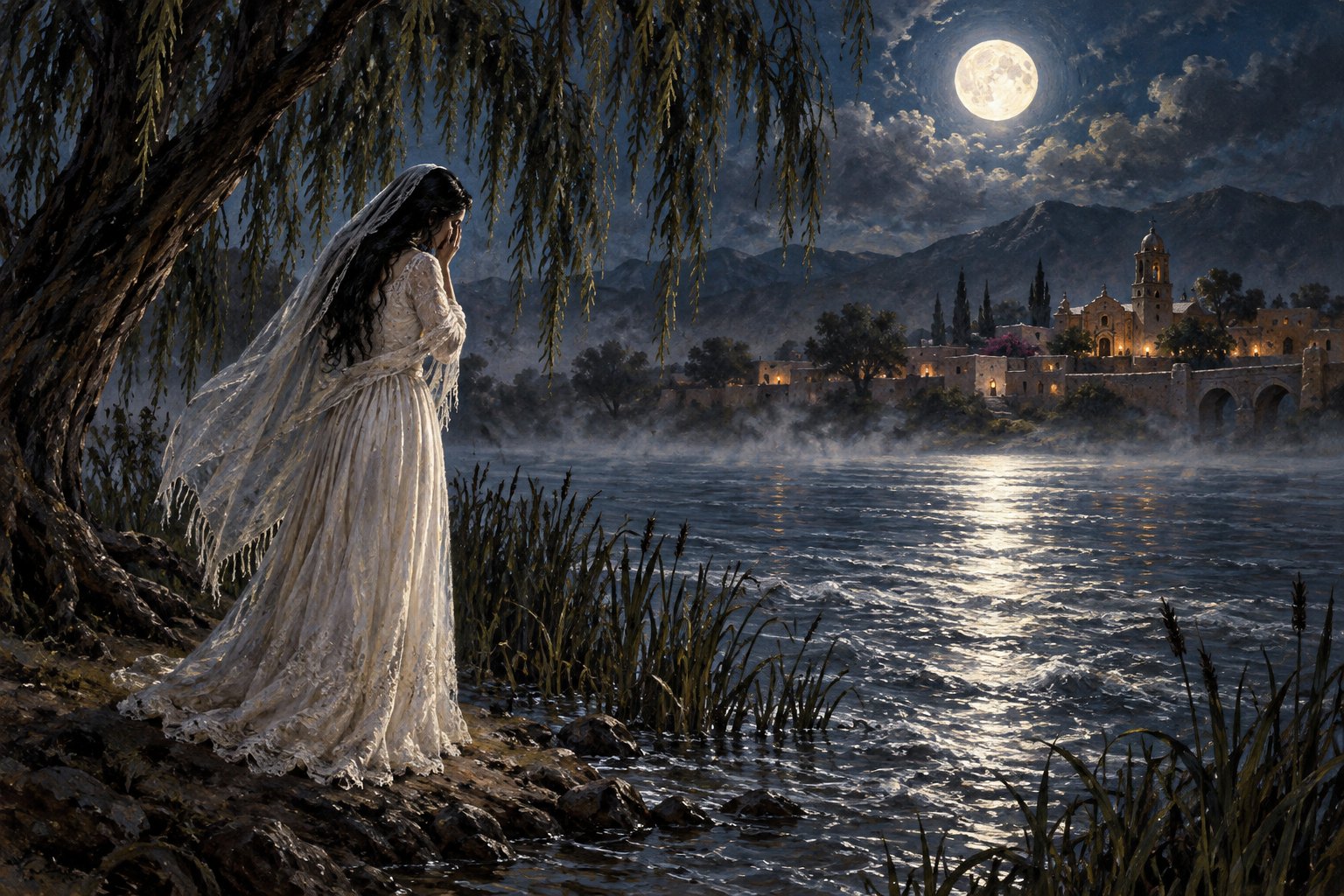
Someone is crying beside the water after dark. It sounds like a woman searching for children, and compassion might draw a listener toward it. That is the first trap in many tellings of La Llorona: the sound asks to be understood before the person who hears it knows what is making it. The riverbank becomes a place where grief and danger share the same voice.
A widely told version makes her a mother who killed her children and now wanders, unable to recover them. Other tellings change her circumstances, motives, appearance, and the danger she poses to anyone she meets. She may threaten children, frighten travelers, or simply repeat an endless search. There is no single official plot against which all the others should be marked wrong.
The Smithsonian's account of a La Llorona doll emphasizes that variation across Mexico and the Southwest. It also records connections people have made with older divine figures and La Malinche; those identifications should not be mistaken for one proven origin. A river ghost needs remarkably little scenery. A bank, darkness, and a human cry are enough. Each teller can move the sorrow to a familiar stream, where the next listener already knows how strange ordinary sounds become after sunset.
Sources and further reading: Smithsonian National Museum of American History: La Llorona
4. Mothman: the shape in the headlights
Point Pleasant, West Virginia · modern legend beginning in 1966
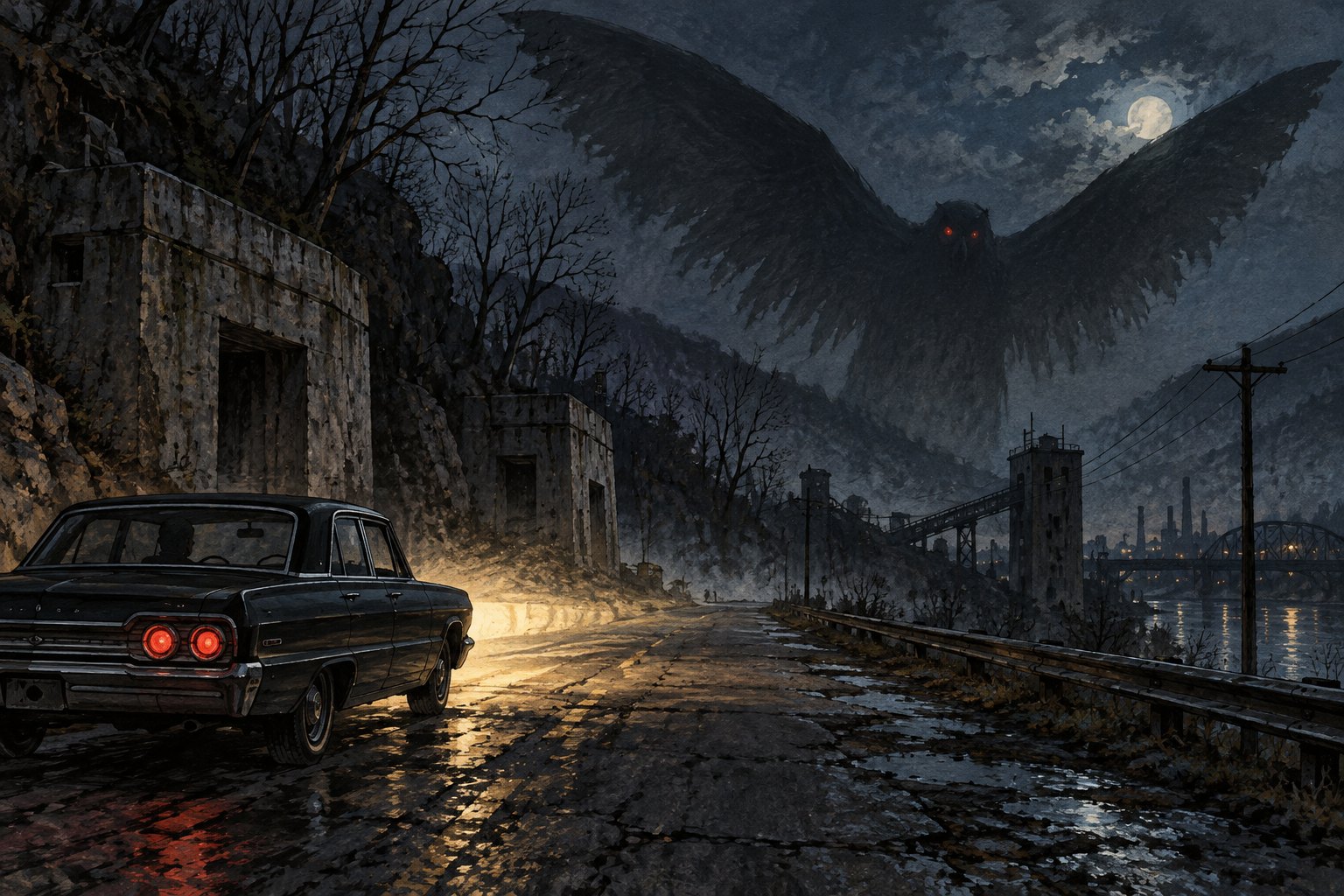
Two red eyes appear in the dark, and the figure around them does not resolve into anything familiar. In the reports that launched the Point Pleasant legend in November 1966, witnesses described a large winged creature near the former wartime explosives plant outside town. Later tellings made it capable of following a car through the night. Headlights, roads, and newspaper offices replaced the castles and lonely tracks of older monster stories.
Then something indisputably terrible happened. The Silver Bridge collapsed on December 15, 1967, killing 46 people. Popular retellings connected the catastrophe with the preceding sightings. Mothman became, depending on the speaker, a threat, an omen, or a messenger whose warning no one had understood. The documented disaster and the unverified creature were woven into one narrative, although that connection is folklore rather than an established cause or prediction.
The Smithsonian's discussion of Point Pleasant treats Mothman as part of a community's storytelling and identity. That offers a better question than whether a statue proves a monster: what work does the story do for its tellers? The warning version can be read as a painful wish that tragedy might have announced itself in advance. Something incomprehensible seen in the dark becomes a sign that, afterward, people desperately want to read.
Sources and further reading: Smithsonian Center for Folklife: Mothman and Point Pleasant · USC Digital Folklore Archives: a recorded modern telling
5. Black Shuck: the storm with a dog inside it
East Anglia, England · black-dog tradition and a 1577 pamphlet
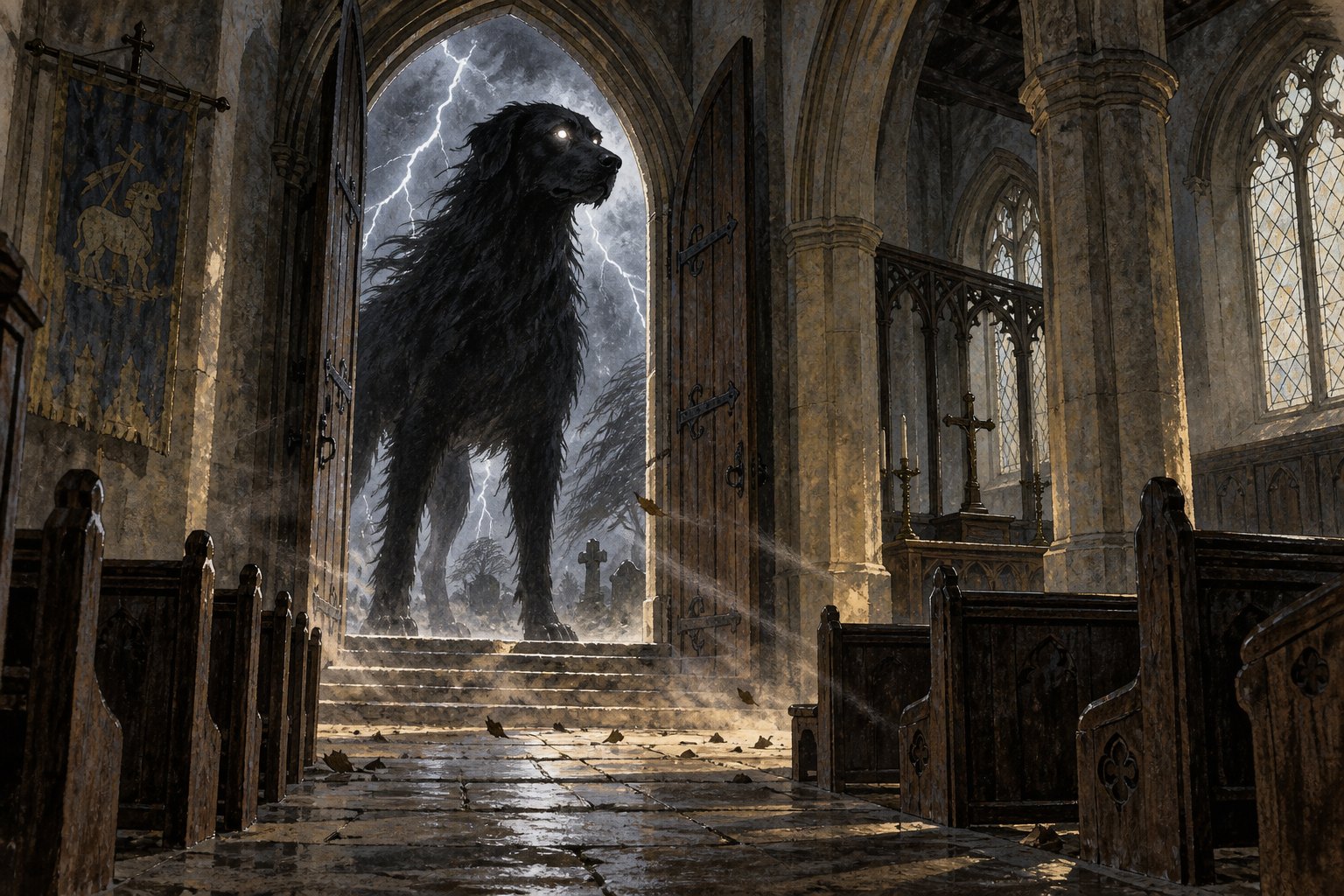
A storm catches a congregation inside its church. Thunder and sudden darkness would be frightening enough, but the account that circulated after the Suffolk storms of August 4, 1577, supplied something worse: a black dog racing through the sacred interior. People died, others were injured, and the place intended as refuge became the setting of a supernatural assault.
The printer and clergyman Abraham Fleming published a sensational account that year. It described the devil in canine form at Bungay and related a further incident at Blythburgh. Later storytelling gathered these events into the broader Black Shuck tradition, in which a huge spectral dog haunts roads, coasts, and lonely places. Marks on a church door acquired their own place in the legend. A surviving pamphlet proves that the story was being told, not that a demonic animal caused the storm's damage.
Modern historical scholarship also reads Fleming's account within the religious arguments of Elizabethan England. That makes it more interesting than an isolated monster sighting: disaster was being interpreted for readers with particular fears and beliefs. Within the story, the dog gives the weather an intention. Lightning is sudden and impersonal; a creature can choose a victim, enter a doorway, and appear to know exactly where frightened people have gathered to feel protected.
Sources and further reading: Blythburgh village history: Fleming and the storm · Journal of Religious History: the Black Dog of Bungay
6. The Nuckelavee: escape between salt water and fresh
Orkney, Scotland · recorded by Walter Traill Dennison in the nineteenth century
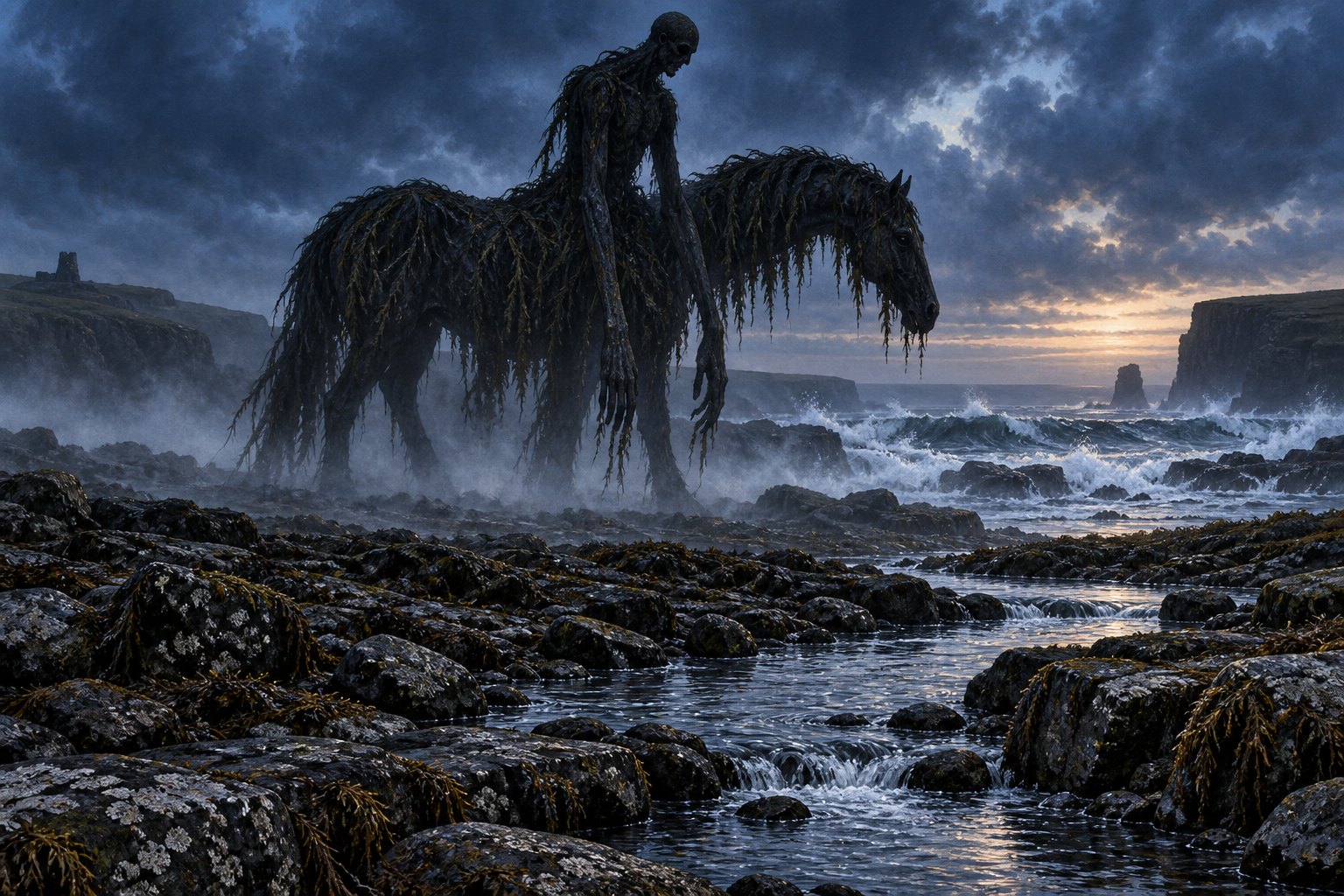
Tammas has chosen a bad place to meet a nightmare. His road runs between the sea and a freshwater loch, leaving little room to turn aside. Ahead, something enormous approaches. As it draws closer, its shape becomes more impossible: a monstrous horse, with a humanlike figure apparently growing from its back, long arms hanging toward the ground. Most dreadful of all, the creature has no skin.
In Walter Traill Dennison's recorded telling, this is the Nuckelavee, blamed for crop blight, sickness, and livestock disasters. Tammas edges toward the loch. Water splashes, and the monster recoils. That reaction offers a possibility: a being that comes from the sea cannot tolerate fresh water. Tammas runs for a stream, and the escape depends on reaching the crossing before those extraordinary arms reach him.
Dennison identified his informant as a reluctant local storyteller; the account was printed in The Scottish Antiquary and is reproduced by Folklore Scotland. Its existence establishes an Orcadian tradition, not the animal anatomy described within it. What makes the escape so vivid is its geography. The same island environment supplies both the threat and its limit. On one side lies the sea from which danger emerges; on the other lies the ordinary freshwater boundary that can still stop it.
Sources and further reading: Walter Traill Dennison’s account, reproduced by Folklore Scotland · Ísmús bibliography: publication details
7. The Kelpie: the beautiful horse with a claim to collect
Scotland · water-horse legends with local variants
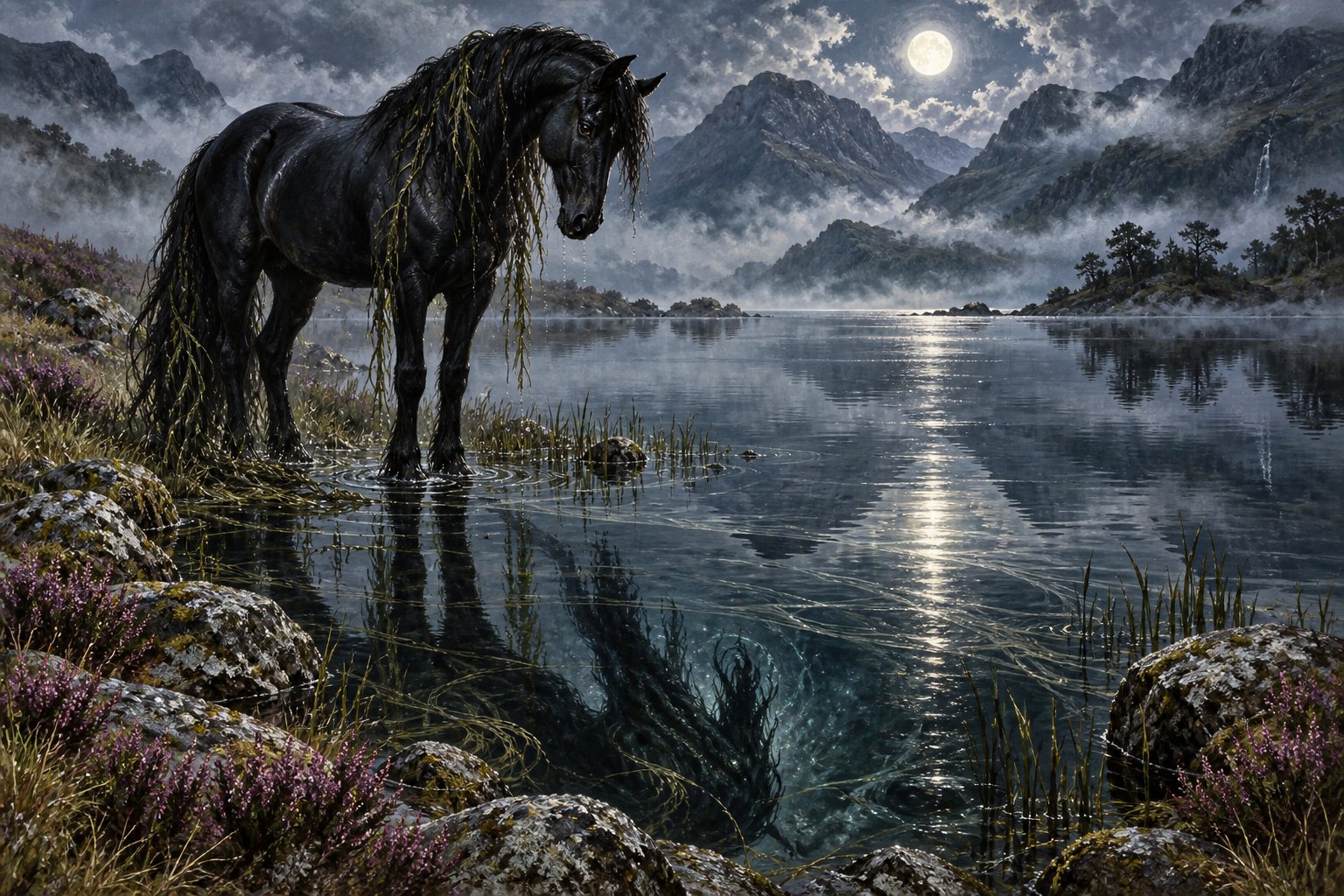
A riderless horse beside the water seems like an opportunity. It may look strong, tame, and eager to be mounted. In familiar water-horse stories, the bargain is revealed only afterward: the rider cannot dismount, and the animal returns to the water with its passenger. The ordinary promise of a horse, that it will carry you somewhere, becomes horrifyingly literal when it chooses the destination.
But there are tales in which a person captures the creature first. Scotland's national website recounts the Laird of Morphie using a magical bridle to bind a kelpie and force it to haul stones for his castle. Released after its labor, the creature curses the laird and his family. This is a more complicated encounter than an animal simply waiting for prey. Human mastery works for a while, but the work leaves a debt behind.
Kelpies and the Gaelic each-uisge overlap in popular retelling, although collectors have distinguished them and local descriptions differ. They should not be compressed into a single monster rulebook. The Morphie story’s reversal gives the creature a grievance. The laird believes a captured supernatural worker means free labor. The legend asks what happens when the thing you harness remembers the work, the pain, and the person who benefited.
Sources and further reading: Scotland.org: kelpies and the Laird of Morphie · The Folk-Lore Journal: collected kelpie stories
8. The Changeling: an ancient voice from the cradle
Ireland and Britain · the eggshell-brewing story
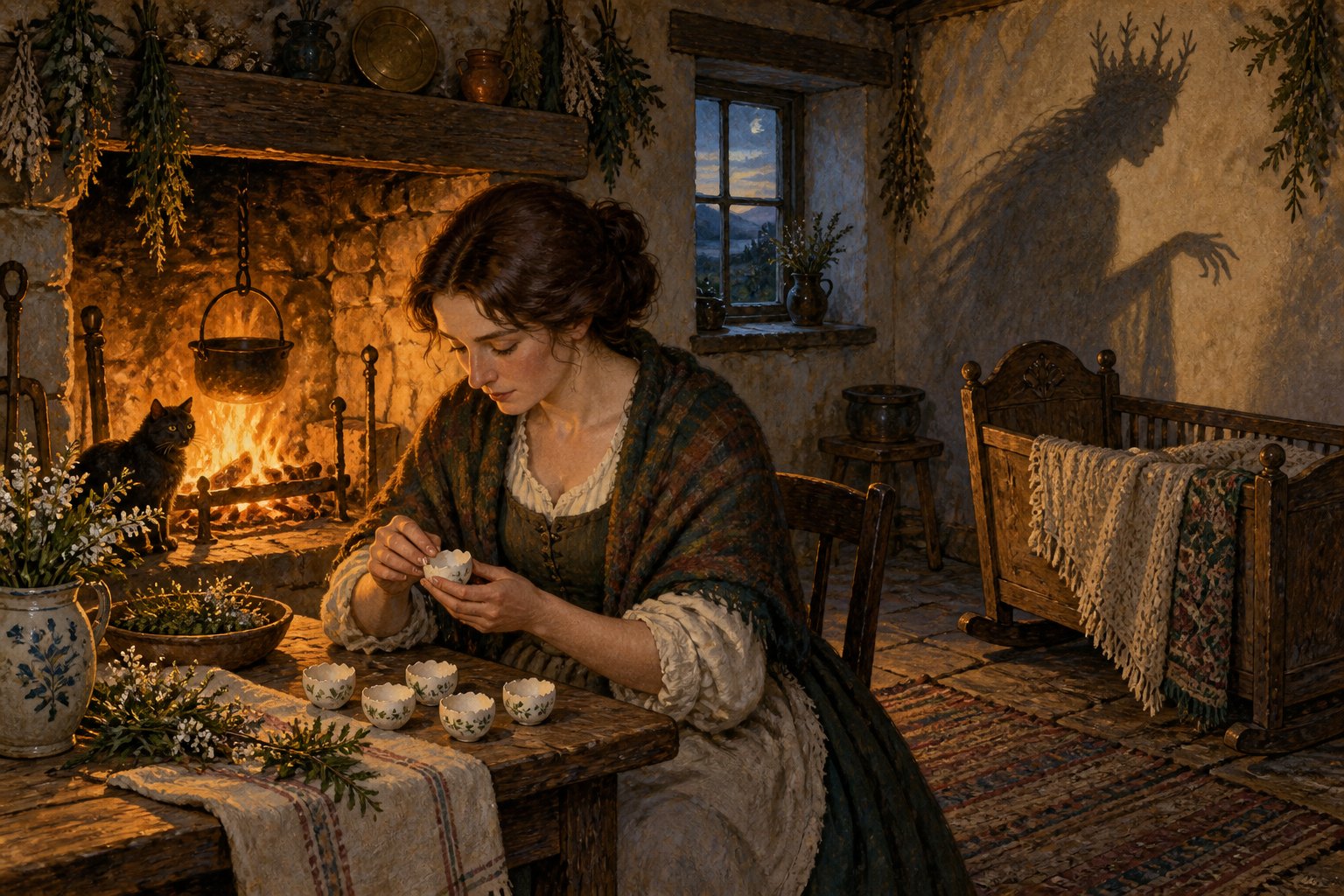
The infant in the cradle seems changed. In a familiar family of fairy legends, the explanation is that the real child has been stolen and an ancient being left in its place. The substitute looks small enough to belong in the cradle, yet something about its behavior does not fit. A worried household therefore needs a test that will make the visitor forget its disguise.
In the eggshell-brewing version, the mother performs an absurd domestic task: she prepares eggshells as if they could make a proper brew. The supposed baby cannot resist commenting. It speaks with the knowledge and astonishment of someone who has lived for centuries and never seen such nonsense. The impossible age gives it away. In the collected Irish account, the real child is restored, and ordinary family life can resume.
T. Crofton Croker published the tale in 1825; W. B. Yeats included it in his 1888 collection. The original also contains threatened violence, a reminder that these beliefs could endanger actual children whose illness or differences adults misunderstood. They are not instructions for interpreting a child. As a narrative device, though, the eggshell test is remarkable: the fairy is defeated by curiosity. It can maintain an impersonation until a kitchen experiment becomes too ridiculous to watch in silence.
Sources and further reading: Croker and Yeats variants, collected by D. L. Ashliman
9. Tailypo: the thing that wants its tail back
Southern United States and Appalachia · oral scare tale
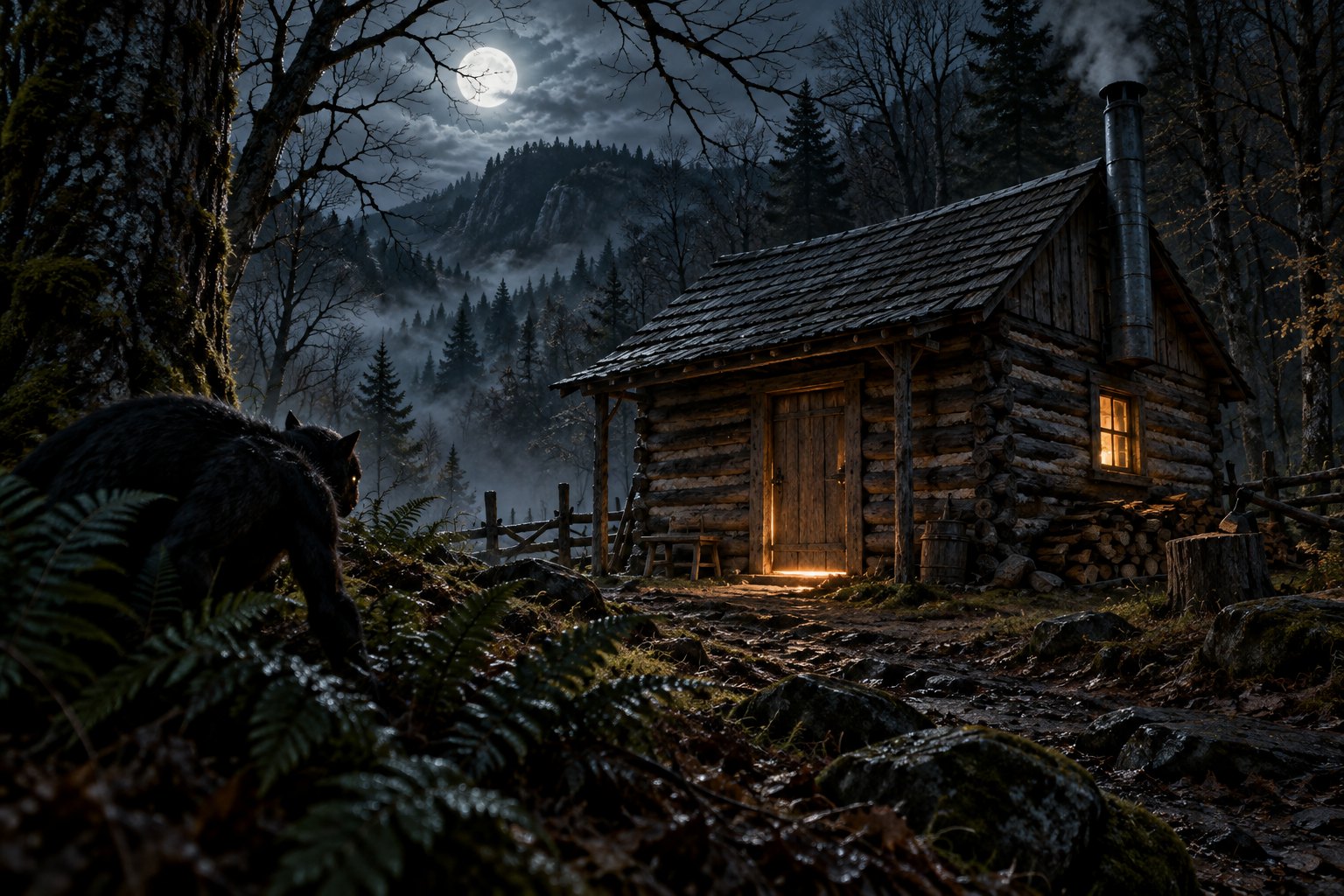
A lonely woodsman is hungry. When a strange creature slips into his cabin, he cuts off its tail, cooks it, and eats. The meal is small, but apparently it is enough to solve tonight's problem. Then the scratching begins. Something outside wants its tail back, and the woodsman has disposed of the one object that might have satisfied it.
His dogs provide a temporary defense. He sends them into the darkness, the disturbance retreats, and for a little while he can imagine the night is under control. But the voice returns. Across variants, the dogs cease to protect him and the creature draws closer to the bed. The repeated demand becomes more terrible because it is so limited. It is not asking for the world; it wants one particular thing that cannot now be returned.
Library collections and folklore archives preserve many performances and retellings, including variants associated with Appalachia. The creature's precise appearance is less stable than the structure of the encounter. Tailypo reduces an irreversible act to the dimensions of a one-room house. Each repetition removes another layer of distance. A teller can begin almost conversationally, lower the voice as the visitor approaches, and make the final movement happen in the listener's room as much as the woodsman's.
Sources and further reading: BYU folklore archive: collected Tailypo retellings · Chicago Public Library: Tailypo in folk storytelling
10. The Golden Arm: the inheritance that would not stay buried
Britain and the United States · traditional performance tale
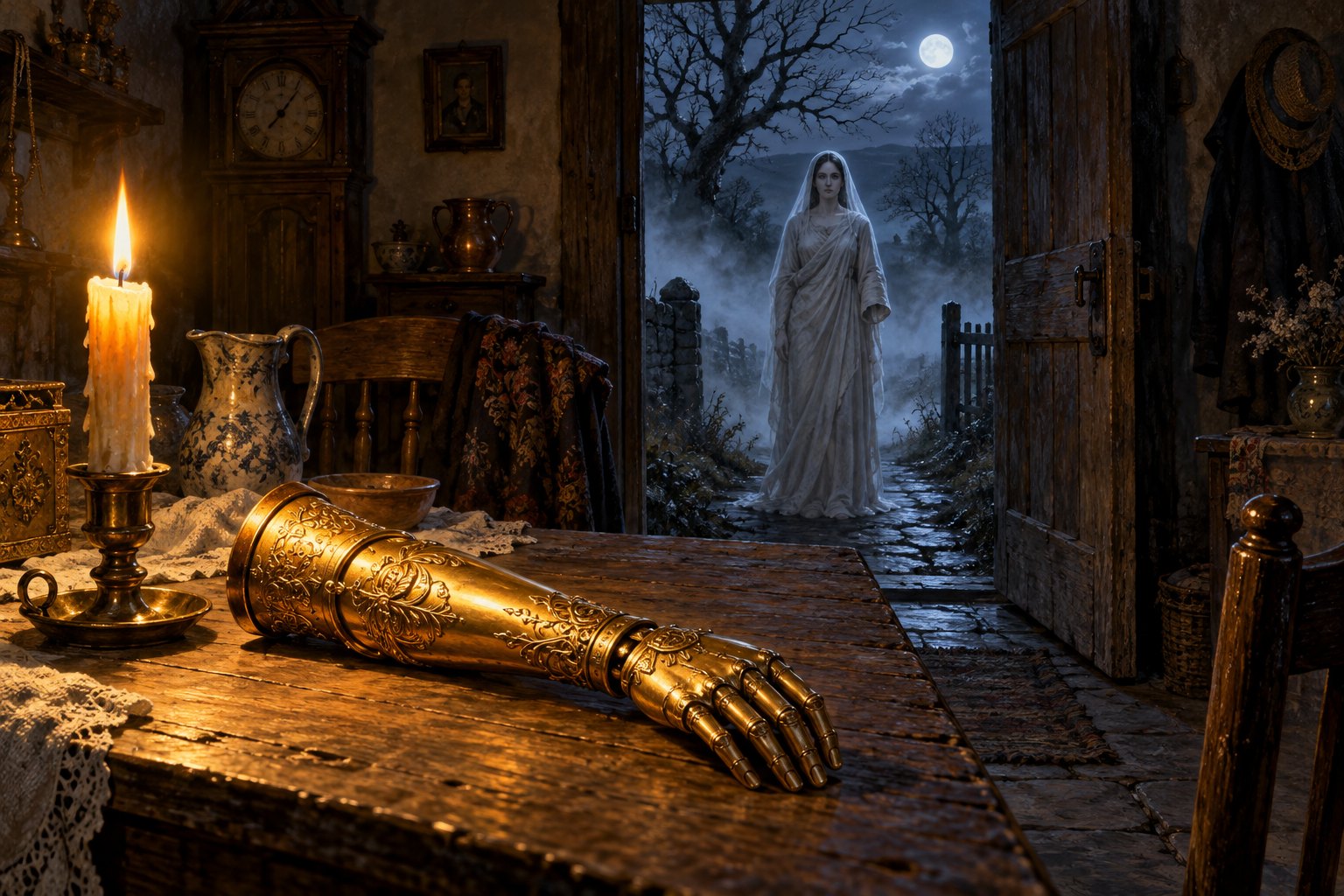
A man finds the perfect wife, or at least the perfect possession: a woman with an arm made of solid gold. In Joseph Jacobs's version, his affection for that extraordinary limb exceeds his affection for everything else about her. Her death creates a problem for him. The treasure has been buried along with the person, and he cannot bear to leave it there.
He opens the grave, takes the arm, and returns home believing the theft is private. The next night his wife comes to his bedside. He asks what has happened to her face, her lips, her hair. Each answer confirms the changes of death. Finally he asks about the golden arm. The ghost has an answer to that question, too, and unlike the others it points directly at him.
Jacobs included the tale in English Fairy Tales in 1890; Mark Twain later discussed a version of it as an example of oral comic storytelling. The precise dialogue changes, but timing is essential: repetition establishes a pattern, a pause stretches it, and the last accusation breaks it. In the logic of the haunting, the treasure never really changes ownership. The widower treats a part of his wife as detachable wealth, while the ghost returns to insist that the story of the object still includes its owner.
Sources and further reading: Joseph Jacobs: English Fairy Tales, “The Golden Arm” · Mark Twain: How to Tell a Story
11. Mr. Fox: the bride who brought her own evidence
Britain · traditional robber-bridegroom tale; Jacobs version, 1890
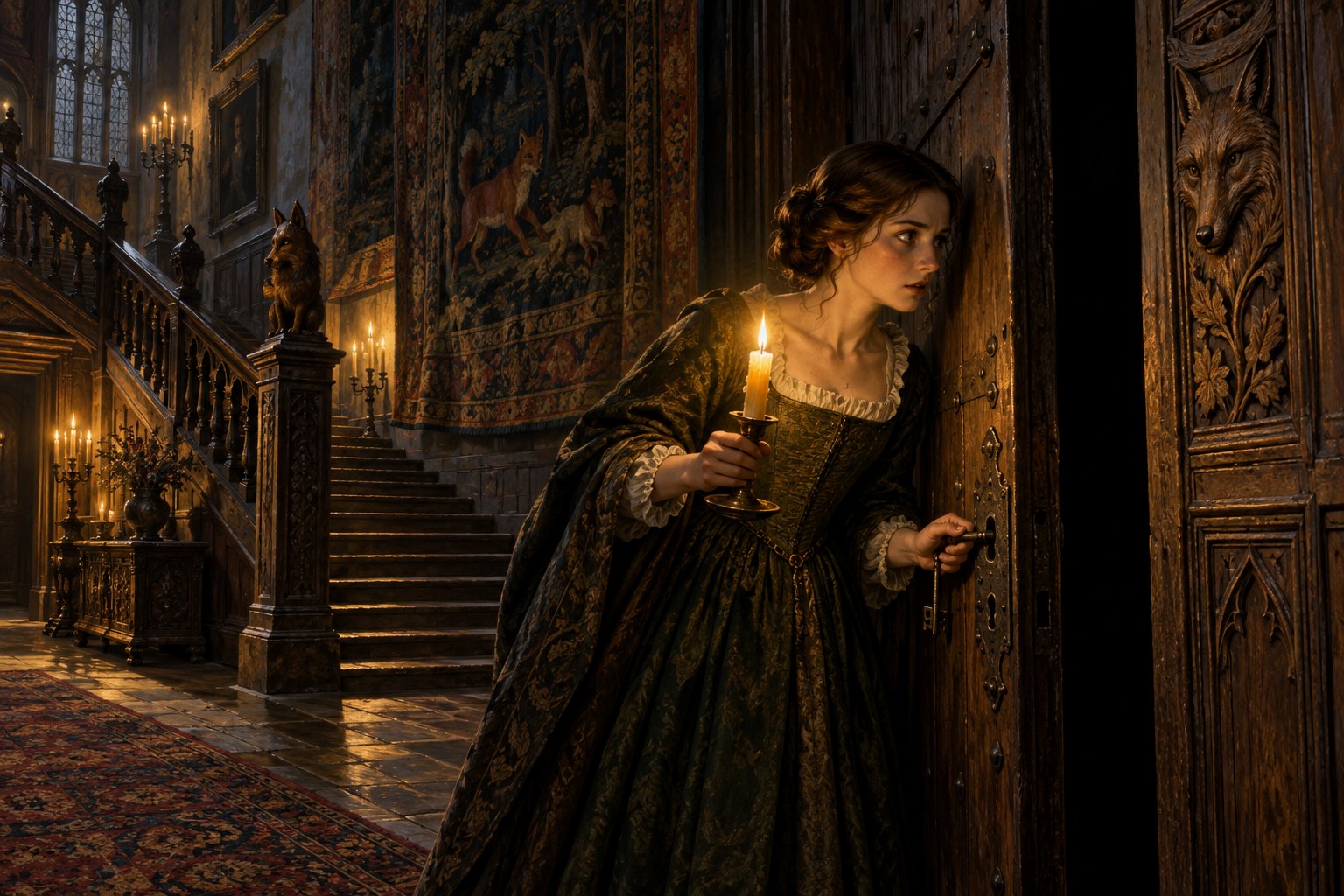
Lady Mary has agreed to marry Mr. Fox, but she has never seen his house. Curious, she goes there alone. The inscriptions she encounters begin by urging boldness and end by telling her to stop. She continues through the building until its secret becomes unmistakable: this is the home of a murderer, and the women who preceded her did not leave safely.
Mr. Fox returns before she can escape. Hidden nearby, she sees him bring in another victim and strike off a hand to obtain its ring. The hand falls beside Lady Mary's hiding place. She takes it when she slips away. At the gathering before their marriage, she presents her account as a troubling dream, letting him deny each stage. Only when he has denied the final detail does she produce the physical evidence. Her brothers and friends deal with the exposed killer.
Joseph Jacobs traced this English tale through earlier printed sources and noted its appearance in an allusion in Shakespeare. This is a named version of a broader family of murderous-bridegroom stories, not a real crime report. Lady Mary’s weapon is control of the telling. Having survived by watching silently, she chooses an audience, lets the guilty man commit himself, and reveals what he cannot explain away. The apparent victim becomes the story's investigator.
Sources and further reading: Joseph Jacobs: English Fairy Tales, “Mr. Fox” and source notes
12. The Manananggal: the monster with something left to lose
Philippines · a living family of supernatural traditions
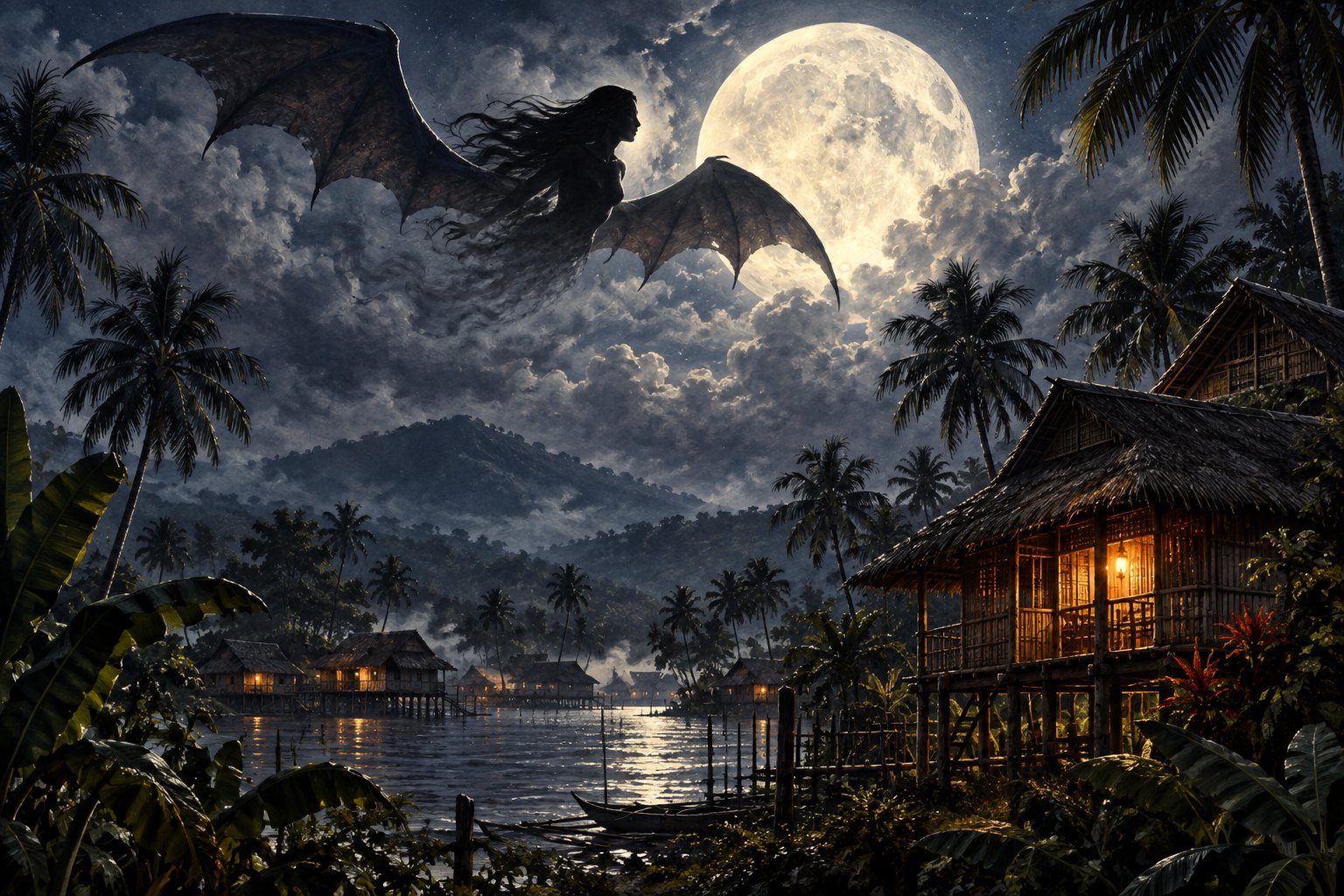
The woman who seems ordinary by daylight has an extraordinary nighttime problem: she cannot take all of herself with her. In widely told manananggal stories, her upper body separates from her lower half, grows wings, and flies out to hunt. The abandoned portion remains somewhere hidden, waiting for the flying part to return before morning. It is both the secret of her freedom and a terrible vulnerability.
These stories commonly place danger around houses, rooftops, pregnancy, and childbirth. Yet the counter-story is just as memorable as the creature itself. A person who discovers the concealed lower body can prevent the two halves from joining again. Salt, ash, or garlic appear as protective substances in some tellings; the exact details vary. The contest therefore does not require catching something in the sky. It requires finding what it had to leave on the ground.
The USC Digital Folklore Archives preserves contemporary accounts from Filipino informants, showing the tradition continuing through family conversation and migration. Such records document a telling, not a proven supernatural event or a single belief shared by every Filipino. The split body gives this legend unusual dramatic symmetry. Every power has a corresponding exposure: the farther the flying hunter travels, the less control it has over the hidden place where its own survival waits.
Sources and further reading: USC Digital Folklore Archives: Manananggal, recorded 2021 · USC Digital Folklore Archives: another Filipino telling
13. Kuchisake-onna: the question with no comfortable answer
Japan · modern urban legend spreading in 1978–1979
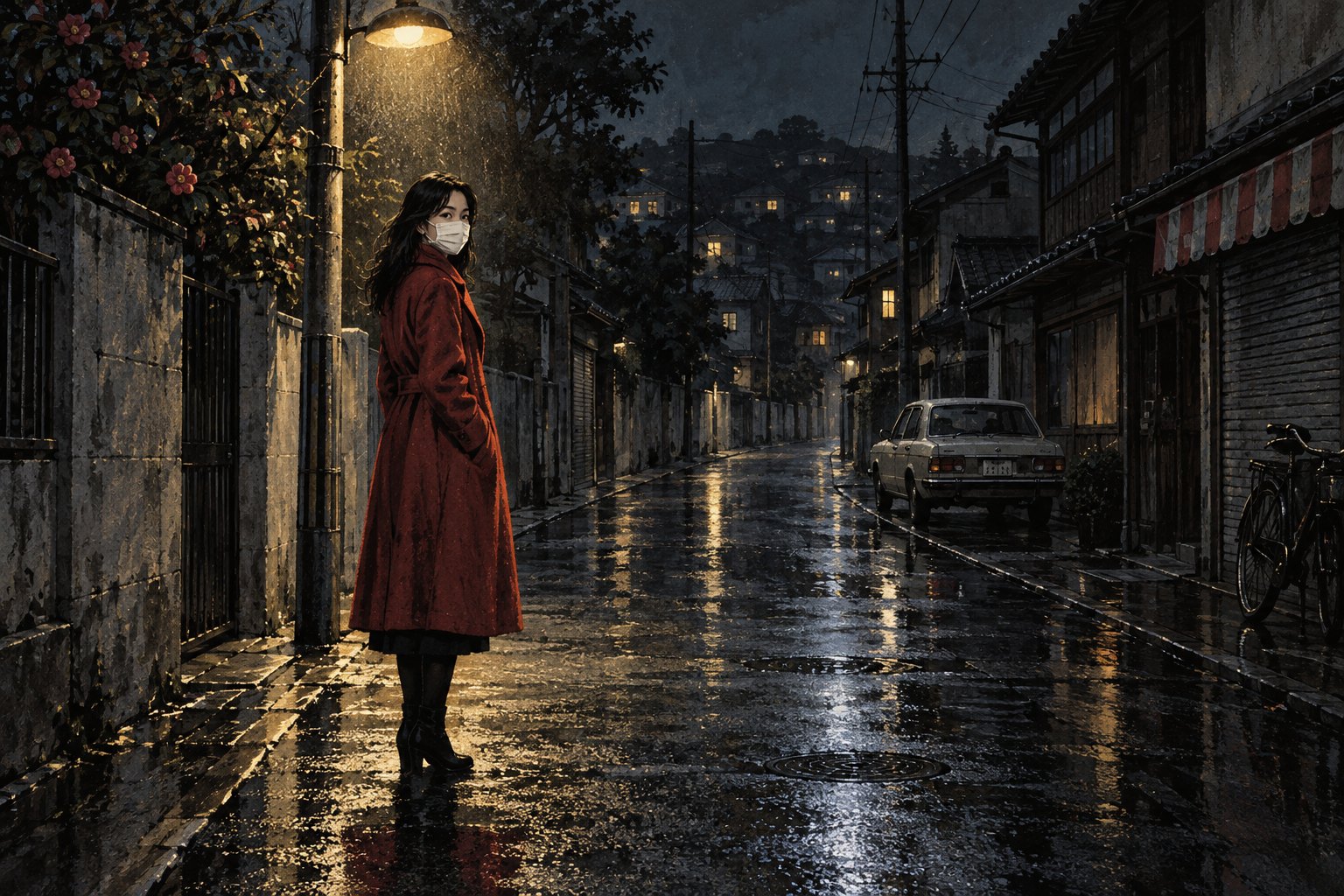
A woman wearing a mask stops a passerby and asks whether she is beautiful. A polite answer seems the obvious way out. Then she takes the mask away, revealing the terrible opening at her mouth, and asks again. The second question changes the first into a trap. In different tellings, approval and rejection both lead to danger, and the listener has to find some third response.
During the legend's extraordinary spread in Japan, the details multiplied. A red coat, a weapon, impossible running speed, a dislike of hair pomade, or distraction with candy could enter a version and change its escape route. Folklorist Iikura Yoshiyuki describes rumors developing around Gifu late in 1978 and circulating nationally in 1979. Cram schools brought children from different neighborhoods together, helping stories cross boundaries that ordinary school gossip had once respected.
This is modern folklore, not a medieval legend simply discovered by the internet. Parents and teachers responded to the fears, and the image outlasted the initial rumor wave. The trap also makes politeness uncertain. The person facing her must simultaneously judge a stranger, avoid causing offense, and decide which rules apply. The story gives an ordinary nighttime encounter a logic in which even the expected socially safe answer can fail.
Sources and further reading: Nippon.com interview with folklorist Iikura Yoshiyuki
14. The Kappa: the river thief that had to make a promise
Japan · water-spirit tales with regional forms
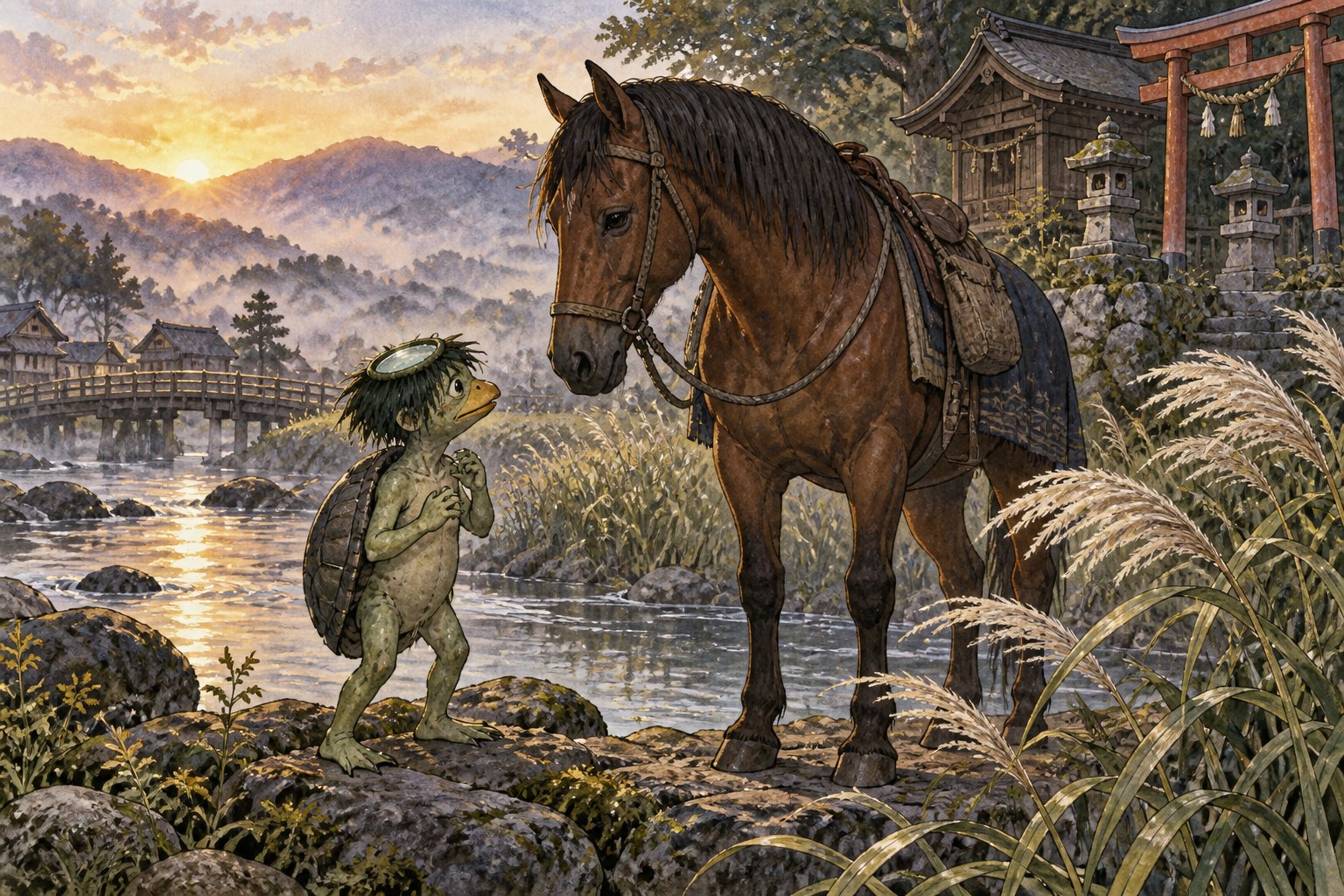
A river creature catches hold of a horse, expecting to pull it under. Instead, the horse drags its attacker out onto land. Suddenly the terrifying presence in the water is a captive, and the people who find it can decide what happens next. In one family of kappa stories, mercy comes with a condition: the creature must promise to stop drowning people in the village.
The reversal is especially striking because the familiar kappa looks small and almost comic: a beak, webbed limbs, a shell, and a dish-shaped depression on its head. Older traditions do not always give it that standardized appearance. Historian Kagawa Masanobu explains how regional names and forms were gradually reshaped by print culture, and how an alarming water creature eventually became a popular comic figure and mascot.
At Kahaku Shrine in Kōchi, a related horse-and-kappa story connects the creature's rescue and promise with its recognition as a water deity. The tradition therefore contains more than a monster weakness to exploit. One possible reading is that the village is negotiating with the river’s danger. It cannot abolish deep water, but it can imagine a relationship in which a threatening power recognizes an obligation. The river remains present and powerful; the story gives its neighbors a promise they can remember together.
Sources and further reading: Kagawa Masanobu: kappa history and Kahaku Shrine legend
15. Baba Yaga: the light that comes home in a skull
Russia · “Vasilisa the Fair” in the Afanasyev tradition
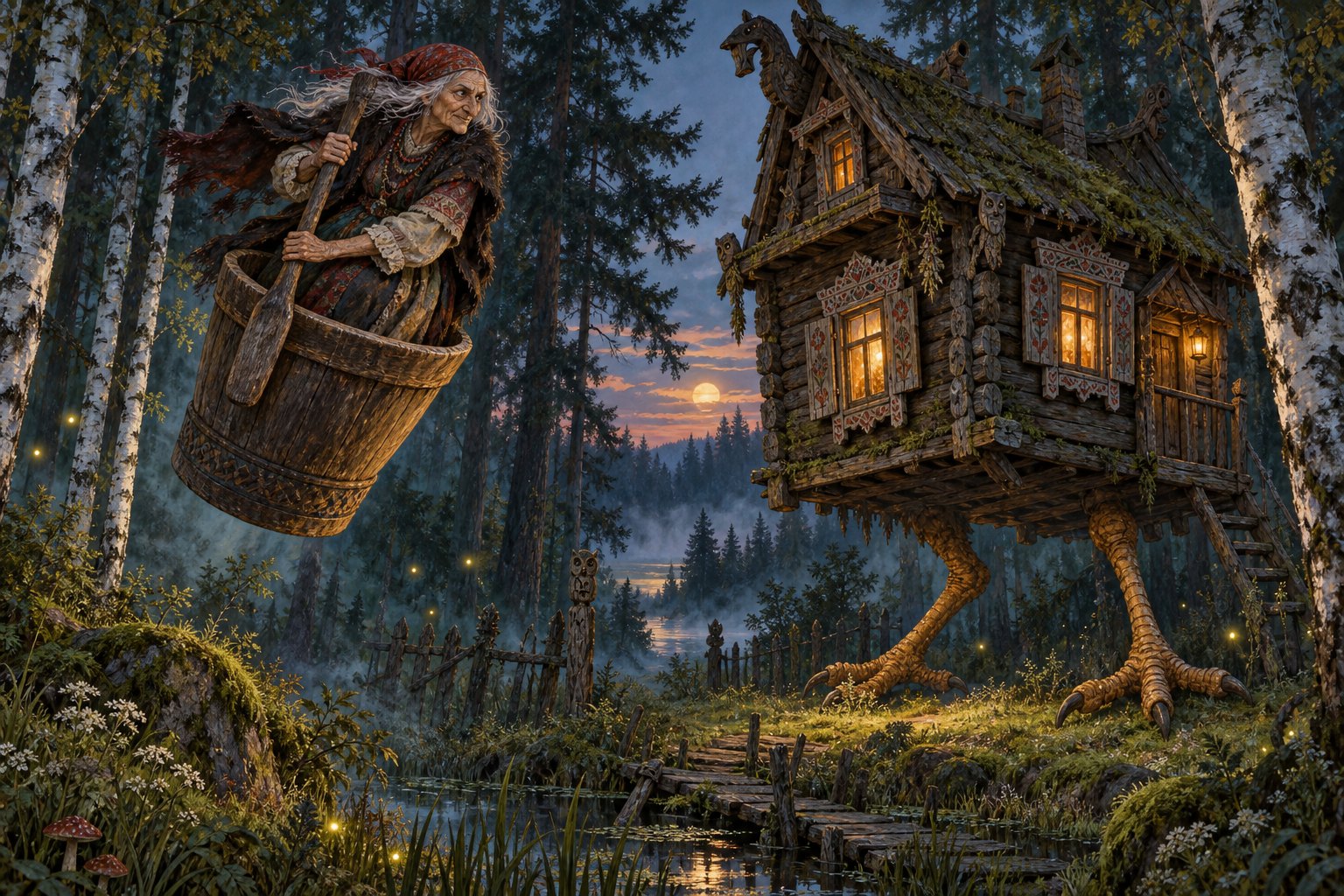
Vasilisa is sent into the forest for fire, but the errand is meant to get her killed. The only household with light belongs to Baba Yaga. On the way, Vasilisa sees mysterious riders associated with the changing day; at the destination, shining skulls illuminate a fence. The forest woman arrives in a mortar, directing it with a pestle and sweeping away her traces as she goes.
Baba Yaga offers an exchange. Vasilisa may obtain fire if she completes the work assigned to her; failure means becoming food. Impossible sorting tasks follow. But Vasilisa carries a little doll left by her dying mother, and when she feeds it and asks for help, it performs the work. Asked how she succeeds, Vasilisa speaks of her mother's blessing. Baba Yaga sends her away with a blazing skull that later destroys the cruel household to which she returns.
W. R. S. Ralston's nineteenth-century collection prints this version from the Russian tale tradition associated with Alexander Afanasyev. Baba Yaga's role varies across tales, so this encounter should not define every appearance. Here Baba Yaga becomes a dangerous threshold. Vasilisa arrives needing permission and protection. She leaves carrying a power that the people who sent her away cannot control. The supposedly impossible errand changes the balance of the home.
Sources and further reading: Ralston: “Vasilissa the Fair,” from the Afanasyev collection
16. Koschei the Deathless: his death is somewhere else
Russia · external-death variant recorded by Ralston
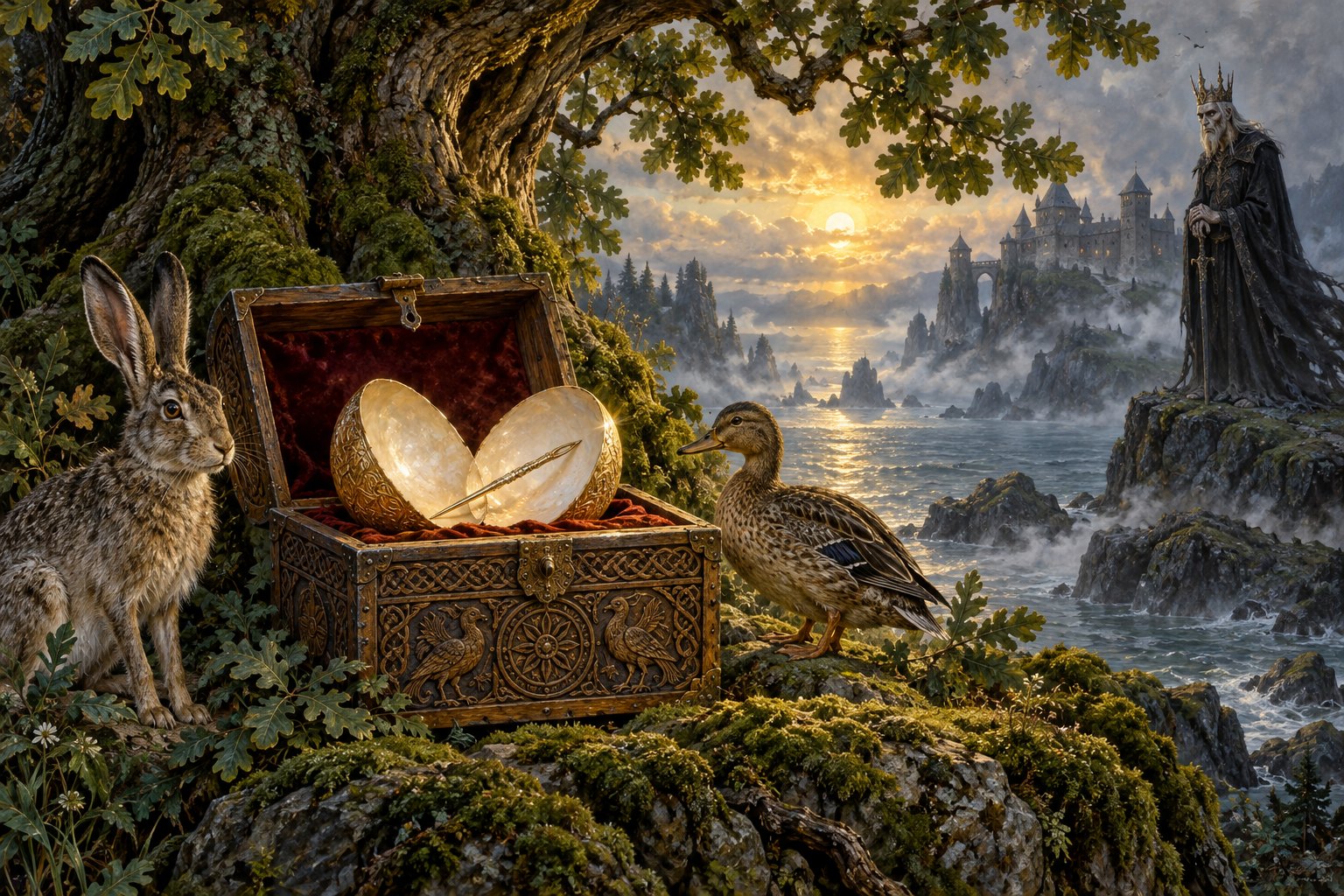
Prince Ivan cannot solve this problem by becoming a better swordsman. Koschei has carried off his mother, and the villain's death is not located in his own body. When she persuades the captor to reveal the secret, the answer becomes a map of increasingly unlikely containers: an oak, a casket beneath it, a hare inside the casket, a duck inside the hare, and an egg inside the duck. His death is in the egg.
Ivan's journey includes chances to kill animals for food. Instead, he spares them. Their help becomes essential when the containers refuse to behave like containers: the hare runs away, the duck flies off, and the egg is lost in the sea. The animals return the favors in their own elements. Only after this relay of assistance can Ivan confront a being whom ordinary violence could not reach.
Ralston's 1873 collection supplies this egg version. Other variants add a needle or rearrange the nesting; the famous Marya Morevna story defeats Koschei differently. The puzzle makes compassion practical without making it simple. Ivan has to preserve lives while seeking a death, and his strength alone cannot finish the task. The seemingly invulnerable villain has protected himself against one hero, but his defenses fail against the relationships that hero creates along the way.
Sources and further reading: Ralston: “Koshchei the Deathless,” external egg variant
17. The Draugr: winning the fight and keeping the curse
Iceland · Grettir’s encounter with Glámr in a medieval saga
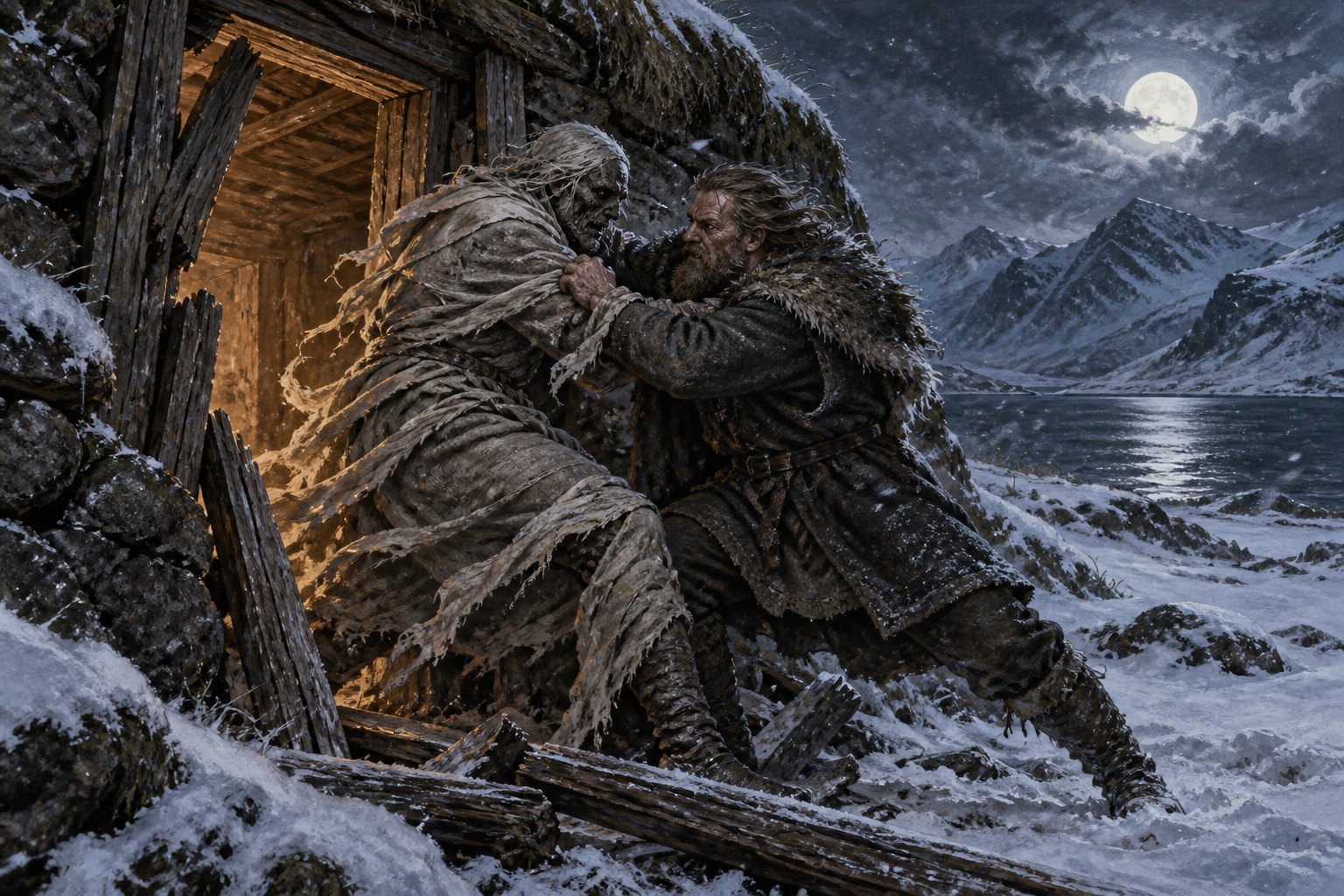
The dead shepherd Glámr does not settle into a transparent afterlife. In Grettir's saga, his presence becomes physical trouble: the farm is terrorized, people and animals suffer, and even the buildings are no longer secure. Grettir, extraordinarily strong and eager to test himself, chooses to remain where others would rather leave. He intends to do something direct about a dead man who will not stay dead.
At night, Glámr enters and the two wrestle. Furniture and door timbers cannot withstand them. Grettir tries to resist being dragged outside, then changes his movement and throws the struggle through the doorway. Moonlight reveals the revenant's terrible gaze. Before Grettir destroys him, Glámr speaks a curse: the hero's strength will no longer grow as it might have, his fortune will worsen, and those eyes will make solitude fearful.
This is an episode in a literary saga, not an eyewitness record, and a draugr is more accurately approached here as a bodily revenant than as a generic modern ghost. The nineteenth-century English tradition made the encounter readily available to new readers. The extraordinary turn comes after the apparent victory. Grettir can end the immediate haunting, but cannot make the experience leave him. He wins against the body and carries away the fear.
Sources and further reading: Andrew Lang: The Book of Dreams and Ghosts, Grettir and Glámr episode
18. The Juniper Tree: a murdered child returns as a song
German-speaking tradition · Grimms’ tale 47, first published 1812
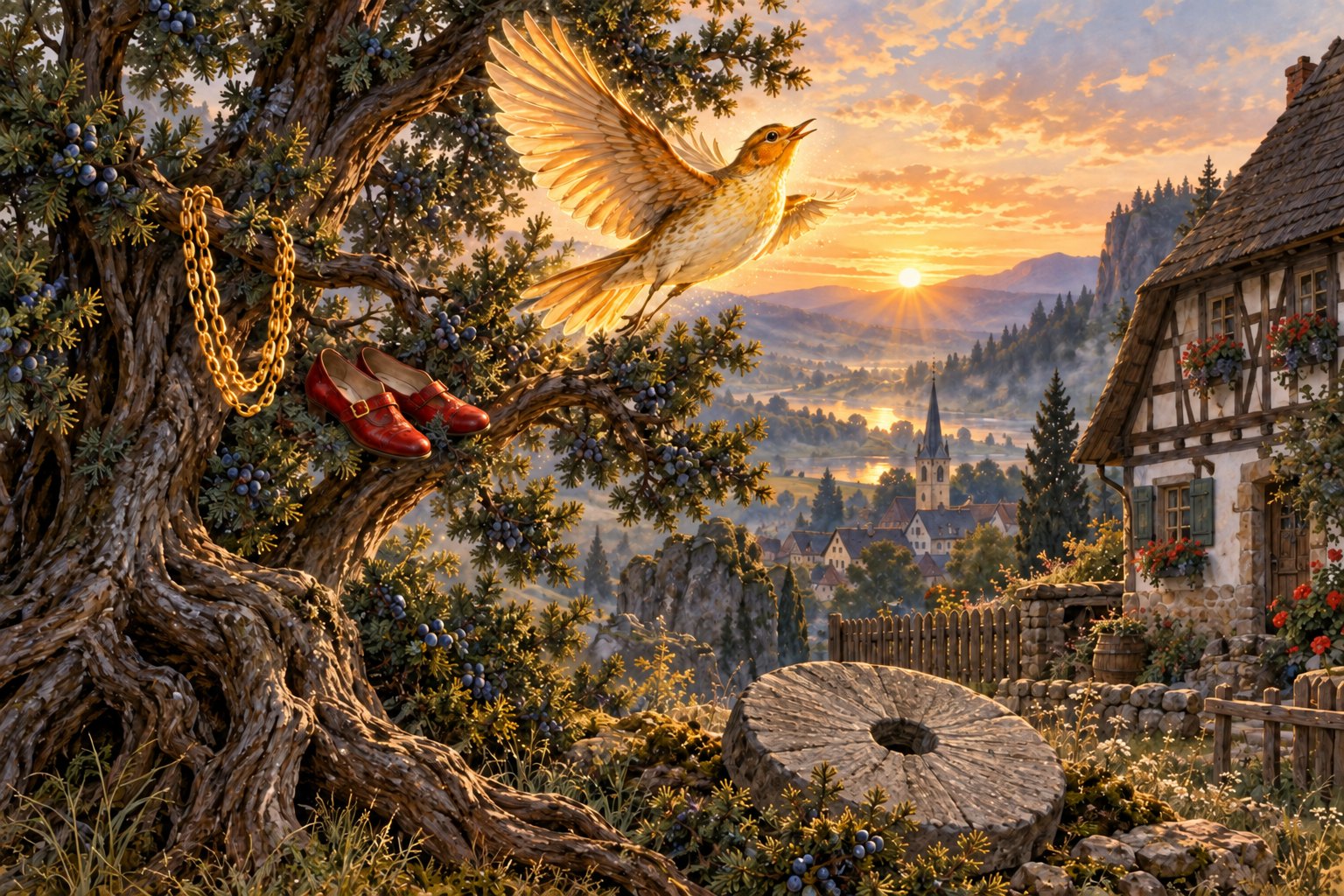
A juniper tree stands at the center of a family's story before the child is born. His mother wishes for him there and is later buried beneath it. After his father remarries, the new household turns against the boy. The stepmother kills him, deceives his sister about what happened, and makes the father unknowingly participate in the crime through a meal. The story is extremely dark, even by the standards of the Grimms.
But the sister gathers the remains and lays them under the tree. A beautiful bird emerges. It travels from a goldsmith to a shoemaker and a mill, singing the family's concealed history. Listeners reward the song with a chain, shoes, and a millstone. When it returns, the gifts are distributed with dreadful precision: kindness receives a gift; the murderer meets the falling stone. The boy returns alive, and the surviving family goes indoors together.
The Grimms published this tale in Low German; their text owes much to the version written down by the painter Philipp Otto Runge. That is a traceable literary history, not a claim that the events occurred. The bird makes silenced knowledge impossible to contain. The household can conceal a body and manipulate a child, but it cannot stop a beautiful song from traveling into town and bringing witnesses back.
Sources and further reading: The Grimms: “The Juniper Tree,” with source history
19. The Singing Bone: the witness nobody remembered burying
German-speaking tradition · Grimms’ tale 28

A dangerous boar has made the countryside unlivable, and the king promises a great reward to whoever stops it. Two brothers set out. The younger receives magical help and kills the animal; the elder sees an easier way to win. On the return journey, he murders his brother, buries him beneath a bridge, and takes the evidence of the hunt to court as his own achievement.
Years pass. The older brother has obtained the reward, and the ground appears to have kept its secret. Then a shepherd finds a little white bone near the bridge and uses it to make the mouthpiece of a horn. When he plays, the instrument supplies words of its own. The dead brother names the betrayal. Brought before the king, the horn repeats its testimony, leading to the concealed burial and the exposure of the murderer.
The Grimms' version is one instance of a wider tale pattern in which the murdered person's remains become a truth-telling instrument. Its evidence is supernatural, but its narrative problem is familiar: a successful lie has acquired respectability and time. The shepherd has no interest in the original dispute, which makes his discovery particularly effective. He is simply making music. Justice enters through an accidental discovery, and the one witness assumed permanently silent turns out to have the clearest voice.
Sources and further reading: The Grimms: “The Singing Bone,” Margaret Hunt translation
20. Tatterhood: the princess who arrived riding a goat
Norway · Asbjørnsen and Moe; Dasent translation

One of the twins is born beautiful in the expected fairy-tale fashion. The other arrives riding a goat, carrying a wooden spoon, and already talking. This is Tatterhood. The palace considers her an embarrassment, but she and her sister are inseparable. When witches and trolls invade at Christmas, the supposedly unsuitable princess goes out to drive them away with the equipment she brought into the world.
Her sister peeps through a forbidden opening and is transformed, receiving a calf's head in place of her own. Tatterhood refuses to accept the disaster. She demands a ship, sails with her sister without a crew, and rides into the witches' stronghold. She recovers the missing head and restores her sister. Later, when a king wants to marry the beautiful twin, Tatterhood insists that the king's son must also accept her.
In the version translated by George Webbe Dasent, the reluctant prince's questions on the wedding journey prompt extraordinary transformations: goat, spoon, clothing, and Tatterhood herself become splendid. The tale comes from the Norwegian collecting tradition of Asbjørnsen and Moe. The splendid ending need not erase what came before. Tatterhood achieves every difficult rescue while looking exactly as the court dislikes. Her authority, competence, and love of her sister are established long before anyone finds her appearance acceptable.
Sources and further reading: Asbjørnsen, Moe and Dasent: Popular Tales from the Norse, “Tatterhood”
21. The Dead Moon: the night the sky needed rescuing
Lincolnshire, England · Balfour’s 1891 record and Jacobs’s adaptation
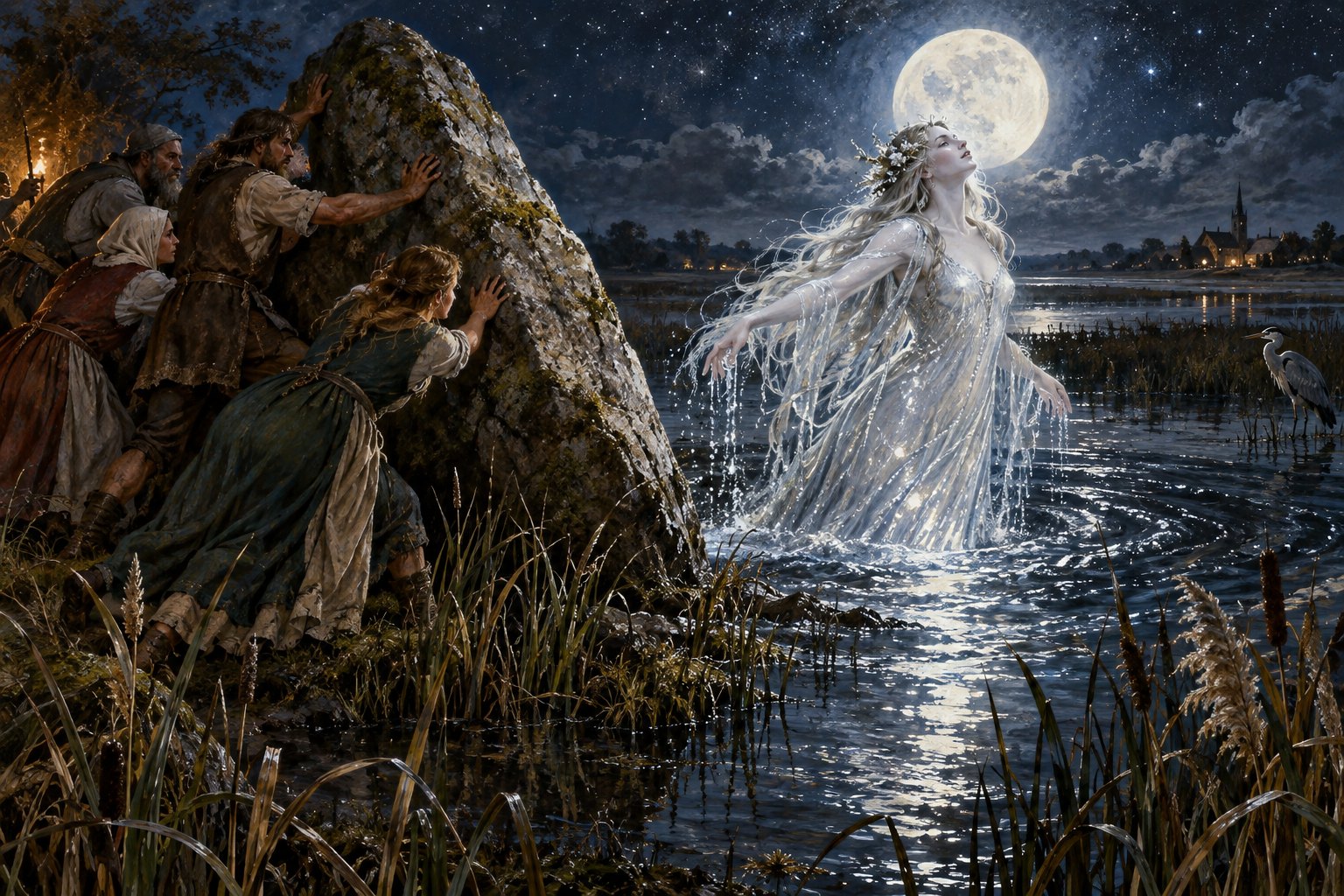
The Moon hears that terrible things roam the marsh when she is absent. Concerned, she wraps herself in a dark cloak and comes down to investigate. This is a mistake. A snag catches her, and the light that ordinarily protects travelers can no longer move freely across the sky. When a lost man approaches, she uncovers her shining hair so he can find the path. He escapes without realizing his rescuer needs help herself.
The marsh creatures recognize their enemy. They trap her beneath the black water and a great stone, and the nights become endlessly dangerous. Eventually the man remembers the strange light that saved him. Guided by a wise woman, the villagers venture into the bog and find the stone. They lift it, glimpse a luminous face, and watch the Moon return to the sky.
Marie Clothilde Balfour published the story in her 1891 “Legends of the Cars”; Joseph Jacobs adapted it as “The Buried Moon.” Both the collecting history and the degree of a teller's or collector's imaginative contribution deserve caution. It should not be advertised as proof of an ancient surviving moon religion. A moving way to read the rescue is that the community finally does for its protector what she has always done for them. The light can return only when people brave the darkness together.
Sources and further reading: Jacobs: More English Fairy Tales, “The Buried Moon” and notes · Lincolnshire Folk Tales Project: Balfour and the tale’s provenance
22. The Three Snake Leaves: resurrection does not finish the story
German-speaking tradition · Grimms’ tale 16
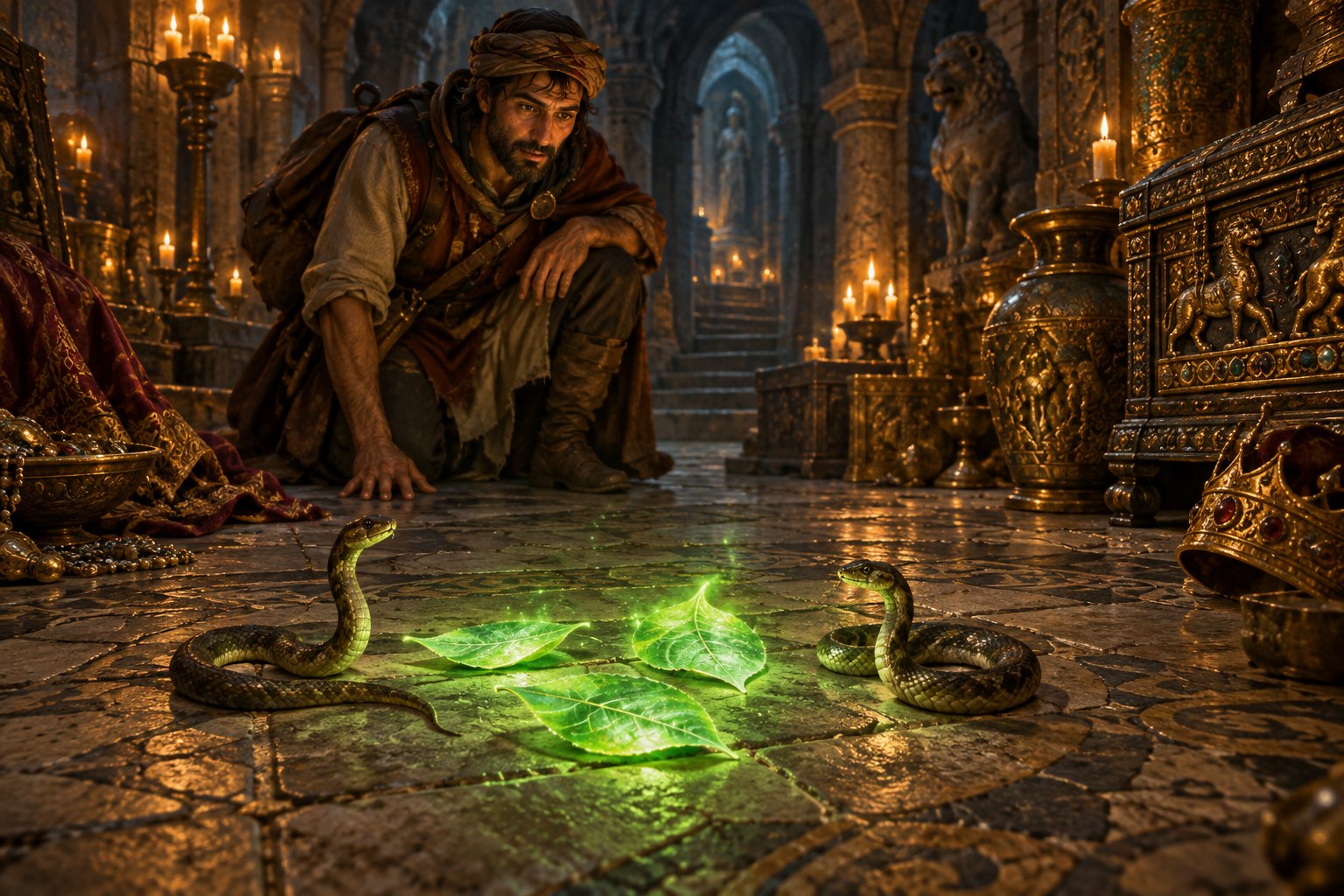
A princess will marry only a man who agrees to be buried alive beside her if she dies first. One suitor accepts, persuaded that love makes the danger bearable. Then she dies. Shut into the burial chamber with a little food and drink, he discovers that the grand romantic promise has become a practical timetable: when his supplies run out, he will follow her.
A snake approaches the body, and he kills it. Another snake arrives carrying three leaves, applies them, and brings the first back to life. The husband tries the leaves on his wife. She wakes, they call for help, and the tale appears ready to end with a miraculous escape. Instead, her affection has changed. During a later voyage, she and the ship's captain throw him into the sea. A loyal servant recovers him and uses the same leaves to revive him, exposing the betrayal.
The Grimms' version is startling because it refuses the obvious ending twice. A resurrection does not repair the relationship, and a murder does not silence the person who knows what happened. The leaves reveal a troubling difference between saving a life and controlling what that life becomes. The husband has fulfilled an impossible promise, but the miracle cannot require gratitude or preserve the love he believed he had rescued.
Sources and further reading: The Grimms: “The Three Snake-Leaves,” Margaret Hunt translation
23. The Tiger, the Brahman and the Jackal: the rescue needs a demonstration
India · a widely circulated animal tale; Jacobs’s collected version
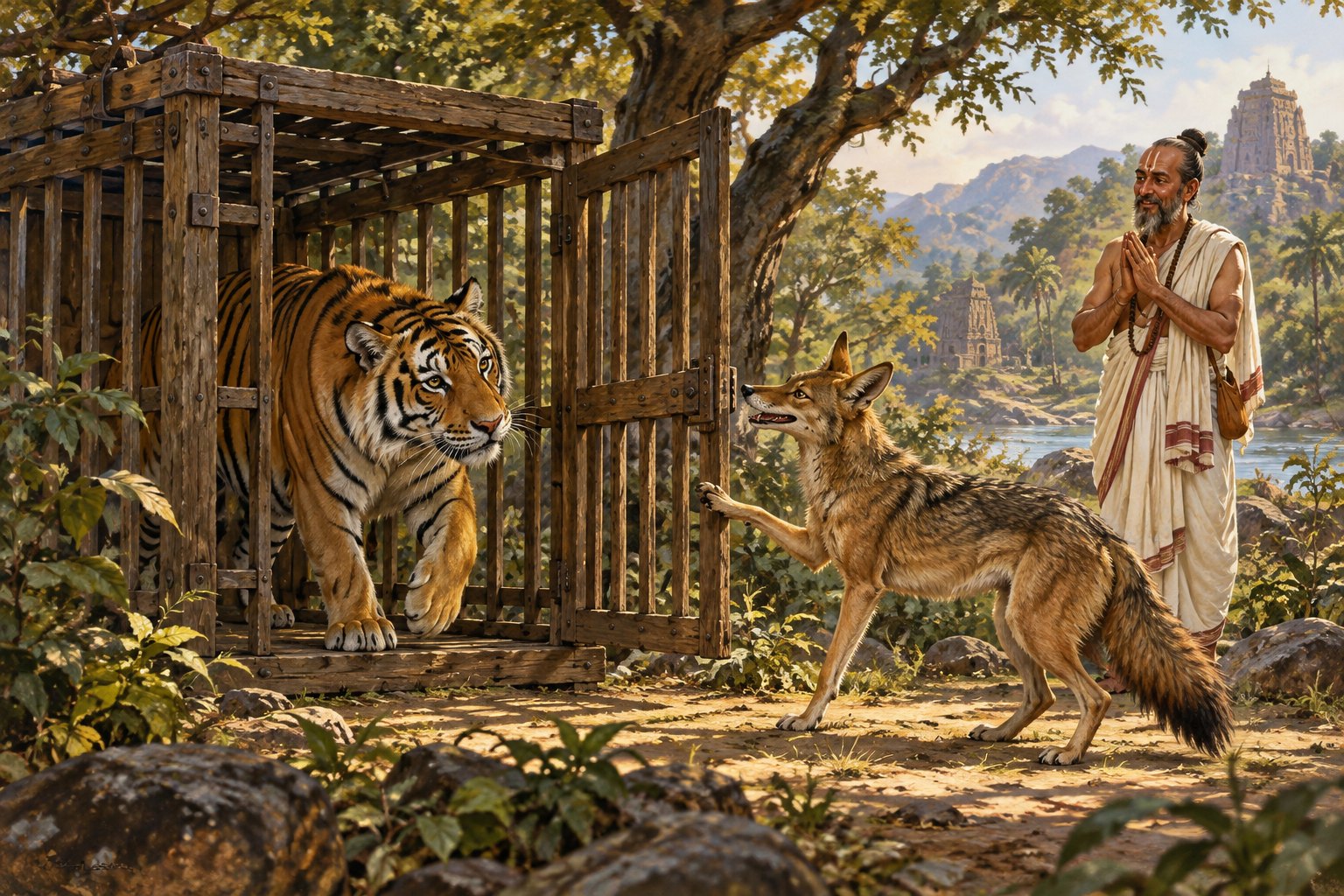
A tiger is trapped in a cage and begs a passing Brahman to release it. The man hesitates for an excellent reason: a free tiger could eat him. The animal promises gratitude, pity wins, and the door opens. Immediately the tiger announces that hunger outranks the promise. The rescued creature has converted its benefactor into lunch.
Allowed to appeal to others, the Brahman finds little comfort. A tree, a buffalo, and a road speak of service rewarded with human cruelty. Then a jackal appears and seems unable to understand the account. Which one was in the cage? Where was the Brahman? How could such a large tiger possibly fit? Irritated by this apparent stupidity, the tiger steps back inside to demonstrate. The jackal shuts the door. The facts are now arranged in a much safer order.
Joseph Jacobs included this version in Indian Fairy Tales, drawing on earlier collections; related ingratitude-and-recapture tales travel widely. It is a comic rescue, but its humor depends on a real imbalance of power. The jackal seems to recognize the limits of moral argument. The tiger can answer every plea with its appetite. Pretending to misunderstand creates the one situation in which the smaller, weaker participants no longer need the predator to agree that its behavior is wrong.
Sources and further reading: Joseph Jacobs: Indian Fairy Tales, “The Tiger, the Brahman, and the Jackal”
24. The Girl Who Married a Skull: beauty bought on credit
Calabar region, present-day Nigeria · Dayrell’s 1910 collected version
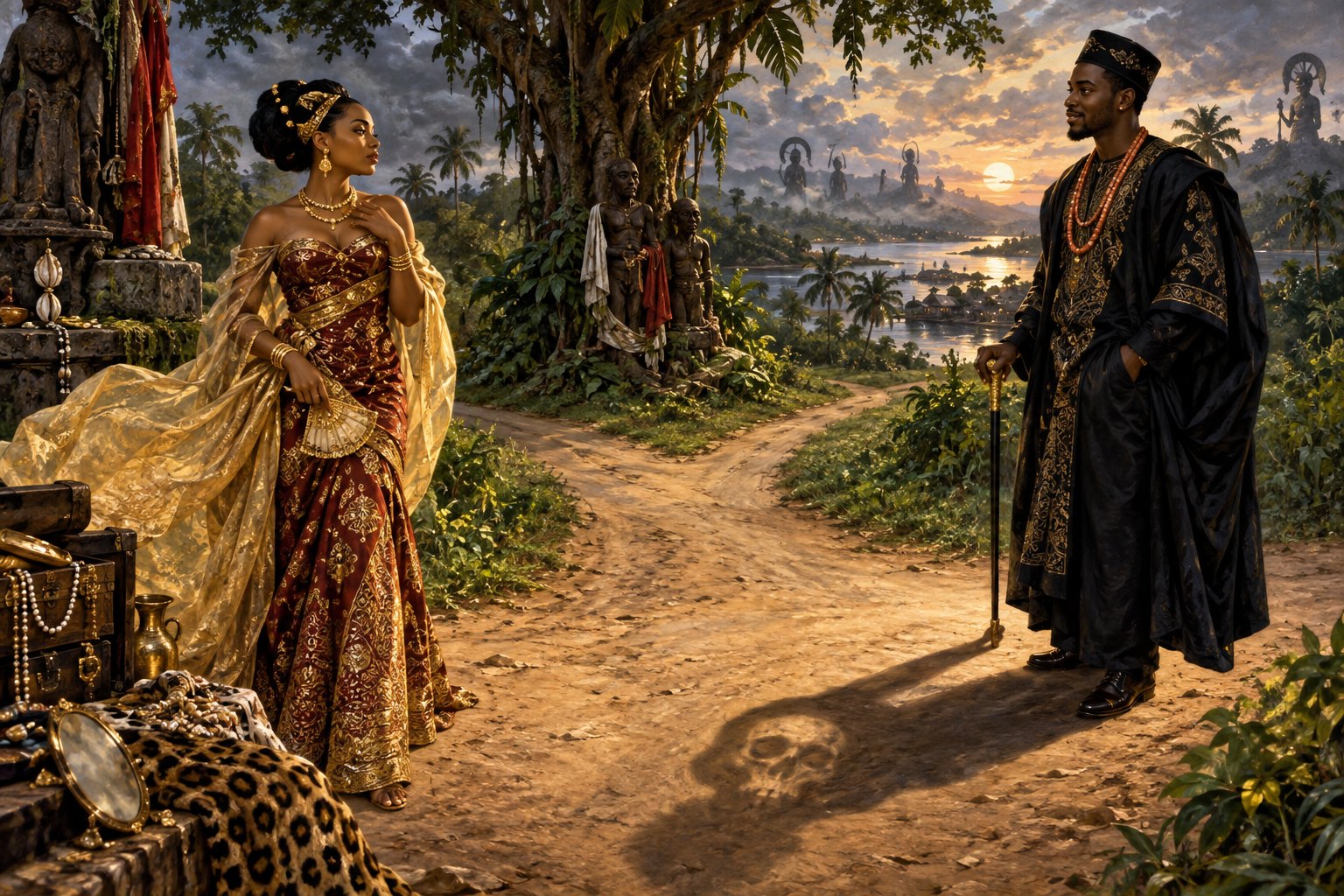
Afiong wants a husband she finds beautiful. The stranger at the market appears to meet the requirement perfectly. What she cannot see is that his appearance has been assembled on loan. He is a skull from the spirit world, borrowing a fine head, body, arms, and legs from other beings so that he can present himself as the ideal suitor.
After the wedding, the couple travels toward his country. Crossing into the spirit realm changes everything. The owners begin collecting their property, and the splendid husband diminishes until only the skull remains. Afiong cannot simply return home. Yet kindness opens an unexpected route: she cares for the skull's aged mother, who protects her, arranges gifts, and calls the winds. A violent storm is rejected; a gentle breeze carries her safely back.
Elphinstone Dayrell published this Calabar tale in Folk Stories from Southern Nigeria in 1910. His colonial-era collection and its moralizing title are part of the source's framing, not a neutral account of every community's values. The rescue offers another focus beyond the title’s accusation of disobedience. Afiong survives partly because she offers care in an alien household. The terrifying family contains someone capable of gratitude, while the handsome stranger proves to be a whole collection of things that never belonged to him.
Sources and further reading: Dayrell: the Calabar skull-marriage tale, reproduced by D. L. Ashliman
25. Anansi: buying the right to tell a story
Akan/Asante tradition, Ghana · a Sky-God story recorded in several versions

The stories belong to Nyame, the Sky God, and Anansi wants them. The price sounds designed to make the request disappear: bring dangerous creatures that a small spider has no business capturing. In Harold Courlander's telling, the required payment includes hornets, a python, and a leopard. The prospect looks absurd if the contest is one of strength. Anansi approaches it as a sequence of conversations.
He makes the hornets believe rain is threatening them and offers a gourd as shelter. He gets the python involved in a dispute about its length, persuading it to lie beside a measuring pole and be bound straight. The leopard, caught in a pit, accepts help that becomes another trap. Each creature supplies the cooperation that Anansi could never have forced. He takes the captives to Nyame, who grants the promised stories.
This is one version of an Akan/Asante tradition, not a plot with one fixed inventory; other tellings add another demanded captive. Smithsonian Folkways preserves Courlander's performance as “All Stories Are Anansi's.” The story quietly demonstrates the skill it celebrates. Anansi wins ownership of stories by telling persuasive little stories to everyone he meets. The purchase is completed using the very power being purchased: the ability to make another mind enter an invented situation and act inside it.
Sources and further reading: Harold Courlander: “All Stories Are Anansi’s,” hosted text · Smithsonian Folkways: Ashanti Folk Tales from Ghana
26. Urashima Tarō: the holiday that outlived everyone at home
Japan · the sea-palace tale; Chamberlain’s nineteenth-century version

Urashima releases a turtle instead of keeping it for food. His kindness opens a route to a world beyond ordinary human time: the creature is connected with the sea princess, and he becomes her companion in a marvelous palace. In Basil Hall Chamberlain's version, he lives there happily for three years. Eventually he wants what many travelers want after an extraordinary stay: a brief visit home, followed by a return to the wonderful place.
The princess gives him a box and warns him not to open it. On reaching his old shore, he finds the landscape partly familiar and the village entirely changed. Strangers tell him that Urashima disappeared centuries earlier. His family is gone; even the cottage has vanished. Hoping the box might help him return to the palace, he opens it. A white cloud escapes, and his body rapidly takes on the age that the enchanted visit had kept away.
The numbers and transformations differ among Japanese versions. Chamberlain's illustrated translation is one historical telling, not the universal script. Arguably, the deepest loss arrives before the box opens. Urashima has kept his own memories intact, but the world has ceased to contain their living counterparts. The past remains vivid inside him while every person who could share it has become part of a story told by strangers.
Sources and further reading: Basil Hall Chamberlain: The Fisher-Boy Urashima
27. The Crane Wife: the cloth that costs the weaver herself
Japan · crane-gratitude and animal-spouse tale traditions
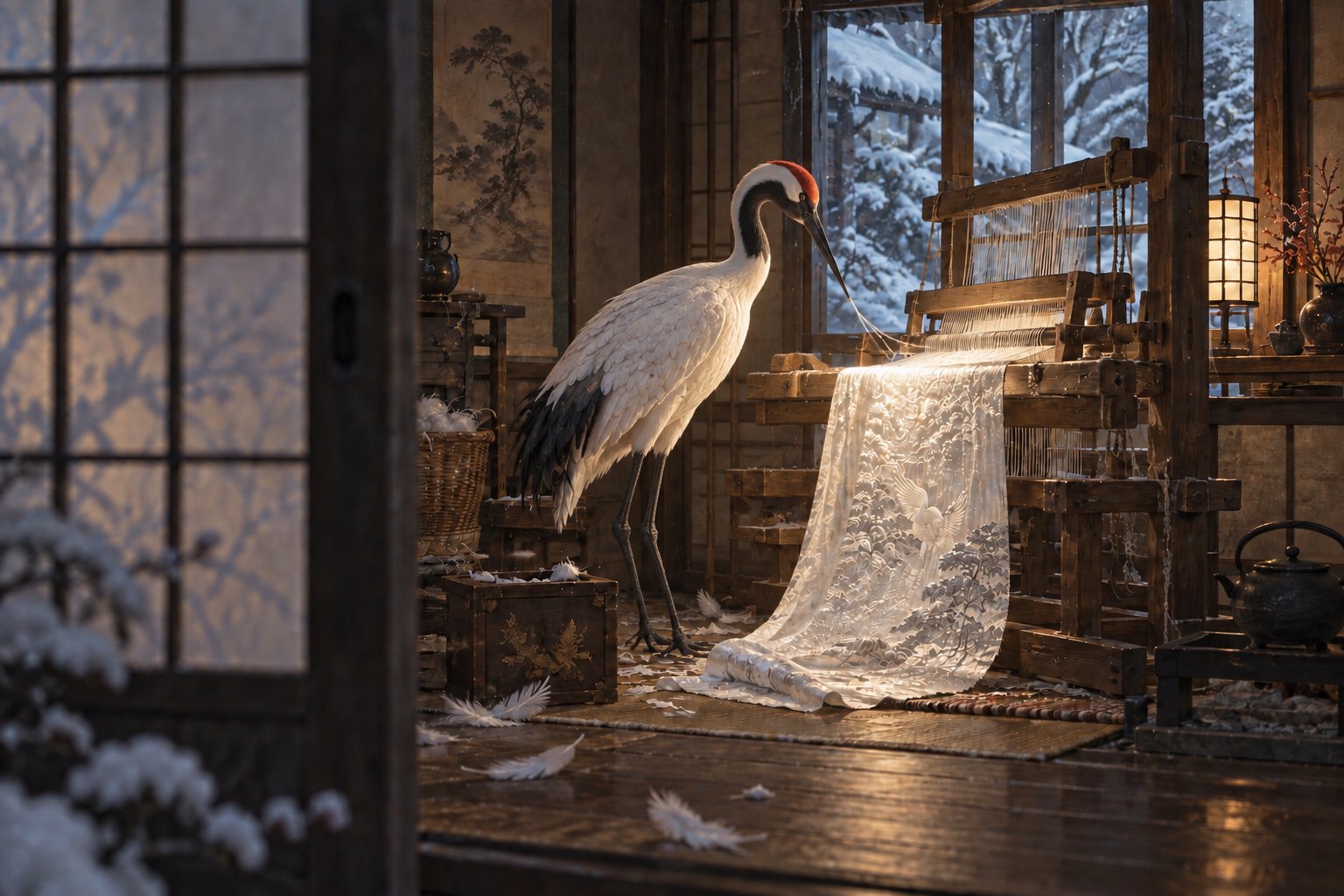
A man rescues a crane. Later, a mysterious woman arrives, becomes his wife, and offers to weave cloth that will help their poor household. There is one condition: he must not watch her work. Behind the closed door, the loom begins. When she emerges with fabric of extraordinary beauty, the material seems to have come from a source the household cannot account for.
The husband eventually looks. The weaver is the crane he saved, making the cloth with feathers taken from her own body. Her human form and her secret can no longer continue together. She reveals who she is and leaves. Related gratitude versions make the human beneficiaries an elderly couple rather than a husband; the combination of rescue, repayment, hidden work, and a broken promise links the tellings without making them identical.
Scholarship on the Japanese play Twilight Crane distinguishes its literary adaptation from these underlying folk-tale variants. That distinction helps keep the traditional premise clear. The closed door can represent both trust and the concealed cost of a gift. The purchaser sees beautiful cloth; the household sees welcome income; the bird is giving part of herself. The moment of looking exposes the labor inside the miracle, and the relationship cannot return to the innocence it claimed before the door was opened.
Sources and further reading: Waseda University discussion paper: crane-wife and gratitude variants · Highlighting Japan: crane tales and cultural context
28. The Sea Tsar and Vasilisa: the princess who keeps changing the escape route
Russia · Afanasyev collection; Leonard Magnus translation

A ruler accepts supernatural help and promises the helper whatever he has at home without knowing it. The debt turns out to be a son born during his absence. Years later, the Sea Tsar collects. The young prince enters an underwater kingdom where impossible tasks become conditions of survival. Fortunately, the Sea Tsar's daughter, Vasilisa the Wise, understands both her father's power and how to defeat his demands.
She obtains the work through magical helpers, guides the prince through a bridal identification test, and marries him. When they flee, she leaves enchanted replies behind to delay discovery. The pursuit becomes a succession of disguises: a shepherd and sheep, a priest and church, then ducks on a lake. Finally the Sea Tsar himself pursues them as an eagle, but the pair repeatedly dives beyond his reach. He abandons the chase, and they reach the prince's home.
Leonard Magnus's translation of Afanasyev preserves this particular ending; other magic-flight tales carry different obstacles or an additional forgetting episode. Vasilisa’s intelligence keeps the adventure moving. The prince is the person whose debt brings him into the story, but she decides how the story moves. Her knowledge of a threatening household becomes a means of leaving it, and every transformation converts pursuit into a new problem her father cannot quite solve.
Sources and further reading: Afanasyev/Magnus: “The Sea Tsar and Vasilísa the Wise”
29. The Hobyahs: the danger that survived every ignored warning
Scottish family tradition recorded in the United States · Jacobs, 1894
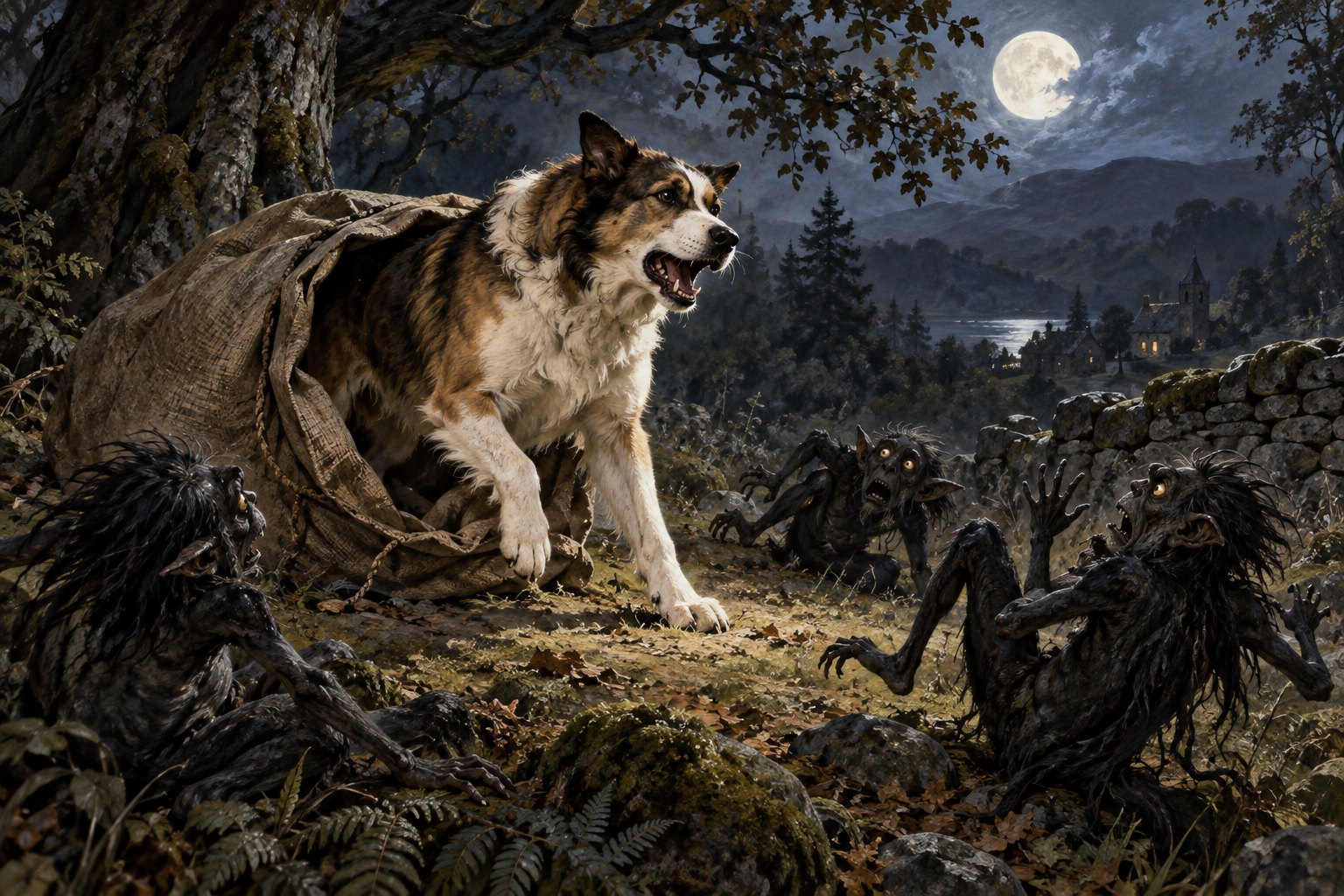
An old man, an old woman, and a girl live in a house made from hemp stalks. Each night, strange beings gather outside and announce what they intend to do: tear down the house, kill the adults, and carry off the girl. A little dog named Turpie barks, and the Hobyahs retreat. From inside, however, the old man hears only an animal interrupting his sleep.
His response is appallingly cruel. Across repeated nights he injures the dog until it can no longer protect them. The Hobyahs then carry out the attack and take the girl away in a sack. During the day, while the creatures sleep, a passing man hears her, rescues her, and leaves his own large dog in the sack. When the Hobyahs open it that night, their expected captive has become their undoing.
Joseph Jacobs included the story in More English Fairy Tales, crediting a version collected by S. V. Proudfit from a family deriving from Perth. Its label does not mean its circulation stopped at England's borders. The old man’s certainty is almost as frightening as the things outside. He punishes the warning because it inconveniences him, while the listener knows what the warning means. The ending reverses that mistake: another adult listens, investigates, and treats a voice in distress as something requiring action.
Sources and further reading: Jacobs: More English Fairy Tales, “The Hobyahs” and source note
30. Māui: the fisherman whose catch became the land
Māori traditions, Aotearoa New Zealand · one telling preserved by Mohi Ruatapu

Māui goes fishing with reluctant older brothers, carrying a hook made from the jawbone of his grandmother, Muri-ranga-whenua. In the account written by the Ngāti Porou tohunga Mohi Ruatapu and discussed by Te Ara, he supplies his own blood as bait. When something takes the hook, the canoe strains and his brothers become afraid. This is no ordinary catch. What comes up from below will remain as land.
The North Island is known as Te Ika-a-Māui, the fish of Māui. Related traditions identify the South Island as his canoe and Rakiura as its anchor stone. Other accounts describe the shaping of the great fish into the contours of the landscape. These names make the narrative visible at a scale much larger than an individual encounter: places people inhabit and travel through carry the memory of the haul.
This is a living Indigenous tradition with genealogical and territorial significance, not simply an exotic monster story. Te Ahukaramū Charles Royal explains that relationships with Māui can help express descent and belonging to the land. Placed beside these other narratives, it enlarges the meaning of an impossible event. Most of these tales change the fate of a traveler or household. Māui's catch supplies the ground on which generations can live, remember their ancestors, and tell stories of their own.
Sources and further reading: Te Ahukaramū Charles Royal: Māui and Mohi Ruatapu’s telling · Te Ara: traditions of how the land was shaped
What joins these stories is the moment ordinary rules stop working. A promise can become a prison. An object can remember its owner. A voice can survive the person who should have spoken. Even time can fail to keep an agreement with someone who has gone away for what feels like a short visit.
Yet the escape routes are often wonderfully human: listen carefully, notice the contradiction, keep faith with someone weaker, or find an ally inside the house that frightens you. The stories disagree about justice, loyalty, curiosity, and what a good ending should cost. That disagreement is part of their life. A tale stays available for the next person to tell because it contains something that still feels unresolved.
The companion collection turns to extraordinary survival stories and historical events. Read together, the two articles approach the same border from opposite sides: experiences so improbable that they sound invented, and inventions so vivid that people keep placing them just beyond the next bend in a familiar road.
Continue reading: 30 Almost Unbelievable True Stories: Survival Against the Odds.