THE INCOPREA ARCHIVE · A GUIDED SHOWCASE
Look past the front page.
A small painting of a workbench. A city assembled from decades. An alien shop crowded with impossible customers. A storm over St. Paul. A world built so that you can walk into it.
These are all doorways into Incoprea, the continually changing body of work by Minnesota artist and illustrator Toby Mikle. Seen one at a time, they can seem to belong to different portfolios. Seen together, they reveal an artist returning to a few enduring questions: What is worth noticing? How much can a picture hold? What happens to places after people leave? And how can an imagined world become something another person can experience?

Incoprea has grown across personal websites, drawing and painting galleries, small Blogger projects, YouTube channels, illustrated books, digital experiments, and virtual spaces. That growth has left some of its most revealing work several clicks away from the main entrance. A brief archive entry or a page with a number for its address can contain an entire visual world.
This is a long walk through those rooms: a showcase of the work, the documented stories around it, and the connections that become visible when older pieces return to view. You can read straight through, choose a medium below, or follow the artwork links and get pleasantly sidetracked. The images come from the existing archive; the captions identify the medium and any useful limits in the original record.
01 · THE PERSON BEHIND THE ARCHIVE
A habit of looking closely
Toby’s own account of his background begins in Hastings, Minnesota, and includes childhood visits with cousins and explorations around his grandfather’s place near Luck, Wisconsin. The details that stay with him are wonderfully specific: an old car between trees, newspapers about the moon landing under a seat, tadpoles in a pond, machinery and household objects slowly being absorbed into the countryside.
That account gives us a useful way into the art. A discarded object can retain the suggestion of a whole life. An ordinary building can hold a history that its facade no longer explains. In the paintings and drawings, attention frequently settles on things that a hurried viewer might pass: an industrial structure, a modest interior, a tree’s complicated silhouette, a small arrangement of tools. In the imaginary work, the same attention fills cities, shops, and museums with evidence of lives beyond the frame.
His working history crosses art direction, teaching, technical illustration, book illustration, printing, and other jobs outside the studio. The public biography describes hundreds of illustrated books for self-publishing authors and thousands of technical illustrations. Those are his own descriptions of the scale of his practice, and they help explain its range: the artist who can organize a complicated technical scene is also capable of organizing a complicated imaginary one.
A Corel Painter interview offers another view of that connection. Toby describes moving between precise technical work, children’s books, and personal painting. He also recalls illustrating a road-safety book for a charity working with schools in Africa. Illustration here has a practical purpose as well as a visual one: help somebody understand, recognize, or remember something.
It is tempting to divide a career like this into neat phases. The archive resists that. Pencil drawing remains active beside digital painting. Oils continue while films are being made. New software becomes another studio instrument. The useful thread is the recurring act of making an experience visible, whether the starting point is observed, remembered, dreamed, or built.
02 · WORLDS BUILT ONE MARK AT A TIME
Before you enter a world, somebody draws it
Start with the drawing archive and the older standalone works. These images reward a different pace from a scrolling feed. Their interest often lies in what happens after the first impression: a structure turns into an organism; an ornamental line becomes a passage; a crowd of little incidents begins to feel like a functioning place.

The early Incoprea castle
The standalone Incoprea Castle drawing page is one of the most useful finds in the archive. Its visible title identifies the drawing as 1995. The older URL contains 1994, so the date used here follows the published title. Incoprea already appears as a place with its own architecture, and the surviving photograph shows the drawing framed with the name on a plaque below it.
Tall red and pale towers rise above a green hill, connected by bridges, suspended platforms, arches, and smaller buildings. A balloon floats at the upper left; a windmill and clustered houses occupy the ground below. Large areas of pale paper make the precise little structures easy to find. The castle works at two scales: from a distance, the colored towers organize it; close up, the routes between them become the attraction. This invitation to mentally enter an image will return in the later digital drawings and in the virtual gallery.
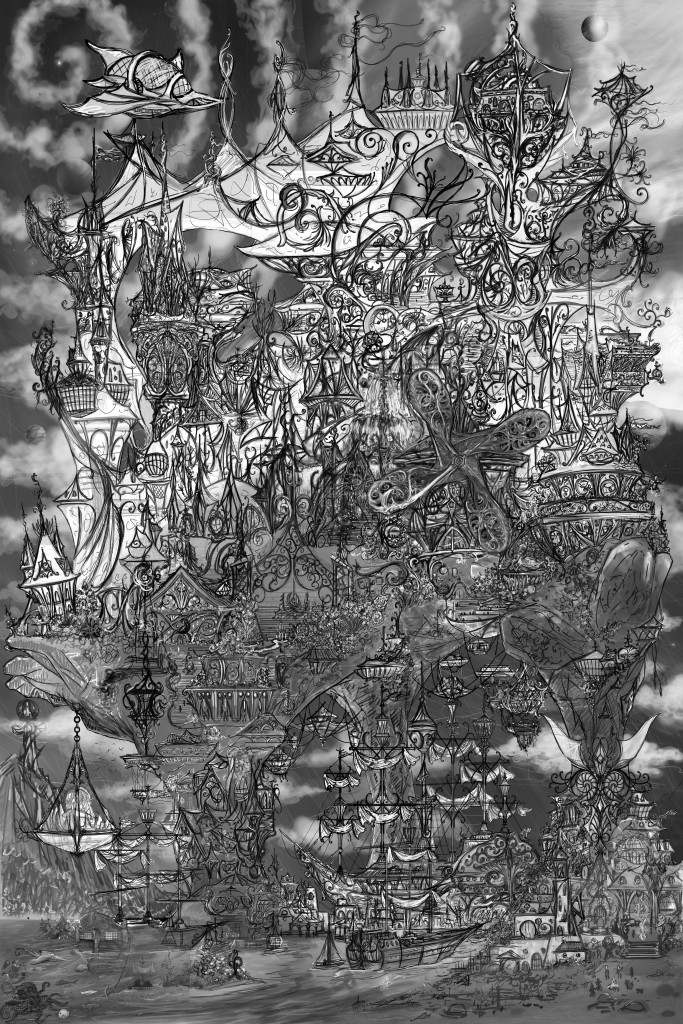
Incoprea v136: the picture as an inhabited structure
Incoprea v136 makes an excellent companion to the early castle. Its tall format encourages a gradual climb through bridges, spires, hanging forms, and tiny openings. The published title includes the version number, although the page does not document what each earlier version involved. It identifies the work as a digital drawing, and the larger image reveals much more than a thumbnail can.
The contrast with the earlier castle is striking. Here, dark clouds and dense monochrome detail replace broad colored towers and open paper. Architecture curls into ornament; small inhabited spaces seem to multiply toward the base. The eye can follow a route and then lose it among the neighboring forms. The drawing invites repeated visits because its overall silhouette and its smallest details offer such different experiences.
Sketchbooks: the archive underneath the archive

One page in the drawing gallery gathers faces and figures at several scales. Profiles, frontal heads, and small standing figures share the sheet; changes of hairstyle, clothing, expression, and viewing angle keep the studies distinct. The spiral binding and uneven pencil tones remain visible. This is a useful reminder that a drawing can be a record of looking and trying things, with several problems held open on one page.
The 2021 Sketchbooks video is a particularly good next stop. It takes the visitor away from the idea of a portfolio as a row of isolated finished pieces and toward the repeated activity behind those pieces. Its nine-and-a-half-minute format leaves room for pages to accumulate and for visual habits to recur.
A sketchbook can hold an observation, a compositional problem, an invented creature, or a line that has not yet found a purpose. Watching a collection of pages is useful because the connections have time to emerge. A shape that seems incidental in one drawing may become the central organizing idea of another. For a viewer interested in Toby’s story, this is one of the most direct routes to the practice itself.
A 2021 tour through Toby’s sketchbooks. 9 minutes 33 seconds. Watch on YouTube.
03 · PAINT, PLACE, AND MEMORY
The ordinary world is already complicated
The painting archive gives this showcase its physical center. Paint can make an imagined scene tangible, but it can also turn a familiar place into something worth looking at again. Several of the strongest older pages make that second possibility especially clear.
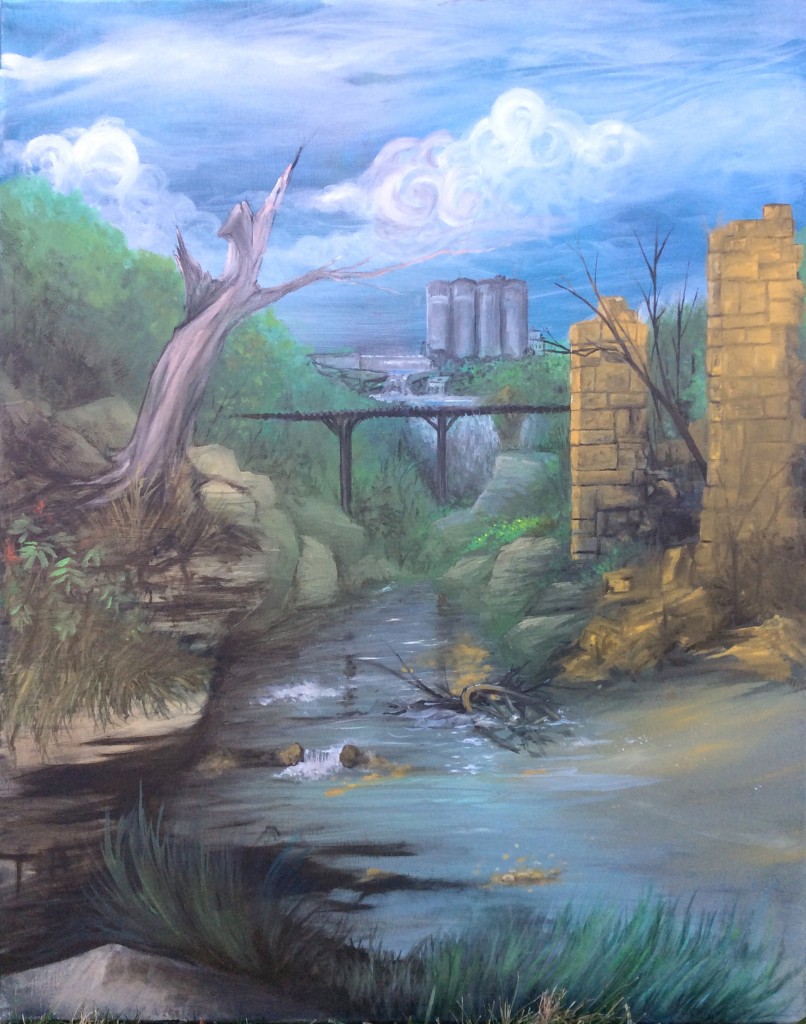
Old Mill, Hastings: a beginning preserved
The Old Mill page calls this Toby’s first painting and identifies its Hastings, Minnesota, setting. A warm yellow wall stands at the right, opposite a pale, broken tree trunk. Between them, water leads back toward a waterfall, a bridge, and distant industrial buildings. The cool blue sky and water give those sunlit stones a particular warmth. The surviving structure is one part of an active landscape, with vegetation and moving water continuing around it. The post appeared in 2015; that publication date does not establish when the painting was made.
A separate Hastings Old Mill, Spring 2015 drawing moves much closer. A short wall of heavy stone blocks meets a broad tree trunk; thin branches cross both. The change of medium and viewpoint matters. The oil painting gathers a whole landscape, while the drawing concentrates on a small meeting of surfaces. Placing them together shows a recurring subject becoming two distinct pictures.
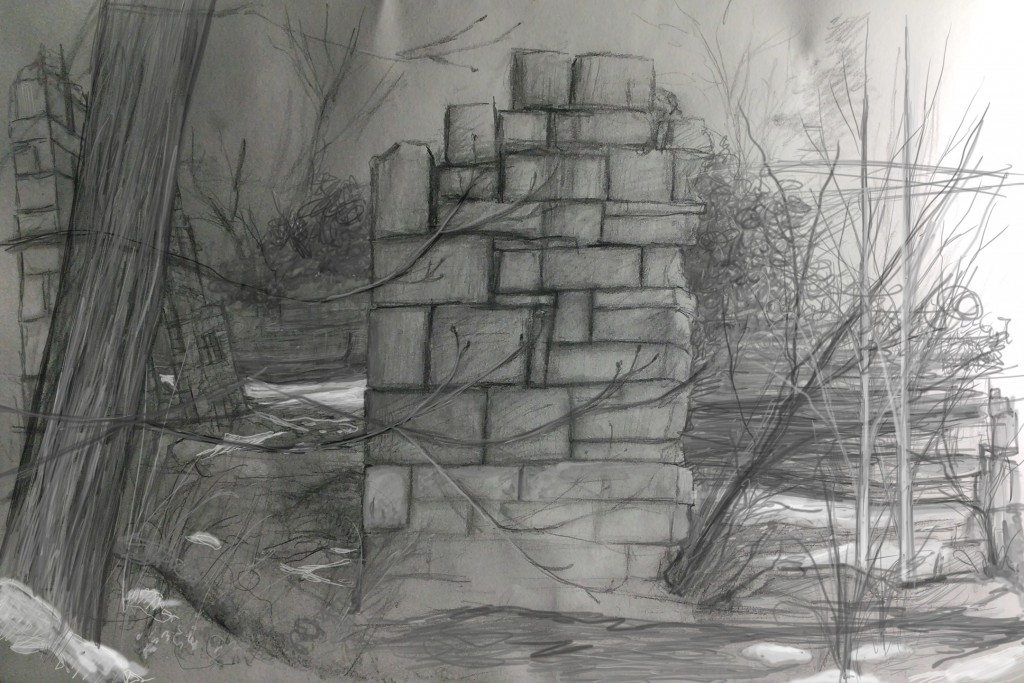
The drawing’s quieter scale also brings the archive’s larger theme into reach. A ruin does not need dramatic lighting or a distant viewpoint to be interesting. Its worn edges, irregular joins, and surrounding growth already provide a complicated subject for the eye.

Father’s workbench: a small panel with a long memory
The October 22 entry in the 2022 journal explains that Toby’s father missed the workbench and tools left behind after the house was sold. Toby had kept reference photographs and made this painting. The source captions it simply workbench and identifies oil on panel, five by seven inches.
A bag hangs at the left; tool cases, containers, jars, and loose objects fill the work surface and the space above it. A smiling sun decoration looks down from the wall. Visible brushstrokes keep the painting lively while preserving the particular arrangement. The workbench can be read as a portrait through possessions: it records the space a person made useful over time. The story gives those ordinary objects a reason to be here. This is a small, specific act of preservation within a much larger archive.

Koch City: a skyline above the clouds
The older Koch City page sits behind the remarkably unhelpful address /621/. Its title and caption identify an oil on canvas. This is exactly the sort of work that can disappear from casual view even while its page remains online.
A fantasy skyline rises from a bank of white cloud beneath a yellow-green sky. Its slender dark towers twist and branch, gathering around a particularly tall central spire. Similar vertical forms stand at the sides, extending the city’s rhythm beyond its dense center. The architecture seems to have grown as much as it has been built. Small red accents and dark upper clouds give the pale atmosphere a sharper edge. The title’s meaning is not explained in the source, but the image itself is clear: an invented city whose elaborate silhouette connects the oil paintings to the castle drawings.
Deep Dreams and Ancient Natural Trap Cave: looking below the surface
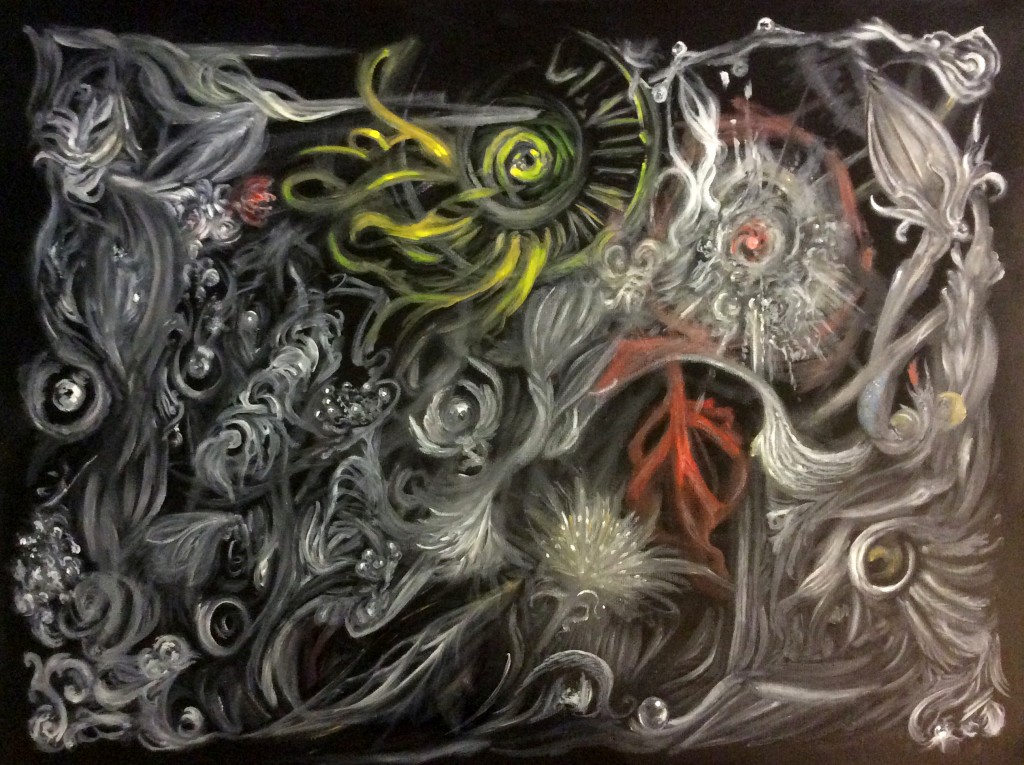
Two more easily missed pages, Deep Dreams and Ancient Natural Trap Cave, preserve paintings identified by their archive titles as oils on canvas. In Deep Dreams, silver-gray curls circulate across a dark ground. A yellow-green spiral near the top and red branching forms to the right interrupt that near-monochrome surface. Shapes can suggest vines, eyes, feathers, or ornamental machinery without settling into one identifiable subject.
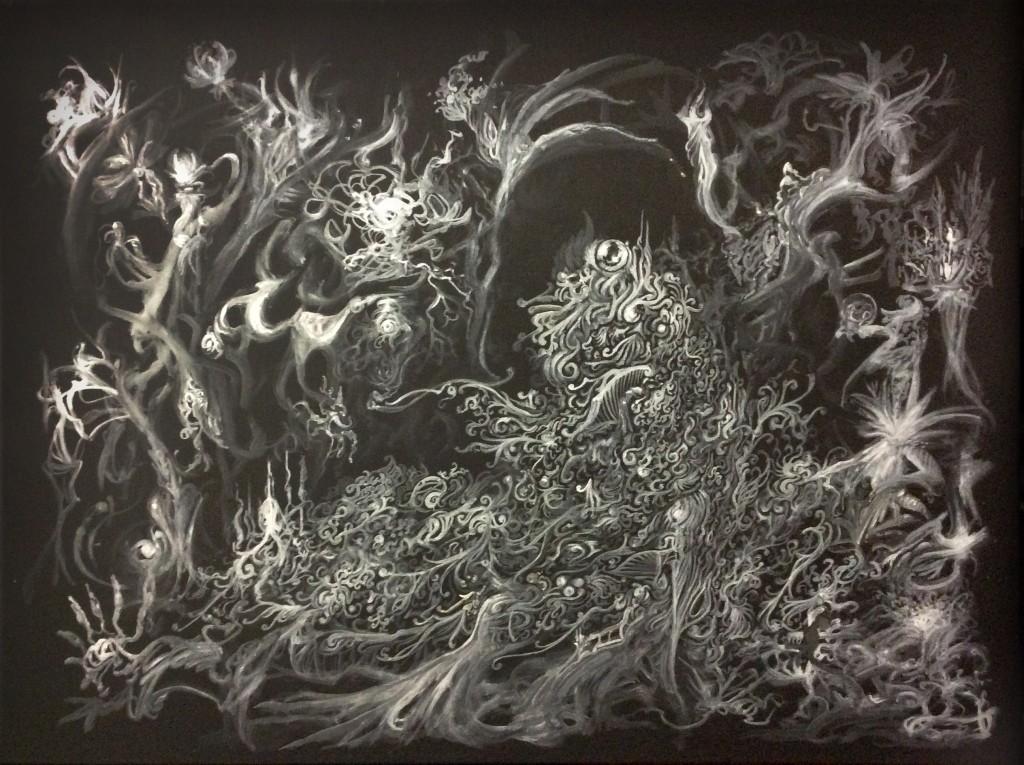
Ancient Natural Trap Cave pares the color back further. Pale, rootlike forms emerge from darkness; smaller loops gather around a mound while larger skeletal curves enclose it. The title supplies a cave setting, but the painting does not identify a particular real cave. Look at how differently it distributes attention: bright edges and curling forms lead the eye through the dark spaces. Both pictures demonstrate that Incoprea’s strange organic imagery was already being worked out in physical paint, well before the later AI galleries.
Darby the bear: a change in scale and tone
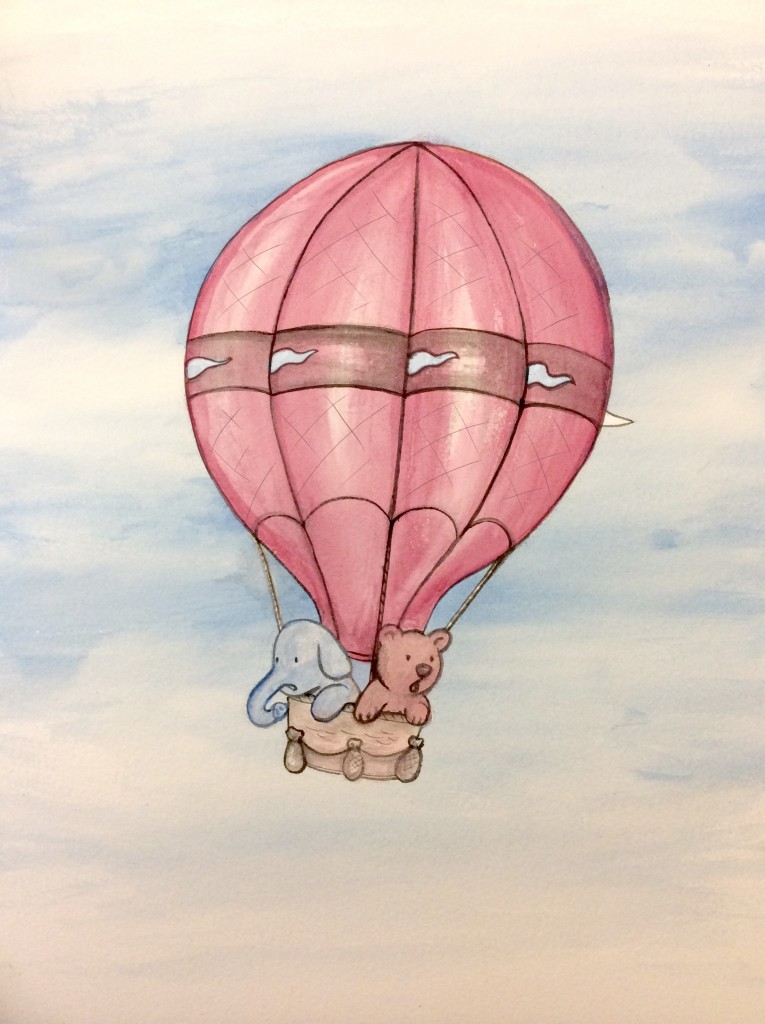
Darby the bear watercolour changes the scale and tone of the visit. A small bear and elephant lean out of a basket beneath a large pink balloon. Dark outlines divide the balloon into curved panels, and a band of pale decorative shapes crosses its middle. Around that bright, simple structure, light blue and cream washes leave ample breathing room.
The two passengers are small enough that a few marks carry much of their character: the elephant’s curling trunk, the bear’s round ears and open mouth, and their paws resting on the basket. The balloon gives the picture an immediately readable shape, while the washes soften the surrounding space. This is an accessible connection to the book-illustration side of Toby’s practice. It also belongs naturally beside the more intricate work: both invite the viewer into an imagined place, with very different amounts of information.
Several older painting pages retain historic sale or work-in-progress labels. They are linked here as an archive of the work; those labels are not a current availability list. Visit the shop or contact Toby through his site for current inquiries.
04 · THE HAND ON THE TABLET
Digital drawing has a history here
The Digital Art gallery explicitly identifies its pen-and-tablet work and distinguishes it from AI imagery. That is useful context for a visitor arriving through the newer films. Elaborate, uncanny, or fantastical imagery has been part of the practice for a long time, through drawing and painting as well as newer processes.
A tablet changes what can be revised, enlarged, copied, and carried between versions. It does not remove the need to decide how a line moves, which shapes belong together, or where the eye should go next. The older standalone pages are especially good at making those decisions visible because some preserve the work before it was finished.
Alien Store: pencil, scan, and digital paint
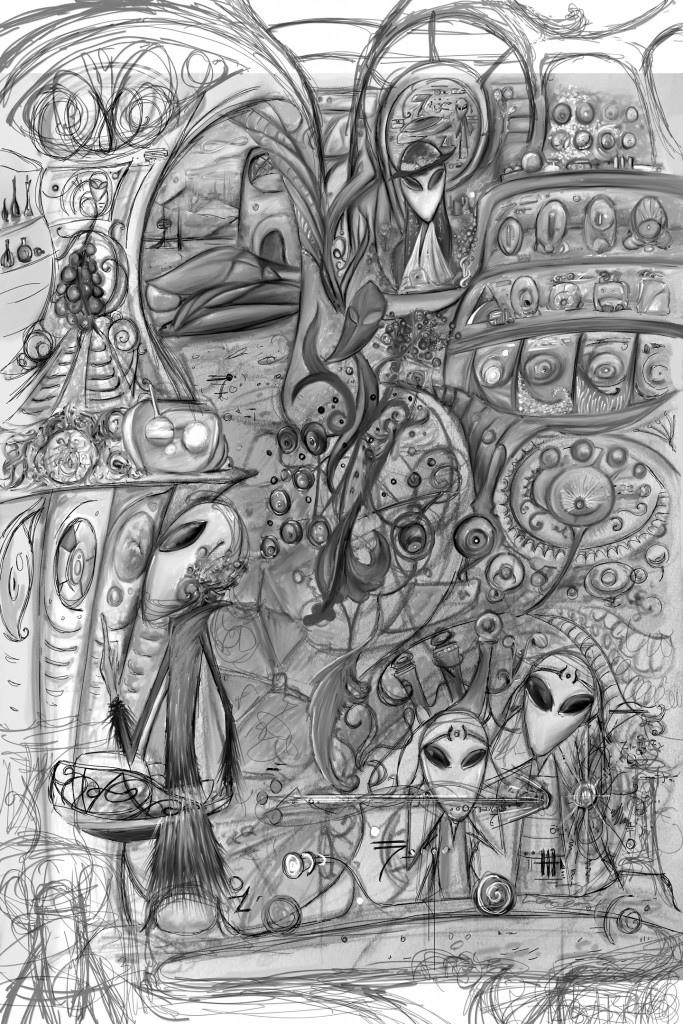
The Alien Store work-in-progress page states the process plainly: a pencil drawing was scanned and then painted in Corel Painter. The image still carries the personality of the drawing. Looping supports, rounded vessels, shelves, and elongated heads overlap to form a shop whose basic organization is recognizable even when almost nothing for sale is familiar.
The little logic of a store is part of the pleasure. Goods need somewhere to sit; customers need somewhere to stand; a display needs to attract attention. The fantasy works because those ordinary relationships remain legible. Repeated eyes and circular objects turn looking into part of the subject. The result is both an invented place and a picture about inspecting an invented place.
Its unfinished status also has value. The image records a meeting between methods, with pencil structure and digital shading sharing the same space. Preserving that moment gives the viewer access to a process that a selection of only finished works would conceal.
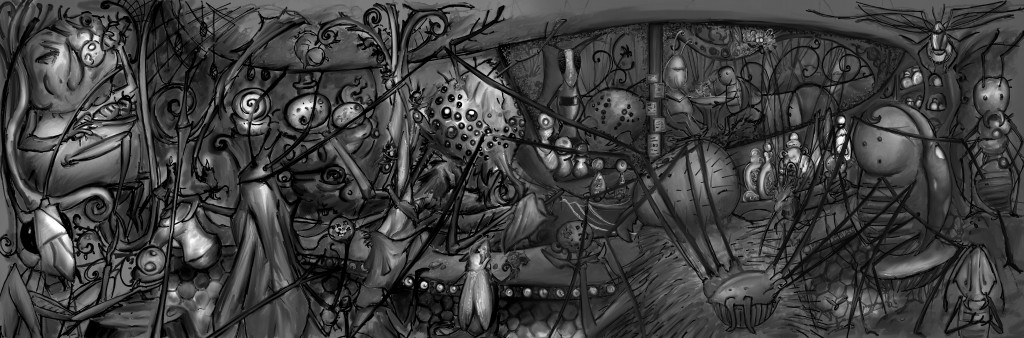
Bug Bar: an idea crosses the room and changes medium
Bug Bar is one of the most satisfying archive discoveries because its page contains a small story of transformation. The source says the idea came from a dream. It shows the wide digital composition, then documents an oil version spread across two canvases.
The room has the familiar social equipment of a bar: a counter, customers, hanging lights, and plenty to look at. Every element has become strange. The long format lets the eye travel along the gathering, stopping at a figure or a cluster of objects before continuing. This is a world arranged horizontally, as if the visitor has entered at one end and is slowly working along the room.

Moving the idea into paint gives it another physical form and another scale. Color enters differently, and the two canvases turn the scene into a pair of real objects. The archive says it does not have photographs of the finished painting, so the work-in-progress photographs are valuable records in their own right. They let us see the crossing between media without pretending the final state has been recovered.
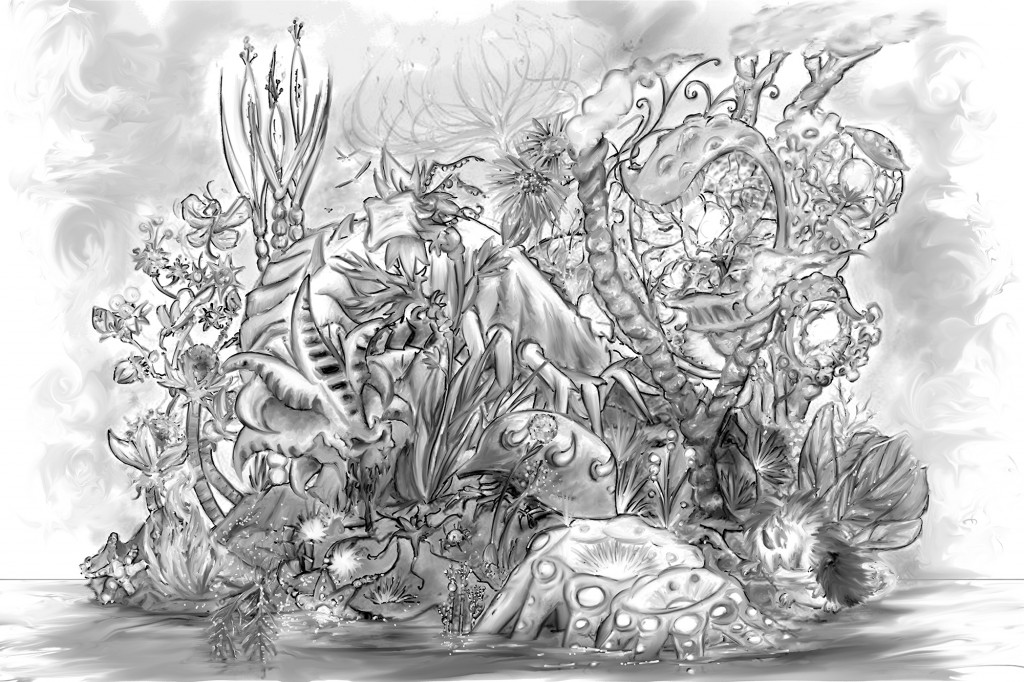
Aquatic Florida: a habitat made of details
The standalone post calls this Aquatic Florida; the pen-and-tablet gallery presents it as Aquatic Creatures. Both names lead to the same image. Shell-like shapes, branching structures, and unfamiliar life gather into a dense habitat. The picture encourages discovery through proximity: follow one contour and another form comes into view.
The connection with the castle and the alien shop is not simply that all three are imaginary. Each picture organizes a population. Different kinds of forms occupy the same environment and seem to have adapted to it. Architecture, ornament, and anatomy begin borrowing from one another. The reader does not need a written explanation of the ecosystem to sense that the image has its own internal relationships.
Alien Museum: stay with the small things
The large drawing at the beginning of this article, Alien Museum, offers perhaps the clearest invitation to this kind of looking. Faces, mechanisms, plantlike shapes, and unusual objects compete for attention without dissolving the whole composition. The museum becomes a useful metaphor for the image itself: one curiosity leads to another.
There is also a forty-two-second video titled Alien Museum (not ai). The label belongs to the artist’s presentation of the work and helps keep the method visible. Pair it with the older Secret Garden (tablet drawing), published in 2013. That earlier process entry belongs to the same long strand of digital drawing; it is a separate work from later films that may share the Secret Garden title.
The 2013 tablet-drawing video, 4 minutes 38 seconds. Its original soundtrack credit is to septahelix via ccMixter. Watch on YouTube.

St. Paul in three eras: drawing with time
The St. Paul photo collage moves from invented creatures to a constructed view of a real city. The gallery identifies three different eras. Older foreground and riverbank details occupy one apparent space with a much later skyline, while the shared monochrome tones help the image hold together.
The July 13 entry in the 2022 journal describes locating historical viewpoints, photographing them again, and combining past and present. That method gives an ordinary city view a second dimension: the eye follows perspective into space while the mind follows the differences through time. The work is a collage, so it should be enjoyed as a deliberately assembled image rather than mistaken for a photograph of a single historical moment.
05 · SMALL BLOGS, LONG CONNECTIONS
St. Paul in 2012, luminous forms in 2017
Some of the most rewarding discoveries occupy very small corners of the web. St. Paul Pics contains five posts from 2012 and seven photographs. The modest size makes it possible to take in the whole collection, then return to the details: a familiar skyline caught at an unusual moment, the dark framework behind a sign, or water glimpsed through summer foliage.

5am, posted on June 22, places the First National rooftop sign beside the moon. The photograph lets two very different presences share the sky: a large commercial sign, full of supports and equipment, and a pale circular light beyond it. The arrangement is ordinary enough to have happened in front of anyone, but its proportions and timing make it worth keeping.

In 1st National lightning, the city changes character. A bright, branching flash crosses a violet sky while the buildings become silhouettes. Open St. Paul Fountain afterward and the atmosphere changes again: leaves, falling water and a red flower fill the view. Together, these photographs offer an early introduction to the attention paid to weather, structures and overlooked surroundings elsewhere in the portfolio.

The next small blog opens onto a different kind of detail. Fractals by Toby Mikle Jan 7th 2017 holds 43 images in a single long post. Orange and turquoise filaments describe overlapping circles; elsewhere, colored starbursts gather into branching webs. The page gives the collection its name and publication date without explaining the software or assigning individual titles.

That leaves room to look closely. Some forms suggest intricate instruments, others organisms or light moving through fibers. These are visual associations rather than named subjects. The collection is especially revealing beside the later imaginary architecture: complexity can organize a picture even when there is no building, figure or recognizable landscape to hold it together. Published years before the journal's text-to-image experiments, the fractals preserve another part of Toby's digital history that the newest work can easily overshadow.
06 · ILLUSTRATION THAT HAS A JOB TO DO
From a complicated picture to a complete book

The technical work on the About page offers a useful change of scale and purpose. In the industrial illustration shown here, a complex arrangement must become understandable. Shapes, connections, and relative positions need to cooperate. The visual density may recall the imaginary cities, but the task is precise communication.
Book illustration adds continuity to that problem. A character has to remain recognizable across many situations. A room must make sense when seen from another angle. The picture and the words need to share the page, and the page turn must arrive at a useful moment. A complete illustrated book is therefore much more than a stack of individually attractive images.
MyBookIllustrator is the public doorway into this part of Toby’s practice. For a concrete example, open the Ducky and the Thumb case study, which credits author Jerrian Hawkins. The presented shareable edition has 26 pages in an 8.5-inch square format. Its recurring yellow Ducky, Cheyenne’s appearance, and the warm palette make continuity visible across the sequence. The case study also preserves three stages of the cover, so revision becomes something the visitor can inspect.
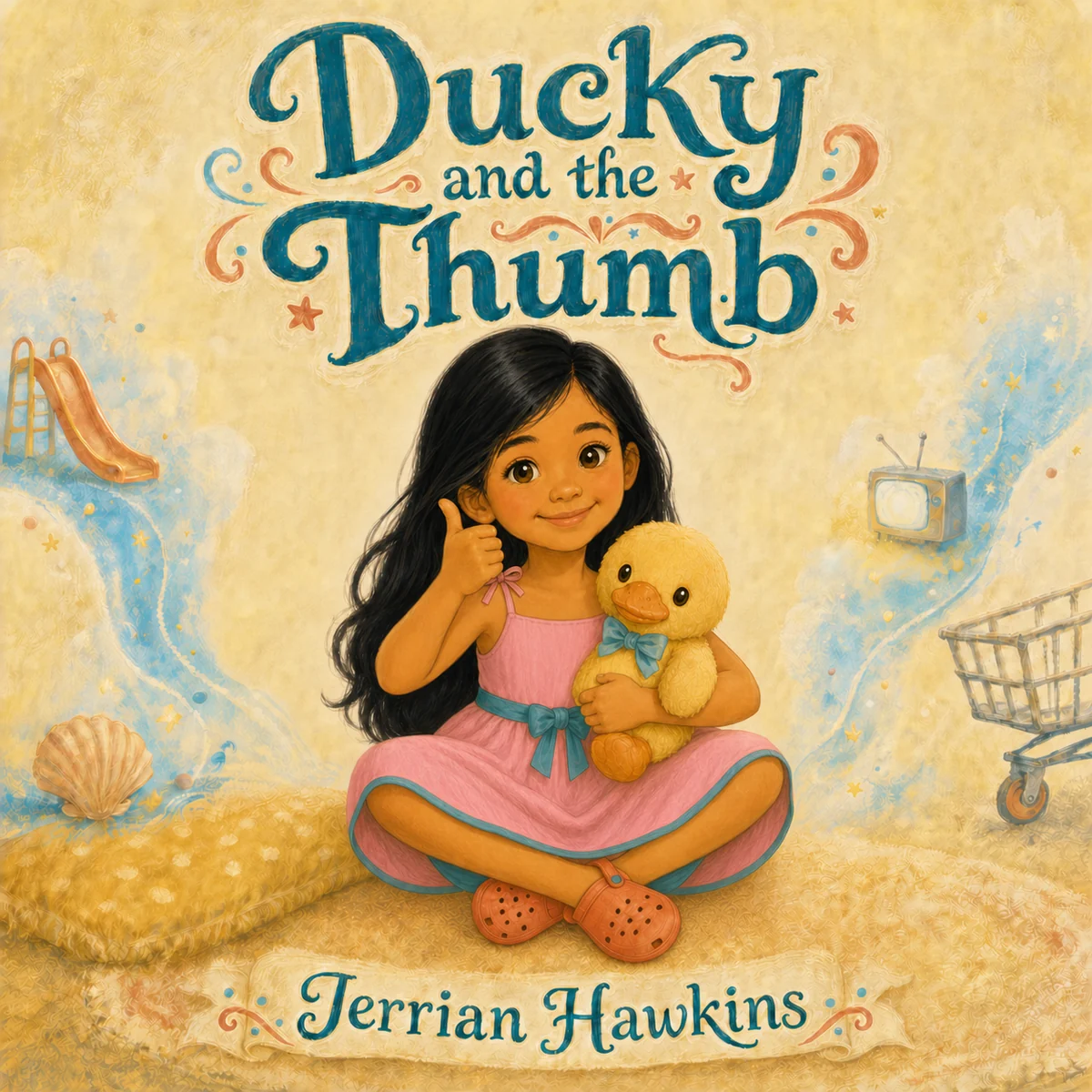
This work belongs in the same showcase as the more experimental images because it reveals another kind of discipline. The individual picture must serve a larger experience. The current studio process page explains its artist-directed AI workflow; older hand-drawn and digital illustration remains part of the longer professional history. The methods should be credited at the level of the actual project.
Toby’s own writing adds another route through the studio. The publications page gathers books, while the narrative films discussed below show stories moving into sound and image. For visitors interested in working with him on a book, the current MyBookIllustrator site is the place to find the portfolio, process, and contact route.
07 · THE IMAGE ACQUIRES TIME
Weather, miniature towns, and unfinished business
Moving images give the archive another way to unfold. A drawing can be explored through a camera; an observed landscape can change with the weather; an imagined place can become the setting for a story. The two main channels, Incoprea and Incoprea 2, contain very different kinds of work. Following a few specific films is more rewarding than treating the whole collection as a single genre.
A night storm above St. Paul
One of the most revealing older entries is St Paul Night Storm, published in 2012 on the camera-focused TimelapseVideosHD channel. Its description credits Toby Mikle through TMCreations.com, preserving an earlier name in the studio's history. The preview places illuminated streets and towers beneath a vivid blue storm sky. The city feels recognizable and unfamiliar at once: ordinary architecture briefly belongs to a much larger atmosphere.

This is a useful place to pause before entering the more fantastic films. The archive's interest in atmosphere also exists in direct observation. Another older route, Vermillion Falls filmed by drone in 2016, returns to Hastings and a waterfall that also appears in the painting archive. The landscape can be approached with paint, with a camera, or from the air; each approach offers a different relationship to its scale.
Places that seem to have existed before the picture
The official image for Shipwrecks shows a damaged spacecraft resting among narrow rock towers. The title's wrecks belong to science fiction. Yet the image makes an interesting companion to the artist's recollections of abandoned machinery being absorbed into the countryside. An object has lost its original purpose, while the landscape begins making something else of it. That is a connection a viewer can draw across the archive, rather than a documented account of what inspired this particular film.

Two other 2023 shorts change the scale of that invitation. train set presents a miniature-looking railway town with glowing windows and a train beside dark water. Lithograph offers fantastic creatures and elaborate, print-like textures; its title names the film rather than establishing a physical printmaking process. Both make good short detours for visitors who enjoy following details into an invented environment.
Then there is flint, a widely watched one-minute film from 2024. Its preview concentrates attention on a prehistoric-looking figure beside stone, with warm light tracing the face and hair. It supplies another possible entrance to the collection: begin with a single character, then move outward toward the towns, ruins, and larger visual worlds. The quieter older entries remain close by once you know where to look.
Velvet Error: the sound-making room
Velvet Error brings the music side of the practice into focus. Its 2026 description identifies a Moog synthesizer, Strudel, vocal samples, and Audacity, with AI assistance noted. Those concrete tools suggest another studio workspace, where different materials can be combined and tested. The visual invitation is just as distinctive: an angular red object stands beside heavy curtains in a dark theatrical interior.

Follow it with the Learning Strudel journal entry or explore Toby's SoundCloud. The music belongs in this showcase because experimentation with sound sits alongside the visual work, adding another way to establish a space, hold attention, and invite discovery.
Second Floor Office: a longer visit
Second Floor Office begins with practical business. Ray Voss has a closing to finish, a bank to satisfy, and a repair he has delayed. People from his past begin arriving with matters he believed were settled. The synopsis frames the story around the difference between acknowledging what happened and actually giving somebody attention. It is a human premise that makes an ordinary workplace feel charged with unfinished responsibilities.
Second Floor Office, 2026 · 23 minutes 18 seconds. Story by Toby Mikle; adaptation and imagery created with AI, narration and music created with Suno. Fiction containing themes of death, fire, and grief. Open on YouTube.
This longer narrative format gives another destination to the archive's interest in interiors, objects, and the histories people carry into a room. Continue through the books and films catalog to find the writing alongside its screen adaptations.
Maintenance Required: beneath the ordinary building
In Maintenance Required, an apartment building's garbage chute extends beyond what its blueprints can explain. The film's premise turns a familiar piece of infrastructure into the entrance to an impossible arrangement. Its public description identifies grief, ownership, sacrifice, and comfort as central concerns: a building can conceal the consequences of decisions made inside it, while everyday life continues above.

The documentary form is part of the fiction. Its unsettling building belongs beside the archive's strange shops, neglected structures, and imaginary cities, where architecture is already rich with implied stories. Here, the suggestion becomes a sustained narrative.
08 · A NEW MEDIUM ENTERS AN EXISTING STUDIO
The original image still matters
The archive provides a much richer account of AI-assisted art than a gallery of isolated outputs could. The July 2022 journal records experiments with Craiyon. The 2023 journal documents further image and video work, including MetaFauna, FerrumFoul, and Autodidactic. These entries sit beside painting and drawing, so the new tools arrive inside an already active studio.
Toby’s AI as a Medium essay explains his interest in direction, selection, and unexpected results. The conductor and director comparisons are his ways of describing the artist’s role. The journals also preserve his attraction to the oddness of early generated imagery: inconsistencies and anomalies can become part of the experience he wants to keep. That is an artistic preference documented in the archive, rather than a claim that technical improvement is automatically good or bad for every artist.


Original Artwork to ai: see the starting point
The June 2026 post Original Artwork to ai is especially valuable because it makes the relationship concrete. A framed original drawing presents a fantastical structure of towers, bridges, suspended forms, a balloon, and a dense settlement. The paired AI transformation carries the architecture into a different treatment of light, atmosphere, and surface.
Seen together, the images let the visitor ask specific questions. Which arrangements survive? Which forms become more definite? Where does ambiguity become material detail? What kind of space does each image invite us to imagine? The original composition remains available for comparison instead of disappearing behind the transformed version.
That visible starting point is important throughout this showcase. Alien Store identifies pencil, scan, and Corel Painter. Bug Bar shows a digital image moving onto canvases. The newer post shows an original drawing used in an AI transformation. These are different processes, each with its own decisions and results. Keeping the labels and the earlier states alongside the work gives the audience a more useful account of authorship than the appearance of an image alone can provide.
The AI gallery and the dated journals offer further paths through this strand of the practice. They are best explored together: one gives you a body of images, while the other supplies the record of experiments, revisions, and changing interests around them.
09 · WORLDS YOU CAN ENTER
From a picture of a place to somewhere to stand
There is a natural next step after drawing an elaborate place: build it in three dimensions. Across the older 3D work and virtual-world recordings, Incoprea's fascination with structures becomes an experience of scale and position. The viewer can imagine moving from outside to inside, looking around a corner, or standing beneath something that first existed as a shape on a screen.
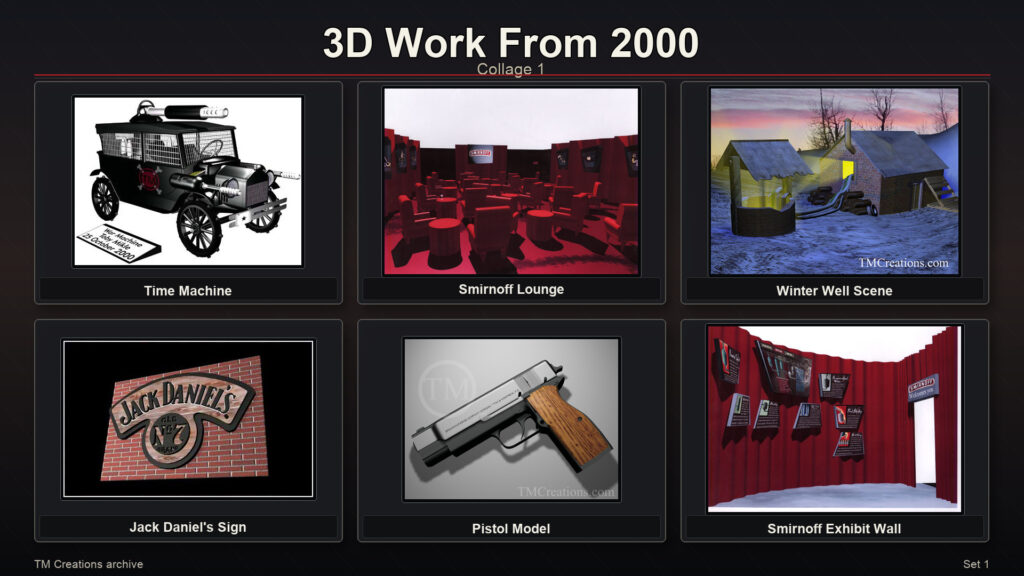
The recorded virtual-world trail reaches back at least to a personal Second Life build documented in 2011. Its original title describes a first creation on a 1,400-prim plot. The preview preserves an avatar, a bright interior, and pictures arranged within the space. This is evidence of the built environment; the individual artworks appearing inside it retain their own authorship. As an archive entry, it lets us see how long the interest in making places has been active.
A later recording, Building a cathedral in Second Life with prims, gives that interest a particular construction task. Published in 2017, it presents a domed building inside the editing interface. The visible tools are part of its appeal: an imposing architectural form is also an arrangement of pieces being adjusted and assembled.

Vector to Second Life, from 2022, makes another connection explicit. Its description identifies the task as turning a two-dimensional vector illustration into a three-dimensional mesh object. Drawing becomes construction. Taken together, these small recordings give the larger portfolio a continuity that a row of finished images can hide: a line becomes a shape, a shape becomes an object, and objects become somewhere to explore.
The tools become part of the invitation
The Apps page and Workshop extend that impulse into games and creative tools. The Workshop groups world builders, music tools, image experiments, and playable environments, including World Studio and AudioBlocks. They offer another route through the studio for visitors who would like to make or explore something themselves. Read their individual descriptions, choose a small experiment, and continue the visit through an action as well as an image.
10 · THE WORK CONTINUES BETWEEN THE FINISHED PIECES
Layers, sketchbooks, and a year chosen for art
The yearly journals let the reader spend time with work while its outcome is still uncertain. In March 2021, Toby set out a year devoted to watercolor, drawing, oils, animation, his own children's books, a virtual gallery and the website. After moving in April, he described exploring riverside trails and working from photographs, ideas and the surrounding landscape. Projects developed alongside one another, with new pieces begun while painted layers dried.
This matters because the archive can otherwise make the different media seem like separate careers. The dated entries show them sharing the same days. By June, dozens of oils were underway; later entries turn toward completed books and graphic novels approaching production. Some notes announce a finished piece, while others preserve a question, a new material or an idea still waiting for its form.
The December 2022 entries are particularly useful companions to the painting galleries. Toby describes continuing a lantern-shop picture and an antique-shop reflection begun the previous year, choosing which paintings to develop, and progressing from smaller panels toward larger ones. Reflections let an interior and the world outside occupy the same surface. At year's end, he identifies a related interest in human-made things blending with nature: rusting cars, old foundations and structures meeting the ground beneath them. The journal connects these subjects to a patient process of returning, adjusting and looking again.

That ongoing practice remains visible in the smaller Blogger posts. Watercolor and ink, posted July 24, 2026, presents four sketchbook pages. In the study shown here, dark curling marks crowd the page, with touches of color breaking through. The spiral binding and paper edges keep the physical notebook present. It is an image to follow line by line, allowing the larger movement to emerge from the smaller marks.

Five days later, St. Croix beach presents three studies, including the objects pictured here and a sparse branching form. The post supplies little explanatory text; the exact objects and their histories remain open. Beside the dense sketchbook page, its quieter spaces show how much the scale and concentration of attention can change.
For a longer browse, the March 2026 post $5 original drawings gathers numbered envelope works into a sequence running through 096, with more proposed beyond it. Read it as a dated archive; its original sale terms do not establish present availability. More broadly, it makes the many small acts of drawing visible beside the large paintings and elaborate worlds. These are useful places to linger if you want to see how the practice continues between its most prominent releases.
11 · KEEP EXPLORING
A few good routes through a very large studio
There is no single correct order for this archive. One of its pleasures is finding a connection that changes how you see something you have already passed. A sketchbook face can make an alien figure feel familiar. A real city at night can prepare the eye for an invented skyline. A tiny painting of a workbench can explain why a much larger body of work needs a place to be kept.
If you have ten minutes
Open Alien Museum and the digital drawings, the Old Mill painting, and 5am. Then watch the short Games, Art, Tools, Stories & Worlds overview. Together they offer a compact introduction to the hand, the local eye, the imagination, and the wider studio.
If you want the discoveries
Follow Bug Bar, Ancient Natural Trap Cave, Deep Dreams, Koch City, and the 2017 fractal collection. These pages bring some of the deeper archive into focus. The surviving Courtyard work-in-progress image, also preserved in the paintings gallery, is another rewarding side path.
If you want to follow the work over time
The yearly studio journals are the long route: 2021, 2022, 2023, 2024, 2025, and the current journal. Read them as dated studio records: plans can change, a painting can reappear, and an experiment can become a new direction.
If you want the moving-image and sound archive
Begin with incoprea and incoprea 2. The virtual-world channel, time-lapse channel, and drone channel preserve other strands. SoundCloud opens the listening side. Some channels also document or curate other people’s work, so retain each item’s own credits as you explore.
Toby’s recent publishing also includes art-history and research projects. The Incoprea Art Atlas and Beyond Familiar Names are examples of that editorial and curatorial work. The historical artworks belong to the credited artists and collections. These projects extend the studio’s interest in looking and discovery, while the drawings, paintings, films, and spaces featured above tell the story of Toby’s own creative practice.
The value of opening the older rooms is that the work begins talking across the years. The local mill, the imagined castle, the alien shop, the illustrated book, and the virtual gallery each offer somewhere to look more closely. Incoprea is the place where those encounters keep accumulating.
Explore the full Incoprea Index · Browse art by medium · Visit MyBookIllustrator