A freeze-dried strawberry can keep a recognizable outline while feeling astonishingly light and brittle. Its shape suggests fruit; its porous interior suggests something has been removed. The missing material did not simply drain out as liquid juice.
Freeze-drying uses a change of state that is easy to name and harder to manage: sublimation, the transition from solid ice to water vapor. The process connects pressure, heat flow, and the structure of a frozen material. Watching all three prevents the misleading impression that a vacuum alone pulls a finished dry object into existence.
Follow the water, not just the object
The FDA's technical inspection guide describes three connected stages: freezing, primary drying by sublimation, and secondary drying by desorption. Its pharmaceutical context is specific; the underlying distinction between ice removal and remaining bound moisture is useful more broadly.
In primary drying, ice becomes vapor under suitable low-pressure conditions. The product is not supposed to become a general puddle first. In secondary drying, additional moisture associated with the material is removed. “It looks dry” and “the process has reached its intended residual moisture” are different statements.
Make three labels on paper: ice in product, water vapor in chamber, ice at collector. Draw a route between them. The water changes state and location, while much of the product's solid matrix remains behind. The drawing is an accounting aid, not an equipment assembly plan.
Sublimation still needs energy
Labconco's laboratory guide explains the importance of vapor-pressure differences and heat transfer. A cold collector helps retain water leaving the product. Heat must reach the product to support sublimation, but excessive warming can compromise a sensitive structure.
That balancing act answers a common puzzle: why add heat to something being freeze-dried? The aim is not to keep every part as cold as possible forever. It is to supply energy for a phase change while keeping the product within the conditions its structure can tolerate.
Think of an elevator carrying boxes away from a floor. A destination below does not supply the labor needed to move every box. Likewise, providing a pressure difference does not erase the energy requirement of changing ice into vapor. The analogy is limited, but it stops pressure from becoming a magic explanation.
The empty spaces matter
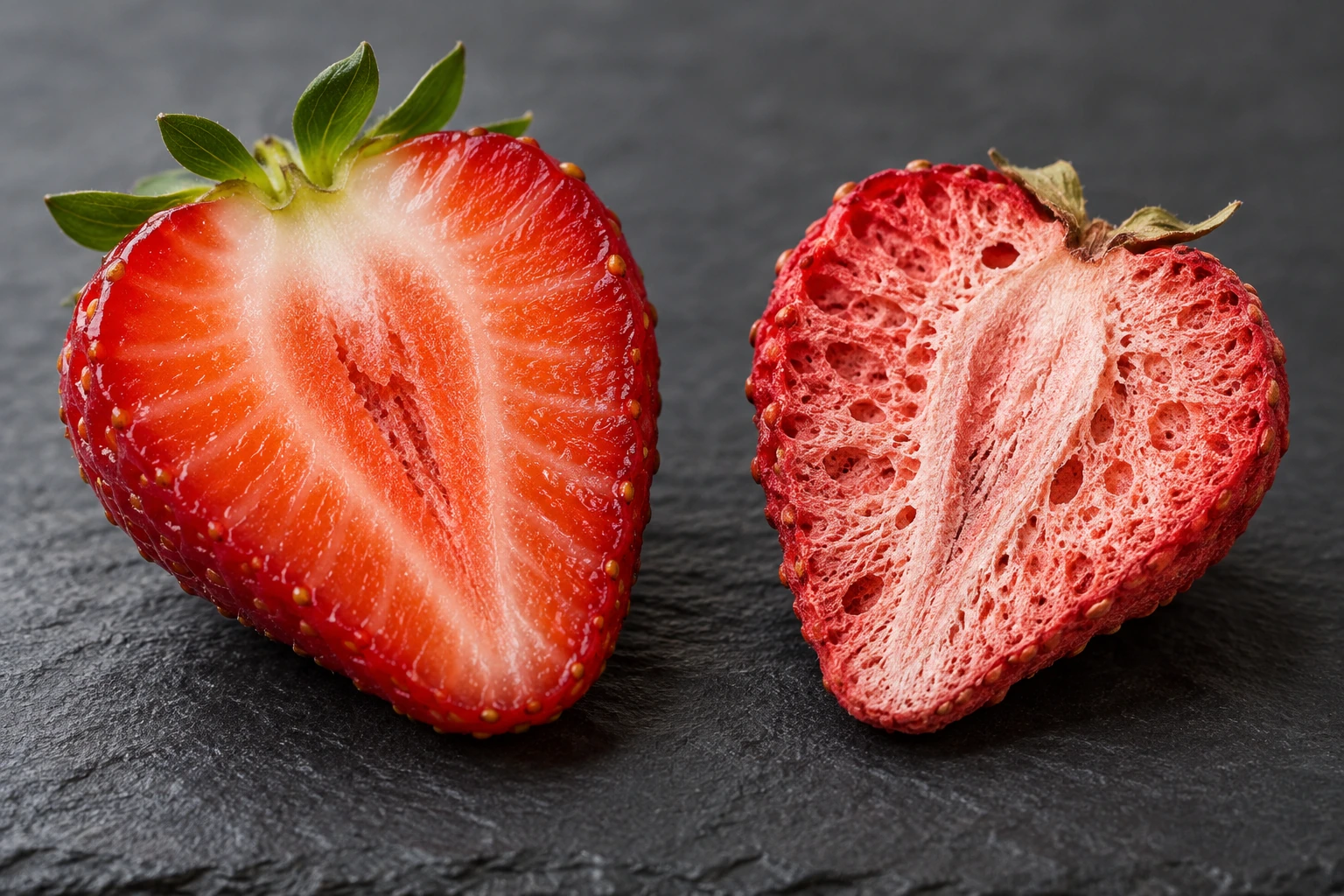
The frozen water's distribution helps determine the spaces left as it departs. A porous structure can make the dried object fragile and give added water routes back into it. The illustration suggests that difference through a fresh and a dried strawberry half. It is not a record of one measured sample before and after processing.
For a close-looking task, inspect a commercially packaged freeze-dried food you already have, following its label. Compare the outside with an existing broken piece. Are the pores evenly distributed? Does the outline survive better than the fine internal texture? No microscope is necessary to notice that shape and density can change by different amounts.
Drying changes a journey's logistics
NASA's Space Food Systems account describes freeze-dried foods alongside heat-stabilized foods and other packaged items. It also explains containers designed for adding water. A menu is a system of preparation, packaging, storage, and crew use, rather than one preservation method applied to everything.
Try a fictional mass budget. A 100-gram sample contains 80 grams of water and 20 grams of other material. If an ideal process removed 75 grams of water and nothing else, the remaining mass would be 25 grams, including 5 grams of water. The example is arithmetic, not a claim about a particular fruit or a finished safe product.
Now add the removed water back at the destination. The transport advantage changes if you also had to carry all that water. This does not eliminate the value of drying; it shows why the surrounding system matters. Water may already be available where the food is prepared, and packaging can solve other practical problems.
Three claims to keep separate
A material can retain its outline, lose most of its mass, and rehydrate conveniently. Those are three different observations. None alone establishes nutrient retention, sterility, or shelf life. Check product-specific evidence before attaching those additional claims.
Inspect the package as well as the dried piece. Instructions about closure, added water, and storage belong to the product's designed journey. Record those instructions without generalizing them to another food. A porous structure that readily admits water during preparation also gives a reason to pay attention to the surrounding package.
The striking thing about the brittle strawberry is not merely the missing water. It is that a managed route through pressure and temperature can remove ice while leaving a recognizable scaffold. The shape records what stayed; the pores invite you to imagine what moved.
Sources and further exploration: FDA: lyophilization stages; Labconco: laboratory freeze-drying guide; NASA: space-food systems.
Explore all 50 new articles · Browse the complete illustrated collection
Explore more art, ideas, and independent projects at Incoprea.


