
A red stone can glow more strongly because of something hidden beneath it. In early medieval garnet cloisonné, thin pieces of garnet sit inside small gold cells, often above reflective gold foil. The final brightness is the work of an assembly: stone, backing, cell walls, and light.
The Sutton Hoo objects reward an unusually close view. Their imagery is compelling, but the join between two tiny components can be just as revealing as the whole design. It records the patient effort needed to make hard materials agree.
Begin below the red surface
The British Museum’s gallery guide explains garnet cloisonné as vivid red garnets set in individual gold cells with gold foil backing to catch the light. The stones are fitted pieces, not red enamel poured into every space. A visual resemblance should not erase a material difference.
Think about the sequence implied by the result. A cell must have a shape; a stone must fit it; the backing must support the optical effect; and the arrangement has to remain secure. The image and the construction are inseparable. A line that looks like drawing is also a physical partition.
A museum’s enlarged image can make the cells seem large and easy to handle. Always check the object’s dimensions. A magnified view is useful partly because it lets us see labor at a scale that ordinary viewing would miss.
One boss makes the geometry visible
A Sutton Hoo sword-sheath boss in the British Museum is described as hemispherical, with a cruciform arrangement incorporating stepped and mushroom-shaped cells. The catalog notes alternating outward-pointing garnets and inward-pointing gold elements around the edge. That is not merely a decorative border. It is an interlocking arrangement of shapes and materials.
A useful looking task is to follow one boundary without reading the whole motif. Where does a straight segment turn into a step? How does a curve end? Which tiny gold edge separates two areas of red? This makes the craft legible without requiring you to assign a symbolic meaning to every shape.
The museum’s purse-lid record offers a different scale and format for comparison. A rounded boss and a wider lid solve different compositional problems. They belong to the same exceptional burial assemblage without being interchangeable examples of one pattern.
The stone has a history before the workshop
The British Museum’s Silk Roads learning materials report that scientific analysis indicates garnets in a Sutton Hoo shoulder clasp came from India, Czechia, and Sri Lanka. The statement concerns that studied object and the museum’s interpretation of the material evidence. It should not be expanded to mean every garnet in the burial came from the same places.
That mixture makes an important point about networks. A finished object can bring together materials with different origins. It does not follow that its final maker visited each source region, or that one merchant carried every stone along a single unbroken route.
The museum’s exhibition account deliberately broadens the idea of Silk Roads beyond one simple east–west track. Land, sea, and river connections intersected. A small object from Suffolk can participate in that wider history without requiring us to invent the missing itinerary of each stone.
A low-tech way to think about backing
Hold a clean piece of transparent red packaging over white paper, then over a dark surface, then over a piece of ordinary kitchen foil. Keep the light source the same. Do not look into a bright lamp or the sun. Notice how the appearance changes when the backing changes.
This is an optical analogy, not a reproduction of garnet or ancient foil. The plastic, its color, and its surface behave differently from a historic stone. The narrow lesson is that a translucent colored layer can depend on what lies behind it. What seems to be a property of one material may be an effect of an assembly.
For a second exercise, draw three adjoining cells on paper and try fitting colored paper pieces into them without leaving gaps. Then repeat with a curved outside edge. Even in paper, the margin between a satisfying fit and a visible mismatch becomes a design problem.
Look for a corner where several cells meet. It requires each small stone to agree with adjacent gold boundaries while preserving the larger design. In a drawing, you could erase an awkward line. In fitted materials, an adjustment changes a physical edge. Then widen your view to see how that junction serves the whole. Following just one junction makes the distance between a pleasing sketch and a finished object easier to appreciate.
A missing stone can reveal a different achievement
Sue Brunning’s British Museum account of the garnet research describes material inside the gold cells: a prepared bed beneath the foil and garnet. Its role was to bring the stone to the required level, rather than simply act as a glue. The account presents tension in the cell walls as the likely means of holding the fitted garnet. That distinction gives the hidden assembly more precision than “gemstones stuck onto gold.”
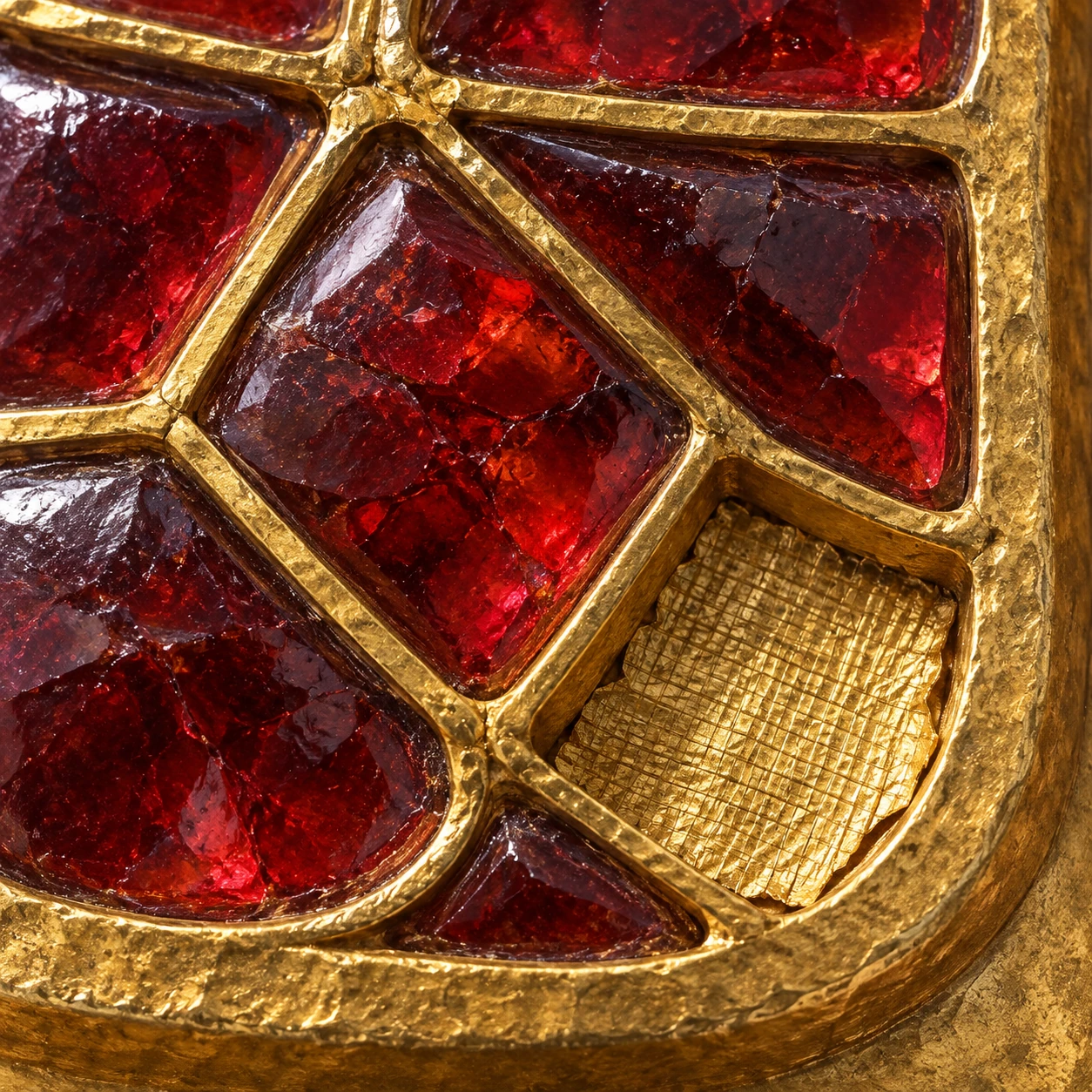
The museum’s shoulder-clasp 1939,1010.5 record also identifies more than one red-and-gold surface ingredient. It distinguishes garnets, patterned glass, blue glass details, foil, and the pin-and-hinge connection. One object combines several ways of making color, line, and attachment work together. A red-looking area should not be assigned a material solely from a small photograph.
Use the clasp record as an inventory challenge. Make one column for materials and another for construction roles. Gold can form a wall, a backing, a pin, or another element. Glass can contribute a patterned inset or a small color accent. The material name alone does not specify its job. The exercise asks what the substance is doing at that particular location.
Now choose an official close view of an area where a component is missing. Describe the vacancy without treating damage as a welcome event. A loss can expose a bed or partition that a complete surface hides, while also removing evidence about the finished arrangement. Greater access to one detail can arrive with less access to another.
A useful way to test your description is to remove the word “jewelry.” Can another reader still understand the physical system you have described? “A translucent fitted piece above a reflective backing inside a thin wall” conveys a relationship that a value-laden category may leave invisible. Restore the object’s identity afterward, so the technical description stays attached to its archaeological setting.
Finally, keep possibilities separate from conclusions. A difference in backing might result from a deliberate choice, a repair, or another history requiring investigation. Brunning’s account discusses alternative explanations rather than turning every asymmetry into a solved symbolic message. That restraint lets the optical effect remain astonishing while the object’s unanswered questions remain available.
Read three kinds of value separately
These objects held value through precious materials, skilled labor, and their role in elite display. Their later burial and excavation added other histories. A modern museum’s interpretation can explain those contexts without reducing the work to the monetary price of gold and stone.
Keep three questions distinct. What materials are present? What work transformed them? What social use did the object have? Material analysis may answer the first more readily than the last. A beautifully cut garnet does not tell us, on its own, the name of the craftworker or the complete meaning of a paired animal image.
The same discipline helps with headlines. “A stone source has been identified” is different from “a complete trade route is known.” “The object is technically intricate” is different from “we know exactly how every tool was used.” Precision does not diminish the achievement; it makes the actual evidence more impressive.
Close looking changes the experience of Sutton Hoo. The object is no longer simply treasure behind glass. It becomes a series of tiny agreements: a red edge meeting a gold wall, light returning through a stone, and a maker turning materials from distant places into an image held at human scale.
Sources and a closer look
British Museum: Room 41 gallery guide; British Museum: sword-sheath boss 1939,1010.27; British Museum: Sutton Hoo purse-lid record; British Museum: Silk Roads learning cards; British Museum: Silk Roads exhibition context.
Find more art, ideas, and unexpected connections at Incoprea.




