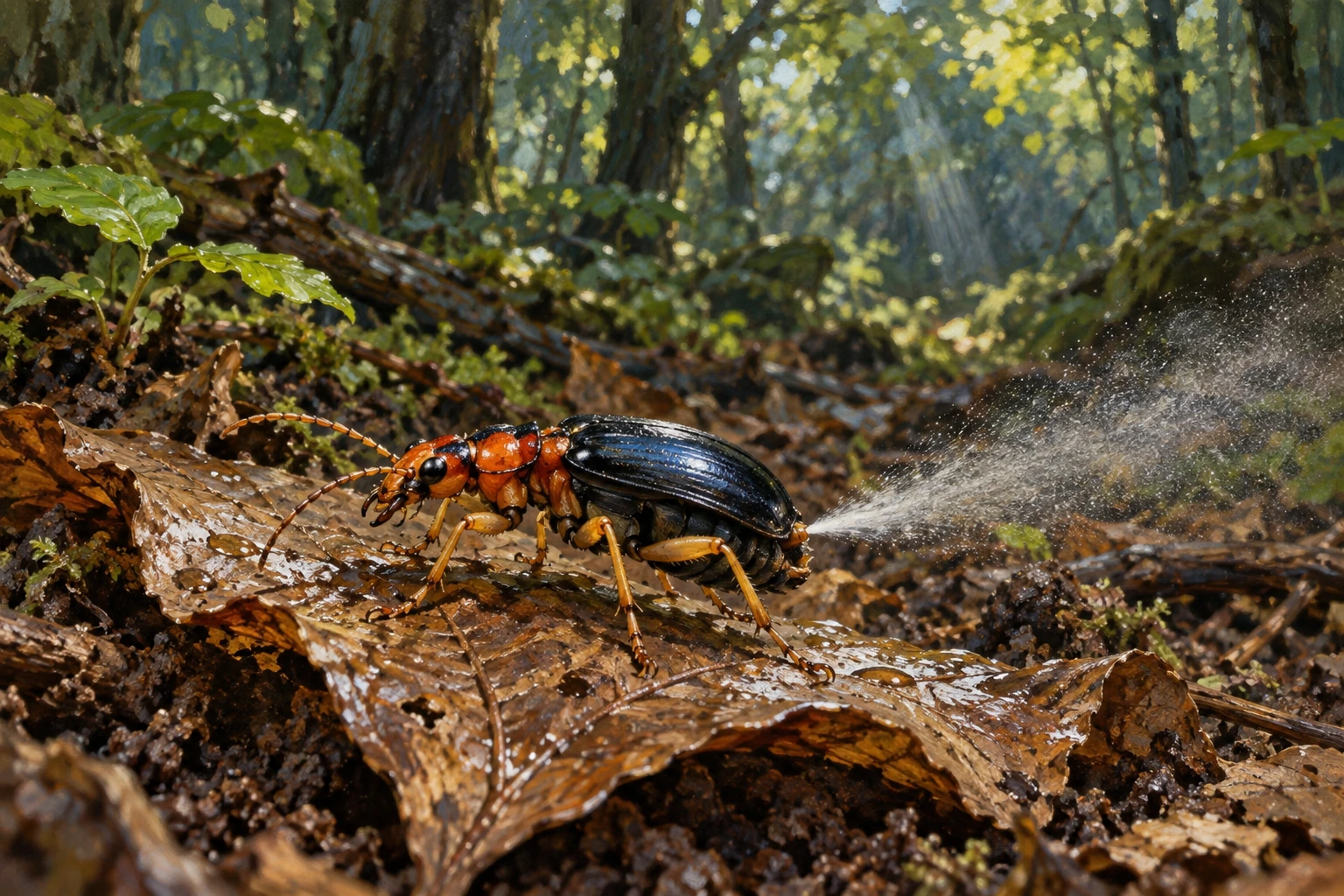
A bombardier beetle's defense can look like one brief puff from the rear of its body. Inside that short event, however, a much faster rhythm may be running. A continuous-looking spray can be assembled from separate discharges, each linked to a tiny pressure-controlled interruption.
That distinction changes the question. It is no longer enough to ask how an insect makes an irritating liquid. We also need to explain how material enters a reaction space, how pressure expels it, and how the next discharge begins.
A puff becomes a sequence
A 1990 study of Stenaptinus insignis resolved a rapid series of pulses, at about 500 per second. At that rate, one interval lasts roughly two thousandths of a second. This is a result for a named species under study conditions, not a fixed specification for every beetle called a bombardier.
Try a scale comparison on paper. Divide a second into ten equal spaces, then imagine dividing each space into fifty more. An ordinary glance cannot separate those events. A description based on unaided appearance could therefore mistake repeated discharge for steady flow.
The older work established a timing problem. Later research could investigate the moving structures behind it.
The pressure helps operate the inlet
In a 2015 study, researchers combined anatomical examination with high-speed synchrotron X-ray imaging. The method made events inside living beetles accessible while the defense operated. Their analysis linked pulsation to structures where a reservoir meets a reaction chamber.
The proposed feedback is local. Rising pressure displaces a flexible region and closes the inlet valve. Ejection releases pressure. The structure relaxes, reopening the passage so more liquid can enter. The system's changing physical state helps determine when the next pulse can form.
“Passive” here has a narrow meaning. It describes how this particular cycle can follow from pressure and material deformation. It does not mean the whole beetle lacks nervous control, never initiates a defense, or cannot direct its abdomen. Starting an action and producing every rapid subcycle are different control problems.
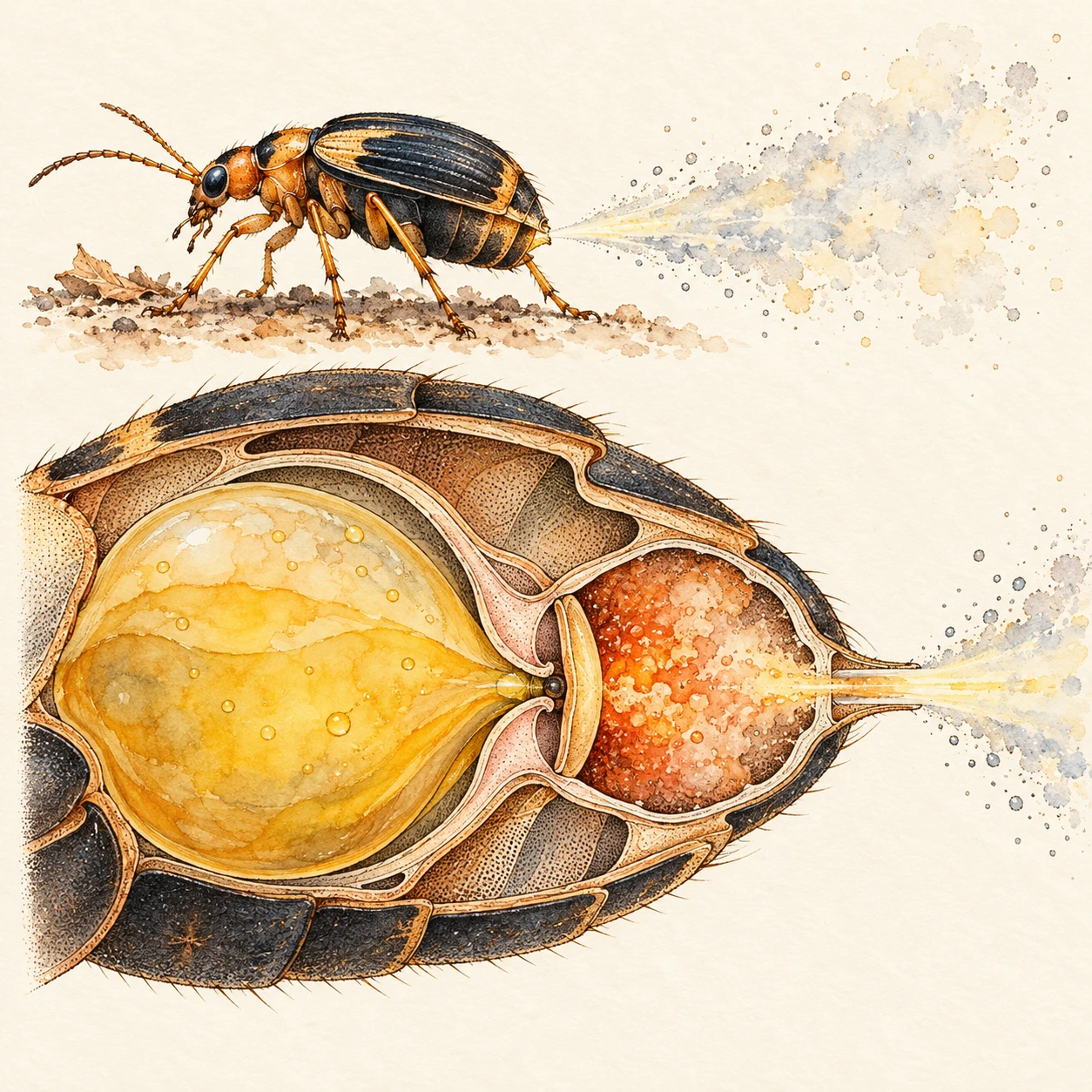
The schematic interpretation separates reservoir, reaction space, and outlet so the feedback is easier to follow. It is not an anatomical map or a drawing to scale. The X-ray study supplies the evidence for the moving parts.
Make a rhythm without adding a drummer
The small model below isolates one idea: a rule can switch its own conditions. Pressure rises until a threshold closes an inlet, then falls until another threshold reopens it. Change either rate and the repeating pattern changes.
Explore a repeating pressure valve
A keyboard-usable threshold model separates rise and release rates. All numbers are illustrative and dimensionless.
Its axes use arbitrary units. Its rises and falls are deliberately linear. Real chemistry, vapor, fluid resistance, and elastic geometry are omitted. You should not compare the graph's peaks with 500 pulses per second. The useful comparison is between two explanations of control: a separate instruction for every event, or repeated events emerging from feedback.
What should you notice in the model?
Hold the release rate steady and increase the pressure-rise rate. The rising part shortens, but the falling part stays the same. Then reverse the exercise. This lets you distinguish the two contributions to a cycle instead of treating frequency as one mysterious setting.
If the upper and lower thresholds were identical, the model could switch too rapidly at one value. Keeping them apart creates a range over which the state persists. Engineers call this kind of history-dependent switching hysteresis. The demonstration uses that mathematical convenience; it is not a claim that those exact thresholds have been measured in a beetle.
A chamber is also a material structure
The MIT account of the research distinguishes relatively rigid reinforcement from regions that can stretch and return. An effective chamber needs both resistance and controlled movement. Making everything equally stiff would not automatically improve a mechanism whose valve depends on deformation.
The researchers also proposed that pulsing could help protect the chamber by interrupting sustained heating. That is a proposed benefit, not a direct reading of evolutionary history. Showing a physical mechanism, measuring a protective effect, and demonstrating why natural selection favored it are separate achievements.
Generating a jet is not the same as aiming it
Photographic work on S. insignis showed striking control of spray direction. Beetles could target individual regions of their legs and sites on the back. Their aim also reflected the position of a leg rather than treating the body as a fixed diagram.
That study adds a behavioral layer to the pressure story. A mechanism that generates pulses still needs an outlet directed toward a relevant threat. Conversely, accurate aim does not tell us what makes the internal pulse repeat. Keeping those questions apart makes both results more impressive and more precise.
The most revealing moment may be the tiny pause inside an apparent blast. For a fraction of a second, pressure changes the shape of a passage, and that shape changes what pressure can do next. The beetle's defense is chemistry organized through time by living materials.
Sources and further reading: Arndt and colleagues: internal imaging of spray pulsation; Dean and colleagues: a biological pulse jet; MIT: how the reservoir and reaction chamber interact; Eisner and Aneshansley: photographic evidence of aiming.
Explore all 80 new articles · Browse the complete illustrated collection
Explore more art, ideas, and independent projects at Incoprea.