A strip holds firmly when pulled one way and opens easily when peeled from an edge. Hook-and-loop fasteners turn thousands of small catches into a closure whose behavior depends on direction. Their familiar ripping sound is the audible trace of many tiny engagements giving way.
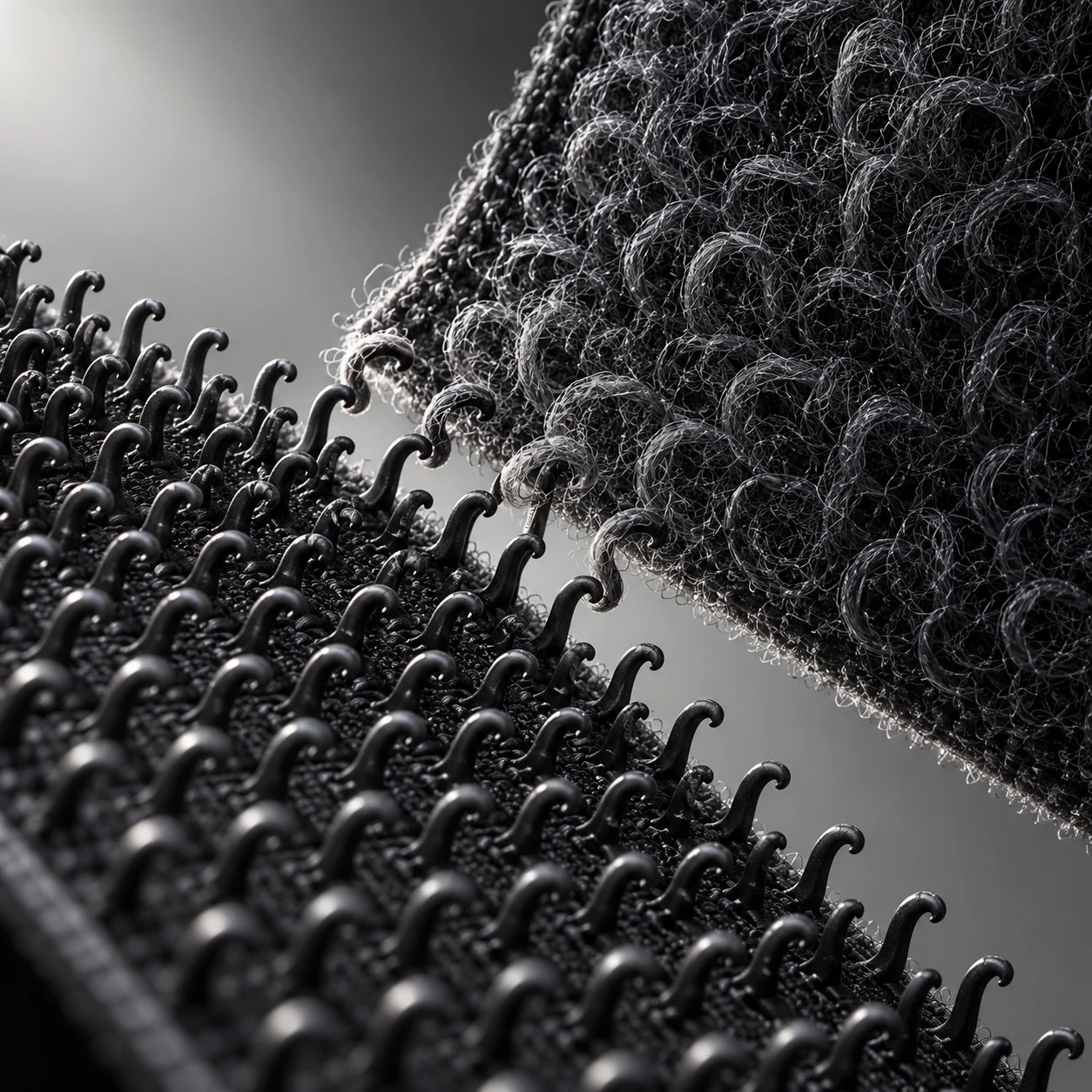
VELCRO is a brand name; hook-and-loop describes the general fastening mechanism. The name is useful here because the manufacturer's own technical explanations make clear that there is no single universal combination of hook, loop, strength and lifetime. A soft clothing closure and an infrequently opened industrial attachment can ask different things of the same basic idea.
The rough side and the soft side have different jobs
Velcro Companies' mechanism guide describes hooks engaging a matching loop material. Pressing the surfaces together creates many opportunities for contact. Separation requires those engagements to release, bend or otherwise disengage according to the design.
The key word is “matching.” A patch that feels rough and another that feels fuzzy are not automatically a high-performing pair. Hook shape, loop construction and material flexibility affect how they engage. The closure is an interface, so looking at only one half cannot explain its behavior.
Try the mental image of a small crowd holding loosely linked hands. Pulling everyone apart simultaneously asks something different from starting at one edge and successively releasing one short row. The analogy leaves out the actual mechanics of fibers, but it prepares a useful question: how much of the connection is being challenged at once?
Peel, shear and direct separation are different tests
The manufacturer's explanation distinguishes peeling from an edge, sliding the faces in opposite directions, and pulling them directly apart. These loading modes can produce very different results. The Professional Series technical brochure lists peel and shear performance separately for specified products rather than giving one context-free “strength.”
That difference is more than a terminology lesson. A label reporting force per width for peel does not represent the same test as a shear value per area. Comparing the numbers without their units and method can make one product look stronger for the wrong reason.
A useful reading exercise is to copy a datasheet value with all its qualifiers: product, test direction, units, sample width or area, and relevant conditioning. If only the number survives into your notes, much of its meaning has been lost. The article does not provide a load rating for a homemade attachment.
| How you pull | What to notice |
|---|---|
| Peel back from one edge | The release front moves across the closure |
| Slide the engaged faces apart | Much of the engaged area resists at once |
| Pull directly away from the face | The separation mode differs from progressive peeling |
A gentle comparison is enough
Use an unloaded reusable cable strap or a spare small closure. Engage the same length each time with similar hand pressure. First peel it gently from an edge, then re-engage it and try a modest sideways pull. Describe the direction and feel rather than estimating a force from your fingers.
If one trial used twice the overlap or a much harder closing press, it is not the same comparison. Those changes may be interesting, but record them as separate variables. Do not test by suspending valuables or people; the point is to understand the mechanism with an empty sample.
Now listen to the release. A continuous-seeming rip contains many small events. The sound helps make the progressive nature of opening noticeable, but it is not a calibrated measurement of holding strength. A quieter product can be designed to behave differently without necessarily being defective.
Sometimes the closure is crowded, not exhausted
The manufacturer's cleaning guide explains how hair and lint can obstruct engagement. It recommends removing debris with suitable simple tools and keeping closures fastened when not in use or during permitted laundering. Follow the specific garment's care directions rather than applying one washing rule to every attachment.
This separates two possibilities that everyday language often merges. “It no longer grips” can mean the hooks and loops cannot reach each other because debris occupies the space. It can also mean the material has worn or been damaged. Cleaning may address obstruction; it cannot promise to rebuild a broken hook or restore every distorted loop.
For a small maintenance record, photograph the unloaded closure before cleaning, remove lint gently according to its care guidance, and compare the same overlap afterward. If the feel improves, that supports obstruction as part of the problem. It does not tell you the closure's original strength has been fully restored.
One opening is a different design brief from a thousand
A closure can be excellent at holding strongly and less suited to frequent reopening. Another can open gently and survive repeated cycles. Those goals need not rank products in the same order. The mechanism is chosen for a use history as well as for one initial pull.
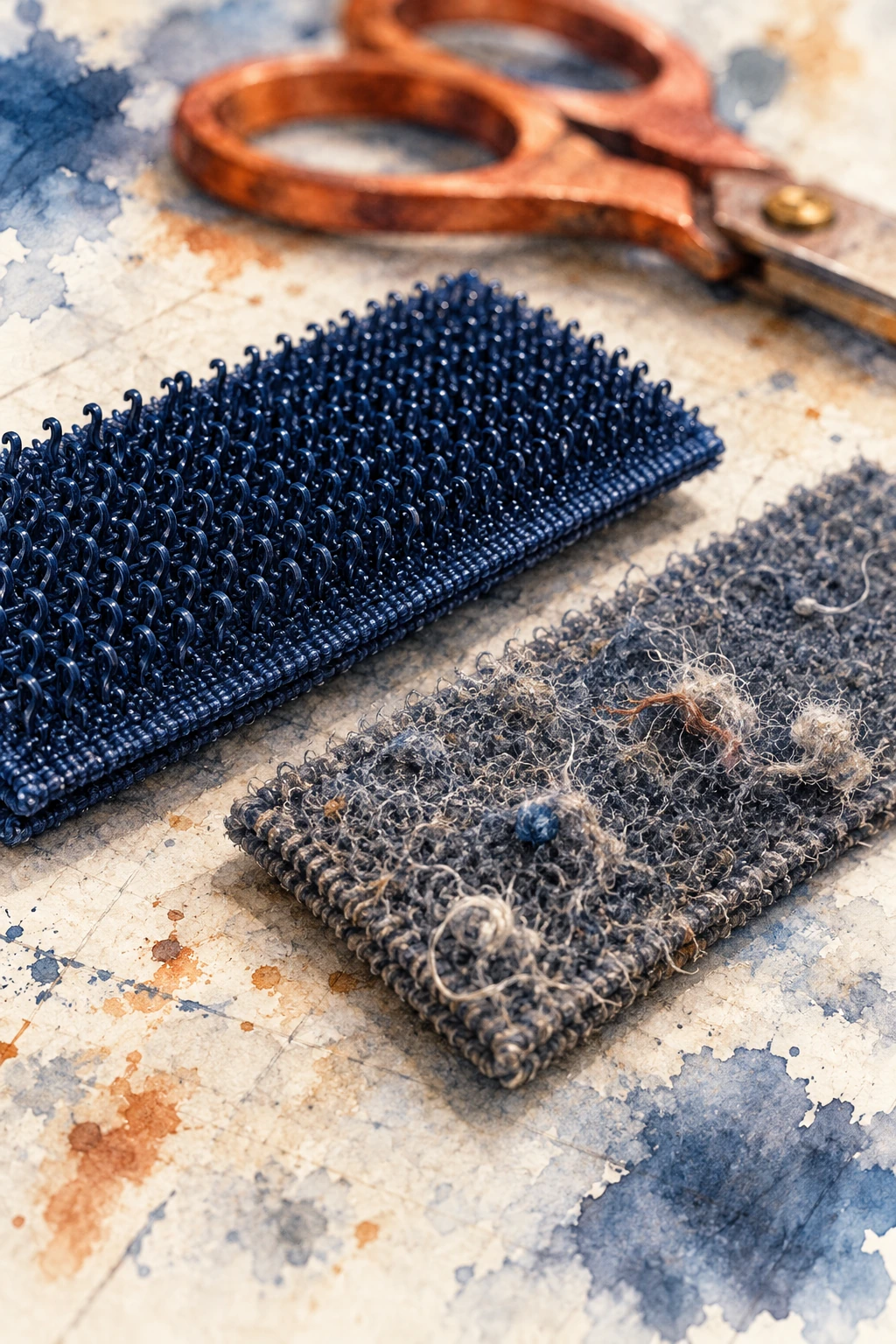
The manufacturer’s textile-fastener overview separates woven, knitted, and nonwoven constructions and their intended uses. Its woven-fastener technical brochure lists distinct matched pairs with separate peel, shear, and qualitative cycle-life categories. The historical brochure illustrates the tradeoff; it is not a current load rating for an unidentified strap.
A particularly clear contrast is between a pair intended for easy repeated cycling and one with high holding performance intended for little or no cycling. “Stronger” alone would lose the reason for choosing between them. Softness, noise, materials, operating environment, and the attachment behind the closure can also belong in the brief.
Choose a question before choosing a winner
Imagine three fictional jobs: a cable wrap opened every day, a display panel opened once a year, and a soft garment tab used repeatedly. Write a priority beside each. For the cable wrap it might be repeated handling; for the panel, a specified holding requirement; for the garment, comfortable opening and contact with fabric.
Now create three candidate cards with invented qualitative properties: high peel/low cycle, moderate peel/high cycle, and low peel/high softness. There is no universal best card. Match a card to each job, then list the missing evidence before any real purchase or design decision: actual paired materials, test method, support attachment, environment, and the manufacturer’s suitable-use guidance.
Finally distinguish a cycle-life label from a measured force after a stated number of cycles. A qualitative category does not specify an exact guaranteed lifetime in your use. Repeated engagement pressure, contamination, alignment, wear, and the definition of failure influence how such a test relates to an application.
What would a fair wear comparison preserve?
Use the same matched materials, overlap, closing procedure, separation direction, conditioning, and endpoint. Record whether failure means lower peel force, lower shear force, damaged loops, or backing separation. Without that endpoint, two “lifetime” numbers may describe different outcomes.
The closure’s eventual failure becomes more informative when its intended job is known. A rarely opened strong connection and a gently released daily connection are different achievements. The hooks and loops cooperate within a design that includes not only how they hold today, but how they are expected to let go tomorrow.
The backing can fail while the tiny catches survive
An adhesive-backed patch adds another interface: the bond between the fastener and the object. A sewn patch adds stitches and fabric. If the whole patch lifts away while hooks remain engaged, the failing connection may be behind the fastening surface. The visible symptom belongs to a chain of connections, not just the material that makes the ripping sound.
This is an original system-level inference rather than a product-specific repair prescription. It suggests a better inspection question: where did separation actually occur? A hook-and-loop interface, its adhesive layer and the supporting fabric can each have a different job and a different limitation.
The fastener's everyday elegance lies in its deliberate imbalance: many catches cooperate to hold, while an edge lets a hand release them progressively. Once you recognize that arrangement, a worn cable strap becomes a readable little structure. Its strength, sound and eventual failure all depend on how two textured surfaces are brought together—and on which direction they are asked to let go.
Sources and a closer look: Velcro Companies: mechanism and load directions; Velcro Companies: product-specific peel and shear data; Velcro Companies: cleaning and care.
Explore art, experiments and other unexpected connections at Incoprea.




