A stone wellhead stands in a Venetian square like an elaborate piece of furniture. Its opening is modest, its carved sides weathered, its silhouette easy to photograph. The tempting assumption is that a simple shaft descends to a convenient underground supply of fresh water.
The larger historical system asks you to look sideways. The wellhead was the visible access point to a rainwater-collection arrangement extending beneath the surrounding surface. The square could participate in supplying water, not merely decorate the place where it was drawn.

Separate the opening from the reservoir
The City of Venice’s account of its freshwater supply describes rain directed from roofs or prepared surfaces into filtering cisterns. Layers of sand and a surrounding clay barrier helped separate the collected freshwater from the brackish environment. The stone vera da pozzo covered and protected the access shaft.
That arrangement changes the object you are looking at. The narrow central opening does not tell you the footprint of the surrounding storage structure. Nor does the depth of a visible wellhead reveal how much usable water its whole system could provide.
Imagine a tree whose trunk is all you can see above the soil. It would be a mistake to infer the entire underground extent from the trunk’s width. The analogy is limited—cisterns are built structures, not roots—but it prompts the right change of attention.
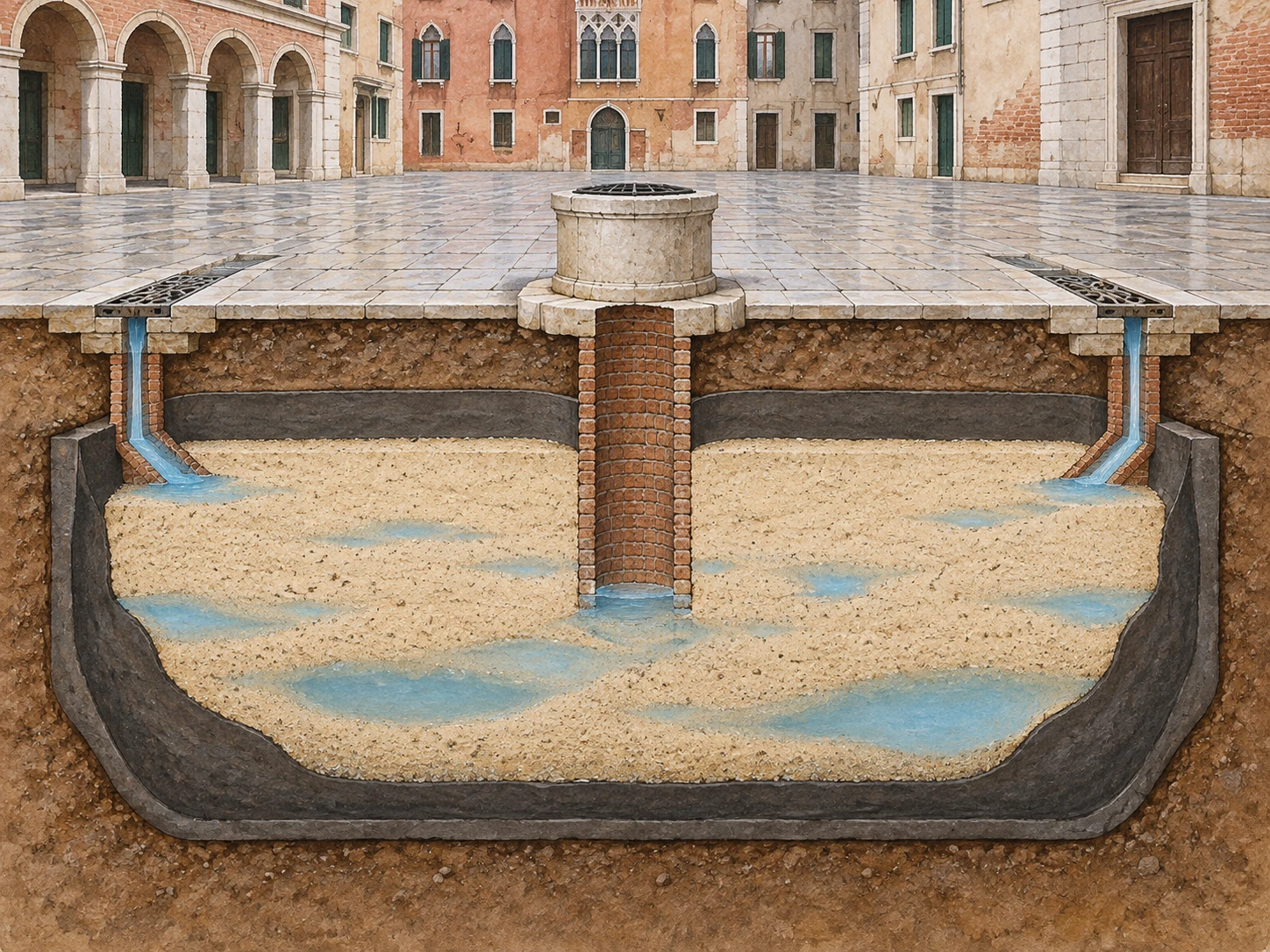
Water can occupy a structure filled with sand
A sand-filled basin may seem to leave no room for storage. Yet grains do not pack without gaps. Water can occupy connected spaces between them. The amount depends on the material and geometry; the cutaway is conceptual and supplies no measured pore fraction.
Beltrame and colleagues’ archaeological research examines well-cisterns in the Venice Lagoon and the northeastern Adriatic. Their work places water collection within a landscape of navigation and changing settlement. A familiar architectural feature can therefore connect to a much longer and more varied history than the decorative wellhead alone suggests.
Keep filtration separate from a modern guarantee of potable water. The historical purpose of a system and its ability to remove particular contaminants are different questions. An appealing diagram of sand does not establish that collected water is safe to drink.
Try a budget before admiring the tank
Suppose a fictional collection surface covers 100 square metres. A 20-millimetre rain event places 2,000 litres on that area. If an assumed 80 percent reaches storage after losses, the input is 1,600 litres. Those values illustrate units, not a measured Venetian installation.
How much rain reaches a cistern?
A unit-aware one-event water budget separates rainfall volume, collection losses and storage capacity.
Now reduce the usable capacity to 1,000 litres. The same rain can deliver 1,600 litres, but the initially empty store retains only 1,000. Increasing the catchment does not remove that bottleneck. In a second scenario, give the tank ample capacity and remove the rain. A splendid reservoir cannot collect water that never arrives.
This small calculation separates three constraints: the area collecting rain, the fraction that reaches storage and the volume available to hold it. Actual operation also depends on demand and timing. A yearly rainfall total cannot tell you how long water remains available through a particular dry interval.
The weather was not the only supplier
The city’s account also describes freshwater brought from the Brenta by boats. Storage and transport complemented local rain collection. Reading the system as a perfectly self-contained rain machine would leave out that logistical work.
Ferrara’s municipal explanation of cisterns “alla Veneziana” documents the same broader architectural tradition outside Venice. Its Palazzo Paradiso example includes a sand-filled basin and connected cisterns. The label identifies an approach that could be adapted, rather than one universal underground layout.
Read a square as infrastructure
In a photograph, locate the wellhead, any visible rain inlets and the slopes or joints of the surrounding paving. Mark features you can see with solid lines and inferred connections with dotted ones. Do not turn a possible drain into a proven cistern inlet without documentation.
Then list the invisible jobs: maintaining a water barrier, keeping collection surfaces usable, clearing inlets and managing supply during dry periods. Infrastructure includes care over time, even when its most memorable public object is stone.
The next wellhead you notice can become the start of a larger question. Where did the water come from, how was it protected, and how did people keep it available? The small opening is an invitation to imagine the whole square working.
Sources and further exploration: City of Venice: Rio dell’acqua dolce; Beltrame and colleagues: Roman well-cisterns; City of Ferrara: cisterns alla Veneziana.
Explore all 50 new articles · Browse the complete illustrated collection
Explore more art, ideas, and independent projects at Incoprea.


