A pencil traces a small outline. Beside it, another pencil follows the same turning gesture along a larger route. No camera has read the picture, and no motor is deciding what a leaf should look like. Linked arms have constrained two moving points to share a geometric relationship.
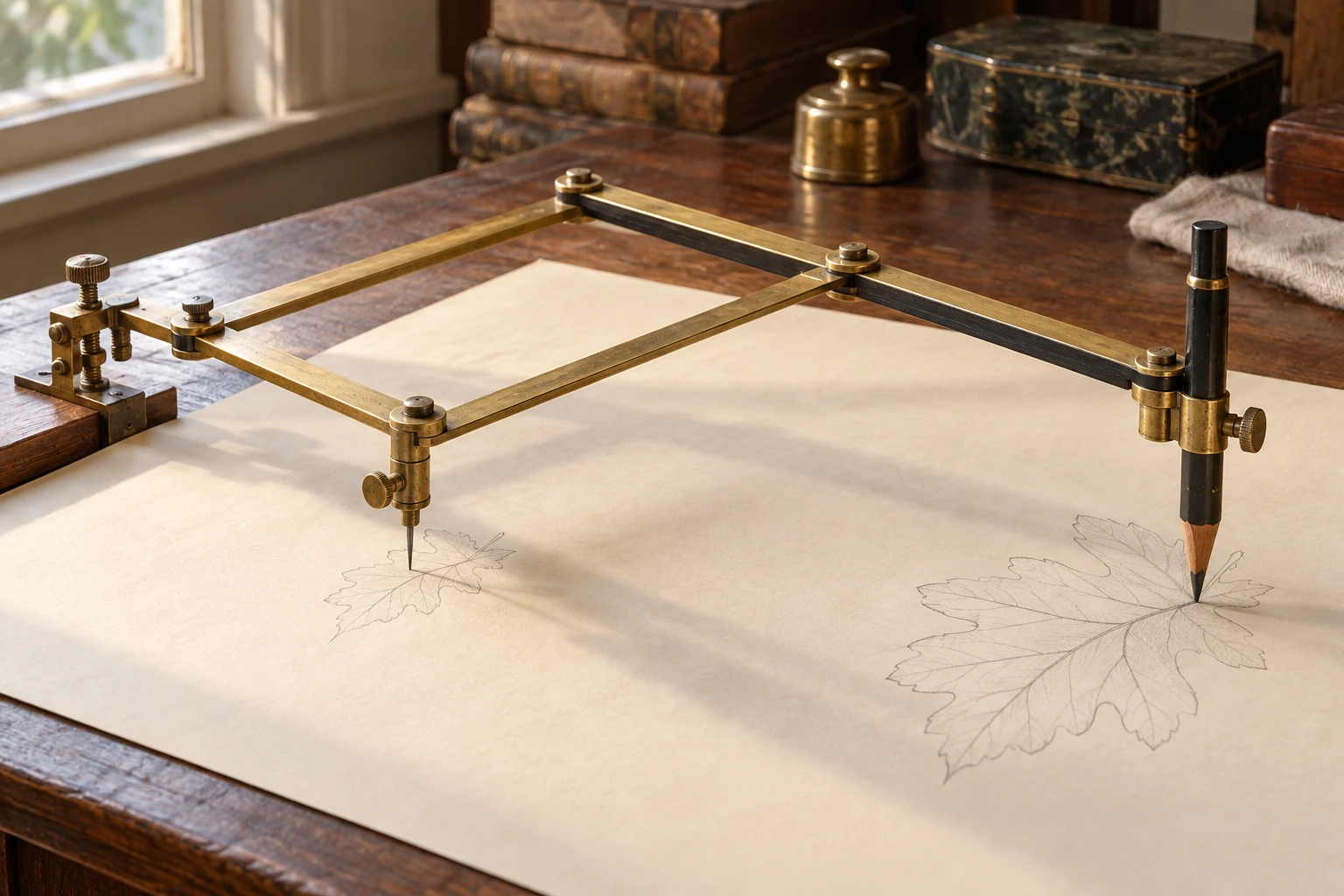
The drawing pantograph is appealing because its intelligence is visible. You can point to the joints, the fixed support, and the two working points. The mechanism does not need to recognize a drawing's subject. It needs to preserve the right relationships while the operator supplies the path.
The fixed point belongs in the explanation
Museo Galileo's instrument account describes hinged rods forming a parallelogram, a fixed center, a tracing point, and a writing point. Their arrangement supports enlargement or reduction. Changing which working point lies between the fixed center and the other changes the relationship between source and copy.
Begin with an ideal mathematical version. Call the fixed point O, the tracer T, and the drawing point P. If P always lies on the ray from O through T, and OP is twice OT, every traced position has a corresponding position twice as far from O. As T moves, P traces a scaled path.
Move a tracer and its scaled partner
Silent coordinate model with a fixed origin, scale factor, point controls, and a three-point path. Geometry only; no false claim of a full mechanism simulation.
Open move a tracer and its scaled partner in its own window.
The model shows that scaling relationship directly. It is not a simulation of every bar, joint, or reachable position of a real pantograph. Use the controls to move T, then change the scale. The coordinate table exposes exactly what the drawn points mean.
The relationship applies to the whole path
For a point at coordinates (3, 2) relative to O, a scale factor of 2 gives (6, 4). A factor of one-half gives (1.5, 1). The same multiplication must apply to both coordinates. Scaling only the horizontal direction would stretch the drawing rather than preserve its shape.
Try the model's three-point path. Predict where each point will go before changing the factor. Distances between corresponding points scale together, while angles in the ideal drawing remain unchanged. At factor 1, source and copy coincide in this abstract coordinate model; a physical machine's layout can place working points differently.
Now move the fixed origin in your mental picture. Scaling occurs relative to that origin, so a point's absolute page coordinates are not simply multiplied unless the origin is at zero. The more general relationship is P = O + k(T − O). That subtraction is what makes the fixed point matter.
A surviving instrument reveals practical choices
The Science Museum Group's 1876 Stanley pantograph survives with a board and drawing, alongside its instrument and support components. The record identifies materials and maker. It gives the geometry a physical setting: the device needs a stable anchor, usable joints, and a surface that can receive the copy.
Look at a museum photograph and trace the force of your imagined hand. Which parts must move freely? Which part must stay fixed? Where would a pencil press against the page? These questions reveal why a mathematically exact principle still needs careful mechanical construction.
The illustration introduces that arrangement but does not certify its pictured bars as a measured mechanism. For identifying a real historic example, rely on the museum record and its documented components. For checking the ideal scale calculation, use the model's coordinates.
A useful copy can preserve the wrong gesture, too
A scaling relationship does not know which wiggle you intended. In the ideal model, a small deviation of the tracer becomes a proportionally scaled deviation of the copy. Enlarging by three also enlarges a corresponding tracing error by three. Loose joints and other physical imperfections introduce additional complications that this coordinate model omits.
Trace an imaginary sharp corner with your fingertip on a table. First stop precisely at the corner before turning. Then round the movement. The pantograph's job is to transmit the path you actually supply, not infer that you meant a perfectly sharp vertex. Mechanical assistance can amplify intention and hesitation together.
The principle traveled beyond drawings
The Royal Mint Museum's activity connects linked-arm scaling with reducing machines used to transfer large coin designs into smaller forms. Its Janvier example also makes vibration a practical concern. A scaling principle becomes useful technology through the surrounding tools and supports.
Two checks before trusting a scale model
Double the factor while holding the tracer still: the copy's distance from O should double. Then hold the factor fixed and move the tracer only vertically: the copy should move vertically by the same factor. These checks test the relationship independently of whether the displayed path looks familiar.
The quiet achievement is a constraint that remains true through motion. A set of linked arms turns a hand's route into another route with predictable proportions. Follow the fixed point, and the drawing stops looking magically duplicated. Its geometry becomes something you can watch working.
Sources and further exploration: Museo Galileo: pantograph mechanism; Science Museum Group: Stanley pantograph on a board; Royal Mint Museum: pantograph and reducing-machine activity.
Explore all 50 new articles · Browse the complete illustrated collection
Explore more art, ideas, and independent projects at Incoprea.


