A tabletop covered in repeated shapes seems to invite a repeating plan. Slide the pattern far enough, and surely the same arrangement should line up again. An aperiodic monotile challenges that expectation: one tile shape can cover the infinite plane while its geometry rules out every periodic tiling.
The distinction is subtle and worth exploring slowly. The shape repeats, local clusters recur, and larger organization can still exist. What is absent is a nonzero translation that carries the entire infinite tiling exactly onto itself. Repetition of an ingredient is not the same thing as a repeating global grid.
First distinguish a choice from a constraint
You can arrange ordinary square tiles in colored patterns that never settle into a repeating color sequence. That does not make a plain square an aperiodic tile. The square also admits the familiar periodic grid. A shape that permits a nonperiodic arrangement has not necessarily forced aperiodicity.
In Smith, Myers, Kaplan, and Goodman-Strauss's hat paper, the authors prove that a particular polygon can tile the plane but cannot do so periodically. They establish larger clusters and hierarchical structure, rather than treating a visually irregular sample as a proof about infinity.
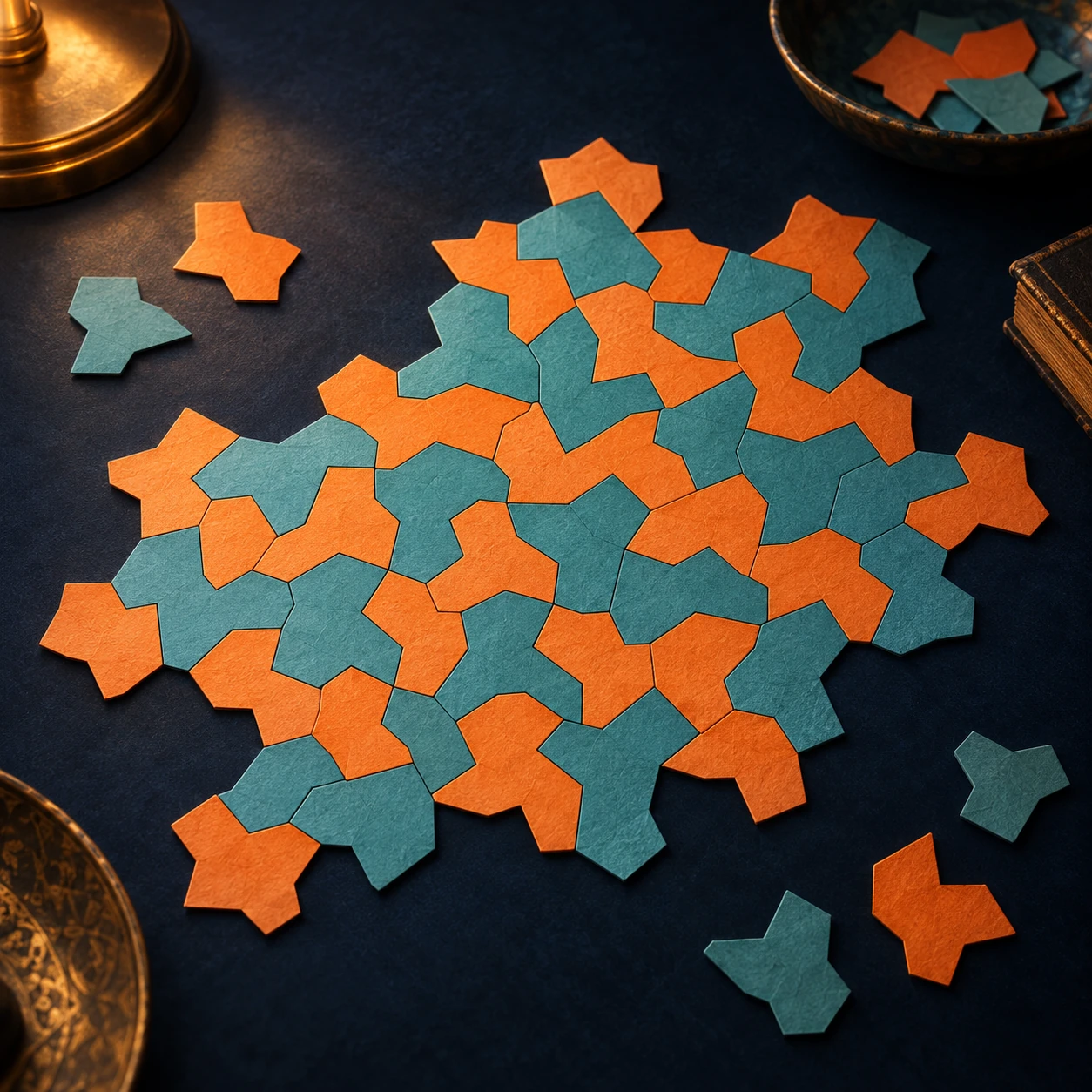
The illustration above uses conceptual paper pieces. They are not the certified hat geometry and should not be used to test its mathematical claim. The exact shapes, substitution tools, and proof resources are available on the creators' project page.
A small patch cannot display an infinite guarantee
Imagine a photograph of a very large floor whose repeating unit is wider than the photograph. Inside the frame, you might fail to find a repeat even though one exists elsewhere. Conversely, a local cluster can recur inside an aperiodic tiling without producing a translation that works everywhere.
This gives you a better question for an image: what exactly repeats, and how far does the evidence reach? A single tile, a cluster of several tiles, and the entire arrangement are different objects of comparison.
Visit the creators' interactive application through their project page. Begin with a small displayed patch. Choose a recognizable cluster and look for another occurrence, allowing rotation if you are studying local similarity. Then ask whether the same displacement carries every surrounding tile into agreement. Finding one matching cluster answers the first question, not the second.
The larger pieces have their own organization
The hat research constructs metatiles—clusters that can be treated as larger building blocks—and substitution rules. That hierarchical viewpoint links local fitting to the structure of arbitrarily large regions. An apparently irregular field can contain strong organization without possessing a repeating translational unit.
For a paper exercise, draw a box around one cluster in a screenshot from the creators' tool. Describe the cluster using position and orientation, not only color. Now imagine making the observation window larger. Which apparent matches survive when their neighborhoods are included? You are testing the scope of a local claim, while leaving the infinite theorem to the proof.
Color is especially tempting. The project images use color to help reveal arrangements, but the hat result concerns geometry without extra colored matching rules. If you mentally recolor a tile, you have not changed the polygon that fits against its neighbors.
Turning a tile over changes the question
The later chiral-monotile paper makes an important distinction explicit: every tiling admitted by the original hat mixes reflected and unreflected copies. The follow-up develops Spectre shapes whose geometry supports aperiodicity without requiring mirror-image copies in the same way.
Use a paper letter such as an asymmetric block shape to think about reflection. Rotating it on the table preserves its handedness. Flipping it over reverses that handedness. The operations are different even when a casual phrase such as “move the tile around” seems to include both.
A three-column pattern notebook
Record an observation, its scope, and the evidence needed to go further. For example: “this cluster appears twice”; “within this finite patch”; “does not establish a global period.” Then record the theorem separately: “the hat admits plane tilings but no periodic ones”; “all complete tilings”; “supported by the published proof.” Keeping the columns distinct makes close looking more valuable.
Finally, compare two kinds of order. A wallpaper repeat tells you how to continue by copying a fixed translational unit. A hierarchical aperiodic construction tells you how local pieces belong inside larger structures. Both can be highly organized. Only one needs a repeating grid.
The pleasure of the monotile is that a modest-looking outline can carry a demand extending far beyond any tabletop. Its edges do more than meet the next piece. Through the constraints they impose, they help determine what the whole plane can never become.
Sources and further exploration: Smith and colleagues: an aperiodic monotile; Creators: hat tools and exact geometry; Smith and colleagues: a chiral aperiodic monotile.
Explore all 50 new articles · Browse the complete illustrated collection
Explore more art, ideas, and independent projects at Incoprea.


