A clean window asks very little of your attention. Look through it, and the material seems to disappear. Making that unremarkable view is a demanding manufacturing problem: create a broad transparent sheet whose surfaces do not distort the scene with unwanted ripples.
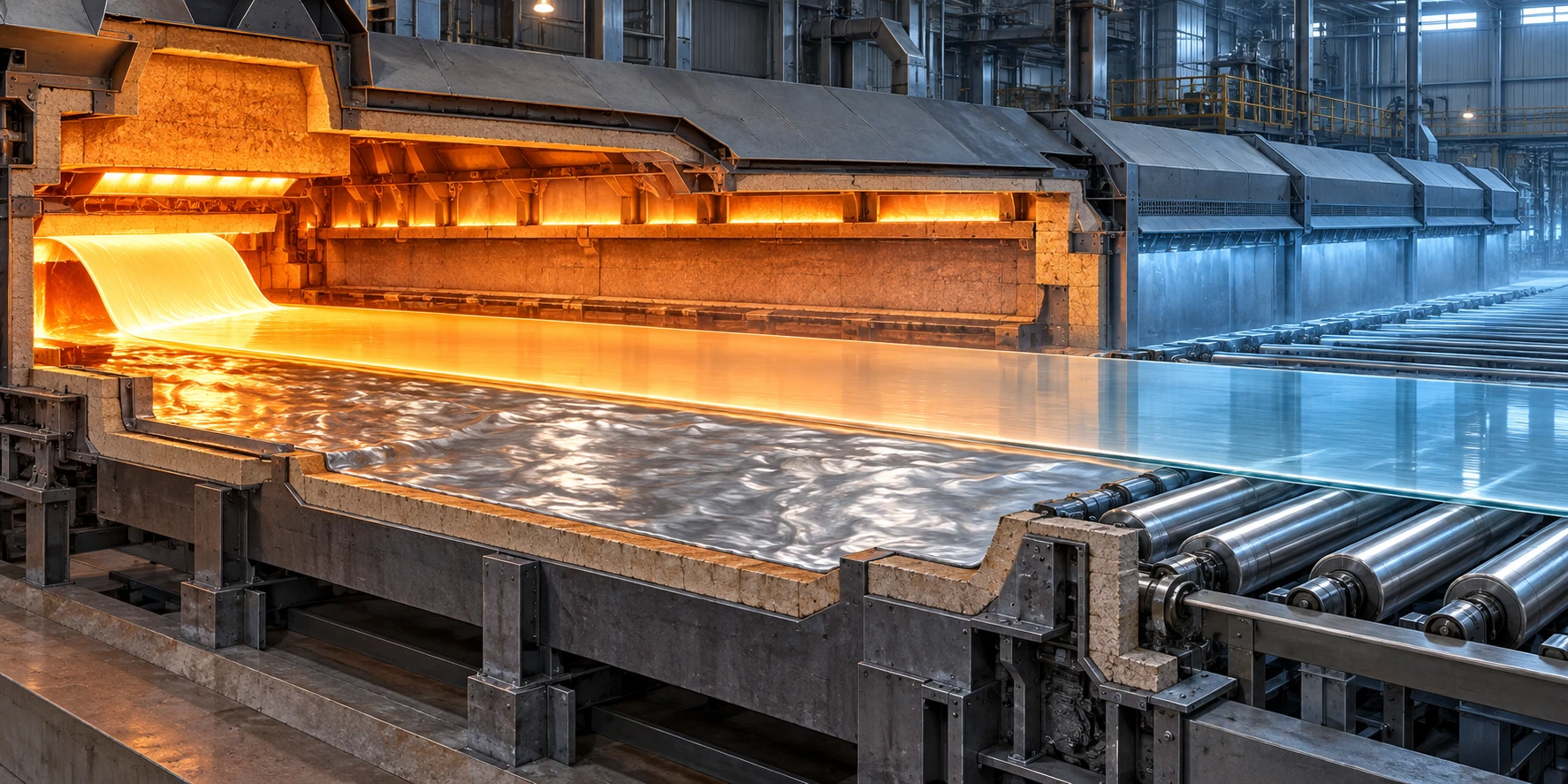
One powerful answer is to stop treating flatness as something that must be ground into every finished sheet. In the float process, a moving ribbon of molten glass forms on a bath of molten metal. The surface beneath it becomes part of the shaping method.
The bath is a support with a useful surface
Pilkington's process account describes molten glass entering a shallow bath of molten tin, spreading into a level surface, and leaving as a solidifying ribbon. Draw-off speed helps control thickness. Controlled cooling, or annealing, follows before the glass is ready for later inspection and cutting.
Keep the two materials separate in your mental picture. The glass is the ribbon being made. The tin is the liquid support beneath it. They are not mixed together as ingredients in a transparent metal-glass soup. The process relies on managing their interface and the glass's changing ability to flow.
In the illustration, follow the bright ribbon from the hot entrance toward the cooler exit. The scene compresses an industrial sequence into an explanatory view. Real plants enclose and control the process; the image is not a scale drawing or a model for building equipment.
A continuous process is also a flow budget
Imagine an ideal ribbon with uniform width, thickness, and forward speed. Its volume passing a point each second equals width × thickness × speed. If volume flow and width remain fixed, doubling speed requires half the thickness. This is a simple conservation calculation, not a full float-line control model.
Try numbers on paper. A ribbon two meters wide and five millimeters thick moving at one meter per second carries 0.01 cubic meters per second. Keep that volume flow and width, then change thickness to 2.5 millimeters. The ideal speed becomes two meters per second. Real operation also involves temperature, edge behavior, equipment, and product constraints.
The calculation helps explain why the word ribbon matters. The product is being formed through motion. A sheet cut at the end is a section of a longer controlled flow, rather than a separate object poured into an individual rectangular mold.
Flat glass had other routes
The Corning Museum of Glass's flat-glass collection account contrasts older methods and the pursuit of flatter, clearer products. Its sample collection preserves different manufacturing histories in pieces that might otherwise look interchangeable. Plate-glass production could require extensive grinding and polishing after forming.
A historical window's visual distortion can therefore be evidence about its making, rather than simply poor care. But do not diagnose a pane's precise method from one reflected line. Age, shape, later treatment, and the viewing arrangement can complicate appearances. A collection record gives the observation a stronger foundation.
Flatness does not finish the object
The museum's Windows Gallery follows windows into questions of safety and performance. A flat sheet may later be cut, coated, laminated, or otherwise processed for its intended role. Float describes a forming route; it does not by itself tell you every property of the final glazing.
This is a useful habit when reading material labels. Ask whether a word describes composition, manufacturing, a later treatment, or an intended application. Several labels can correctly apply to the same object because they answer different questions.
Look at an ordinary view in two ways
From a safe indoor position, look through an existing window at a distant straight feature. Then inspect a reflection on the glass from a comfortable angle. Do not press on, tap, or lean against the pane. Notice whether transmitted and reflected views draw attention to different aspects of the surface.
A window observation card
Record whether you are looking through the pane or at a reflection, the angle, any visible tint, and whether another pane overlaps the view. Separate what you see from what you infer about manufacture. “A reflected line bends here” is an observation; “this was made by a particular historic process” needs additional evidence.
For another flow-budget check, keep thickness and speed fixed while doubling width. The ideal volume flow must double too. A continuous process links dimensions that a finished rectangular sample lets us inspect separately. The calculation makes those links visible without pretending to predict a factory's temperature profile or operating limits.
The surprising achievement is a product designed to become visually quiet. Behind that quietness is a managed sequence of heat, flow, support, motion, and cooling. The next clear view through a window can carry another picture with it: a broad ribbon finding a flat surface on a bath of liquid tin.
Sources and further exploration: Pilkington: the float process; Corning Museum: technology in flat-glass samples; Corning Museum: Windows Gallery.
Explore all 50 new articles · Browse the complete illustrated collection
Explore more art, ideas, and independent projects at Incoprea.


