From far away, Pluto’s bright heart is an emblem. Closer in, part of it becomes a geological problem. The nitrogen-rich plain called Sputnik Planitia is divided into enormous rounded polygons. Narrow troughs outline broad cell interiors. Mountains and scattered blocks interrupt the edges.
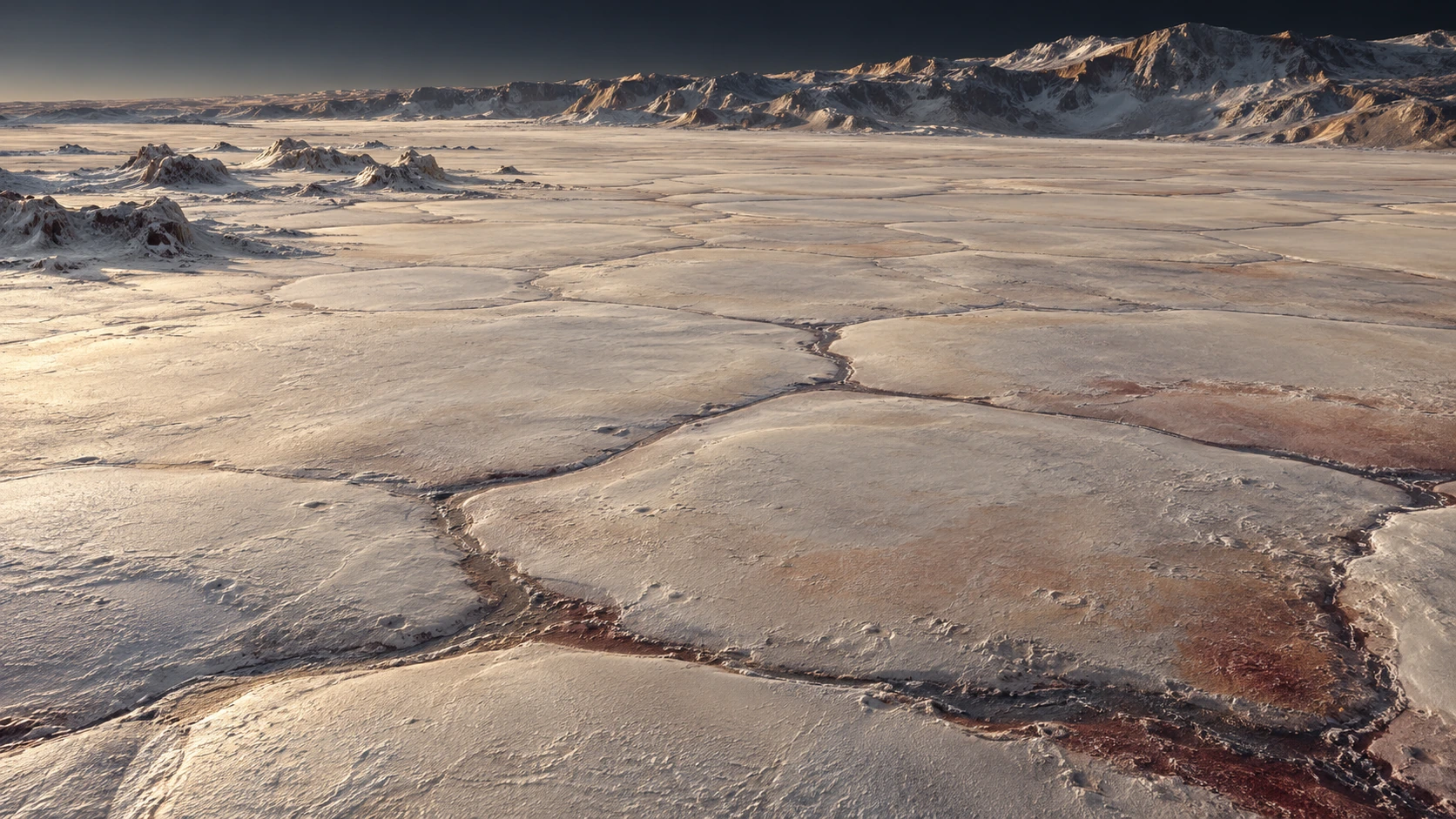
The view invites a familiar kitchen comparison: a warm fluid organized into convection cells. But Sputnik Planitia is dominated by solid nitrogen ice. Under Pluto’s conditions, that ice can deform slowly over geological time. A cold-looking solid can have a moving interior.
That observation does not make every polygon a direct picture of a convection roll. The surface is the result researchers must explain. The flow beneath it is inferred through models constrained by the images, material properties and possible energy sources.
First separate the picture from its scale
NASA’s account of the highest-resolution New Horizons views describes imagery at about 77–85 metres per pixel. Those data reveal details much smaller than the cells, which span many kilometres. A useful reading begins by keeping both scales in mind.
A smooth patch in a reduced web image may contain texture visible in the original. A dark line may be a trough whose shape needs topographic interpretation, not merely a different substance painted on the surface. The occasional dark raised blocks near cell boundaries have been interpreted as water-ice material associated with the denser nitrogen ice.
Water ice and nitrogen ice exchange roles compared with everyday expectations. In this setting, water ice can behave as a strong landscape-building material while nitrogen ice is the more mobile component. “Ice” is a family of materials, not one mechanical behavior shared at every temperature.
For a scale exercise, imagine a cell twenty kilometres across reduced to a twenty-centimetre sketch. One centimetre represents one kilometre. A feature eighty metres wide would occupy less than a millimetre on that sketch. It is easy to lose a genuine observed detail while preserving the impressive outline.
Two early models agreed on motion and differed beneath it
Two papers published in 2016 investigated convection as the explanation for the cellular terrain. Their agreement was meaningful, but their differing interiors were meaningful too.
McKinnon and colleagues used nitrogen-ice rheology and numerical simulations to show how a several-kilometre-thick layer could develop broad cells in a sluggish-lid regime. In that regime, the surface participates in the motion but is more resistant than the warmer material below. Modelled horizontal speeds of a few centimetres per year implied surface renewal over hundreds of thousands of years.
Trowbridge and colleagues explored a more vigorous regime with a substantially thicker layer. Both studies linked visible geometry with slow solid-state flow. They did not simply measure the ice thickness by looking down a trough.
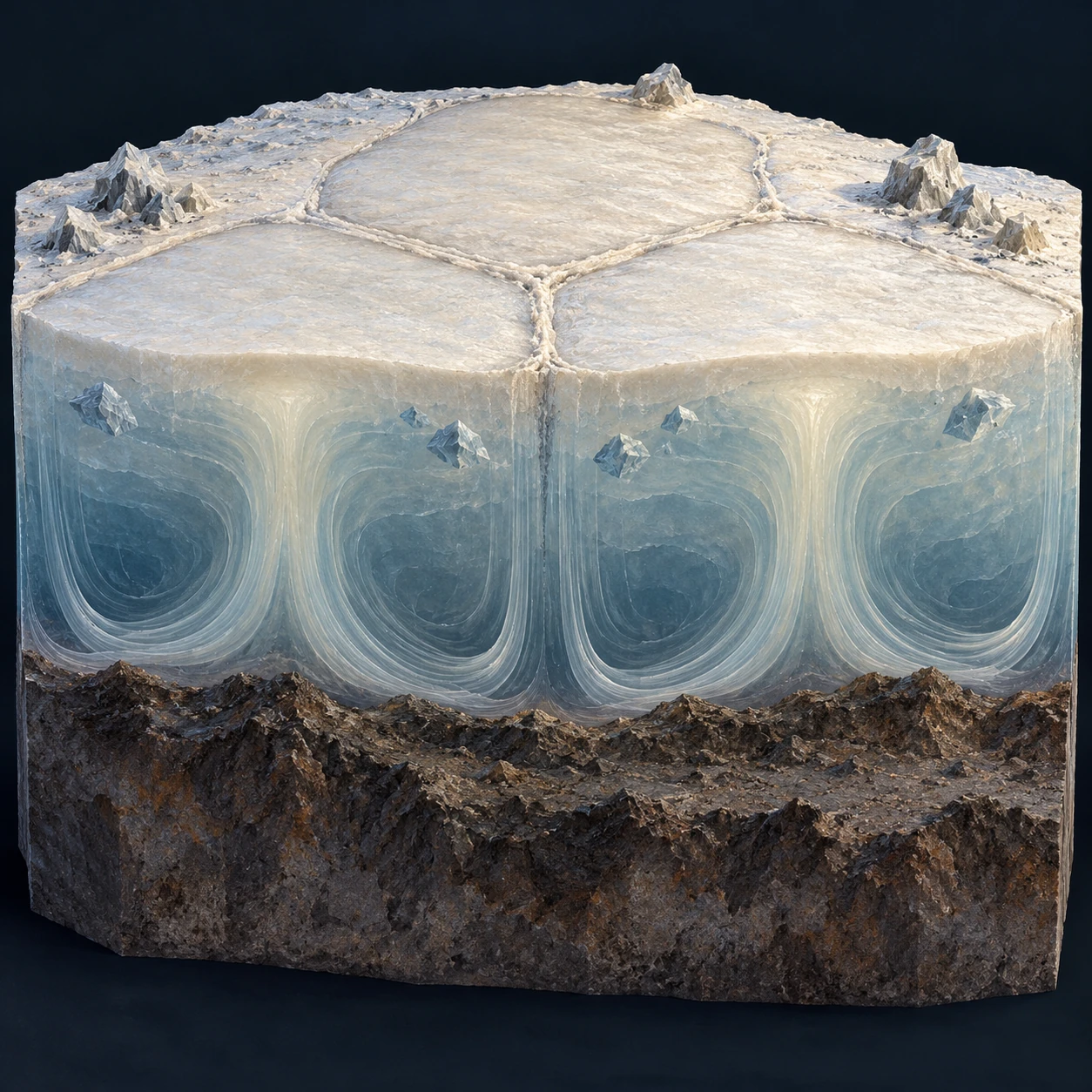
Here is an original clock comparison. At three centimetres per year, travelling ten kilometres takes about 333,000 years. At six centimetres per year, the same distance takes about 167,000 years. These are distance-divided-by-speed examples, not newly measured circulation times. Real paths curve, speeds vary and a renewal time is not necessarily the age of the entire glacier.
The arithmetic makes the phrase “active geology” less misleading. Activity need not be visible during a spacecraft flyby. It can continually renew a surface while remaining imperceptibly slow on a human afternoon.
The top boundary can help drive the interior
A 2021 study by Morison and colleagues brought another process into the convection calculation: sublimation at the surface. Nitrogen ice can pass directly into vapor, exchanging material with Pluto’s atmosphere. Removing material and energy at the upper boundary changes how the ice layer is forced.
The study tested how sublimation-driven convection reproduced flat polygon interiors separated by narrow troughs. Its results depended on basal heat input and viscosity contrasts. That dependence is scientifically useful because it identifies combinations of conditions capable of producing the particular surface pattern.
It also sharpens the standard of comparison. Producing any cellular pattern is easier than reproducing the observed relationship among cell width, surface relief and troughs. A model can capture a broad mechanism and still miss the shape that would make it a good explanation of this location.
| Question | Relevant constraint |
|---|---|
| Can solid nitrogen convect? | Material properties, temperature and layer thickness |
| Why are the cells so broad? | Geometry and the flow regime |
| Why do narrow troughs outline flatter interiors? | Surface topography and boundary conditions |
| How quickly is the surface renewed? | Modelled speeds and transport paths |
The table is a guide to reading the papers, not a vote among them. Different studies can explain different constraints, and later work can reveal that a formerly neglected boundary condition matters.
A newer liquid interpretation belongs beside the solid-flow story
In August 2026, NASA reported a new analysis of the northern Sputnik Planitia imagery. Researchers interpreted some dark linear and diffuse features as possible occasional wetting by liquid, most likely nitrogen emerging from beneath the glacier.
This is evidence interpreted from images, not a camera movie of liquid arriving during the encounter. The wording “possible occasional wetting” preserves the difference. The proposed liquid is also not water, and the interpretation does not turn the entire plain into a liquid ocean.
The suggestion matters because it adds another process to the history of particular features. Slow solid-state deformation, sublimation and localized liquid behavior can be considered within the same evolving landscape without declaring that one observation explains every mark.
When reading the 2026 result, compare the claim with the older cell studies. Which specific dark features are being interpreted? Does the proposed process address their appearance, their timing or the origin of the large cells? Keeping those targets distinct allows new research to add detail without erasing established evidence.
Sputnik Planitia is fascinating precisely because a flyby delivered more than an attractive frozen scene. It delivered a set of shapes that require physical explanations, and those explanations continue to be tested. The quiet plain contains a history of movement whose clock is much slower than the spacecraft that first showed it clearly.
Sources and further exploration
- NASA: Highest-resolution views of Pluto’s icy plains
- McKinnon and colleagues: Convection in a nitrogen-ice-rich layer
- Trowbridge and colleagues: Vigorous convection and polygonal terrain
- Morison and colleagues: Sublimation-driven convection
- NASA: Evidence of recent liquid on Pluto’s surface, August 2026
Explore all 80 new articles · Browse the complete illustrated collection
Keep exploring at Incoprea.