One of Voyager 2’s most surprising views of Triton was a dark column rising from an extremely cold surface. Near its top, the plume bent into a long streamer. Something was lifting particles into the moon’s thin atmosphere, then the wind was carrying them away.
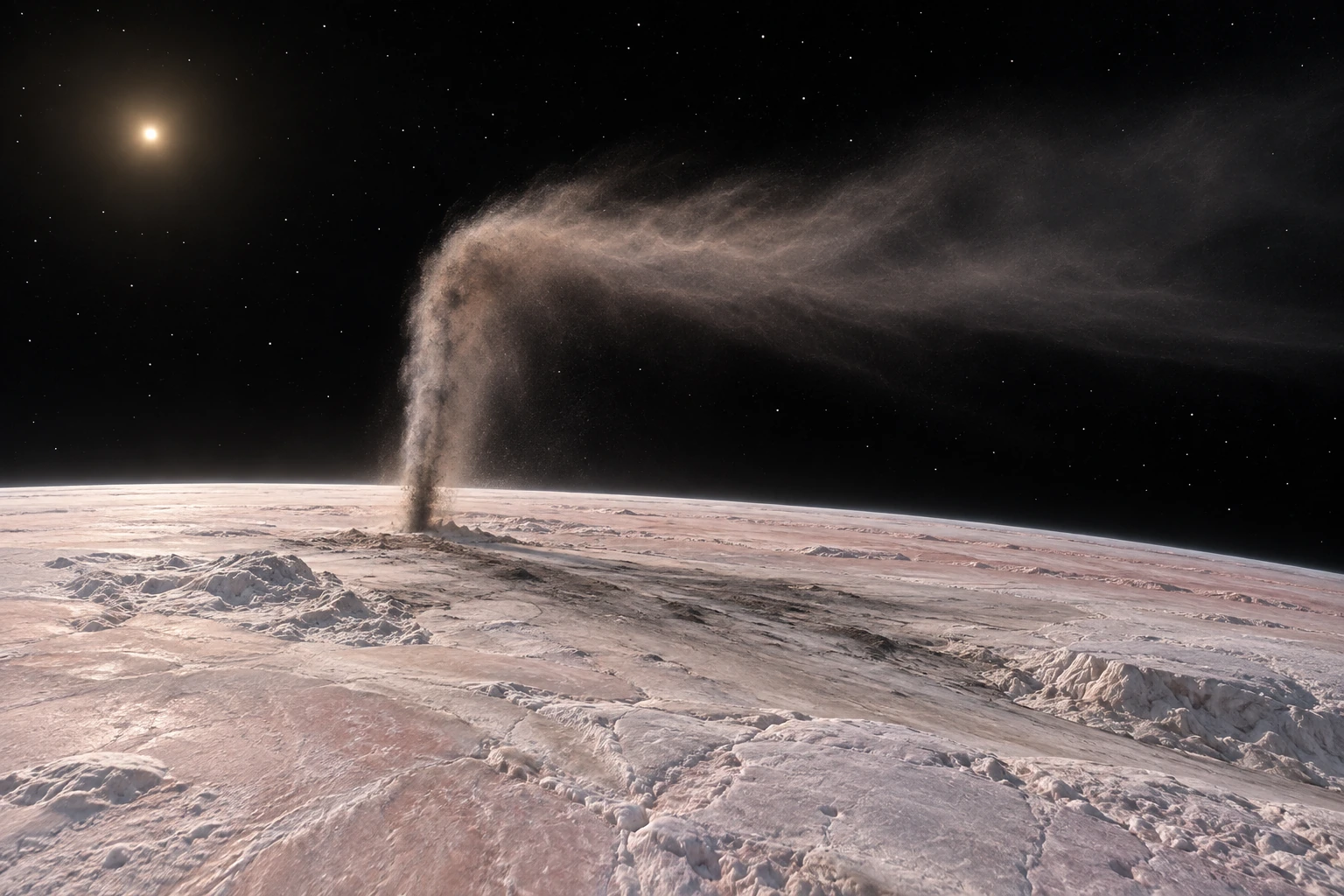
The observation is extraordinary enough without assigning the engine too quickly. A plume’s existence, composition, geometry and source of energy are related questions, but they are not identical. Triton’s evidence is especially instructive because much of the close-up record comes from one brief spacecraft encounter.
Read the three images as a sequence
NASA’s original Voyager image sequence shows a column about eight kilometres high and material extending roughly 150 kilometres downwind. The frames were taken about 45 minutes apart.
The archived caption also notes an ambiguity: an apparent increase in cloud density might reflect a real change or a different viewing angle. That small qualification is useful scientific instruction. A sequence can contain changing geometry as well as changing activity.
Open the source images and follow the vertical column, the horizontal cloud and its shadow separately. The column locates rising material; the streamer reveals transport; the shadow helps relate the elevated cloud to the surface. None, by itself, identifies the heat source below the vent.
A greenhouse can be made of solid ice
One longstanding model allows sunlight to penetrate a transparent or translucent surface layer and warm darker material below. Nitrogen can sublime, gas pressure can build, and venting can entrain particles. The phrase “solid-state greenhouse” describes that subsurface energy arrangement rather than an ordinary warm atmosphere.
The 1990 primary description of Triton’s geyser-like plumes discusses a solar-heated nitrogen model. It shows why a small temperature increase can matter in such a cold volatile system. Its model values are predictions under stated conditions, not temperatures measured beneath a particular vent.
There is an energy-collection problem to solve as well as a pressure problem. A plausible mechanism must supply enough energy over the relevant area and time, retain or transport it effectively, and account for the material that escapes.
Why the familiar explanation remains a hypothesis
A later analysis by Hofgartner and colleagues compared plausible eruption hypotheses, including solar-driven and internally powered alternatives. It reconsidered the argument that plume and fan locations strongly favor a solar mechanism because of their relation to the subsolar latitude.
The authors concluded that the location evidence was less decisive than often assumed. They argued for further consideration of all three plausible eruptive hypotheses. That is not a rejection of the observed plumes. It is a revision of how confidently a particular cause follows from their locations.
Internally powered alternatives also need evidence. A cold surface does not prove the absence of internal heat, just as the existence of internal heat would not automatically establish that it powered the observed eruption. The useful comparison asks which measurable outcomes differ among models.
| Question | Helpful observation | Why it matters |
|---|---|---|
| What is being expelled? | Composition of the plume and deposited fan | Different sources may supply different materials |
| Where can an eruption occur? | Distribution of active plumes and older fans | Tests the proposed relation to terrain or illumination |
| What supplies the energy? | Surface temperatures and subsurface constraints | Connects a model to an actual energy budget |
Dark streaks are a longer record with their own uncertainty
Voyager’s south-polar terrain image shows many dark streaks interpreted as deposits associated with vents and atmospheric transport. A deposit can outlast the eruption that produced it, offering a larger sample of possible past activity than the active plumes caught during the flyby.
But a longer record introduces questions about preservation, age and origin. The current distribution of surviving fans need not be an unbiased map of all eruptions. Comparing it with a present illumination pattern requires those possibilities to be considered.
Triton is a useful place to practice a generous kind of uncertainty. The event was seen; the mechanism remains open enough to motivate specific observations. The next advance would be more satisfying than simply collecting another spectacular plume picture: it could reveal which of several physical engines was actually at work.
Sources and further exploration
- NASA Photojournal: Triton’s Volcanic Plumes
- Soderblom and colleagues: Discovery and basic characterization
- Hofgartner and colleagues: Hypotheses for Triton’s Plumes
- NASA Photojournal: Triton South Polar Terrain
Explore all 80 new articles · Browse the complete illustrated collection
Keep exploring at Incoprea.




