A small brown diamond contained a mineral grain too small to admire without instruments. That grain mattered because its crystal structure and infrared signature offered a physical sample of conditions far deeper than ordinary drilling can reach.
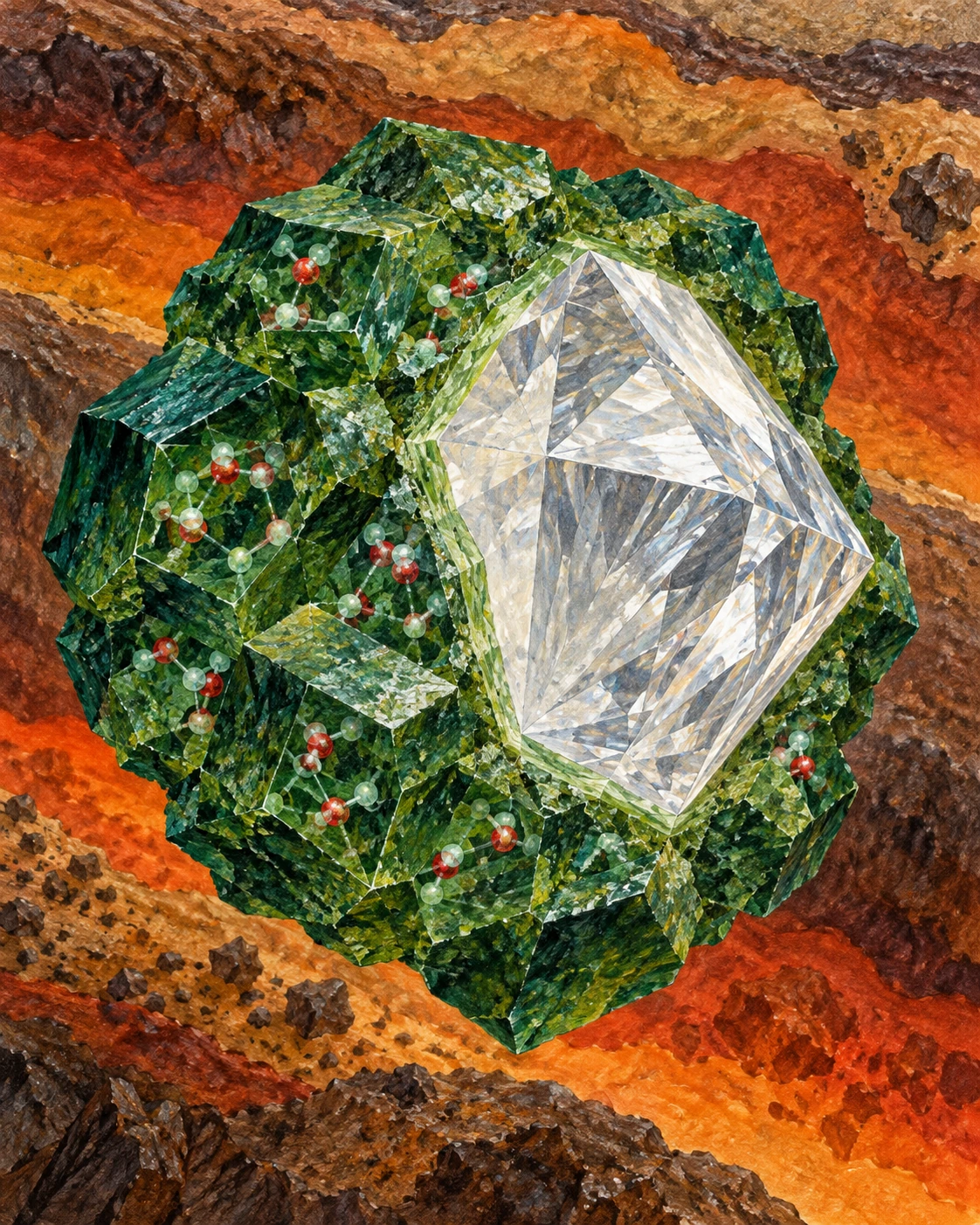
In 2014, researchers reported hydrous ringwoodite enclosed in a diamond from Juína, Brazil. Ringwoodite is a high-pressure form of the mineral olivine. Its relevance to water comes from hydrogen that can be incorporated into its structure, commonly described in terms of hydroxyl groups.
“Water content” needs a chemical translation
A mineral’s reported water content need not mean that liquid water fills visible pores. For ringwoodite, hydrogen can occupy defects in the solid’s structure. Reporting the equivalent amount of H₂O is a convenient compositional accounting convention.
The Northwestern account of deep-water research explains this hydroxyl form and emphasizes the remaining question of extent and heterogeneity. The attractive image of a deep reservoir should not make a solid mineral into an open chamber of liquid.
That distinction does not make the reservoir trivial. A small mass fraction multiplied by a vast amount of rock can represent a large amount of hydrogen and oxygen. It simply changes what is being stored and how it can move.
What the diamond established
Pearson and colleagues’ primary paper used X-ray diffraction and Raman and infrared spectroscopy to identify the inclusion and its hydrous character. The result supplied direct evidence that at least part of the mantle transition zone contains water-bearing mineral material.
The transition zone is usually discussed as the mantle region between roughly 410 and 660 kilometres deep. Ringwoodite is stable within a portion of that range. A single recovered inclusion is powerful evidence of local conditions, but it is not a sample of every part of the shell.
The University of Alberta’s account of the discovery describes the analytical work required to find and characterize the tiny grain. Its crucial point is the existence of a local hydrous sample. Extrapolating from that sample to a total mantle inventory requires additional assumptions.
Do the multiplication, then inspect its assumptions
Take an invented block containing one million tonnes of a water-bearing mineral. If its water-equivalent mass fraction is one percent, the corresponding amount is ten thousand tonnes. At one tenth of a percent, it is one thousand tonnes. The rock amount did not change; the assumed concentration did.
Now suppose only half the block contains that mineral, with the rest unable to store the same concentration. The first estimate halves again. This simple accounting shows why the words “can store” and “does contain” lead to different calculations.
| Assumed host mass | Water-equivalent fraction | Equivalent amount |
|---|---|---|
| 1,000,000 tonnes | 1% | 10,000 tonnes |
| 1,000,000 tonnes | 0.1% | 1,000 tonnes |
| 500,000 tonnes | 1% | 5,000 tonnes |
A global inventory needs the relevant rock volume, density, mineral proportions and actual concentration distribution. A storage-capacity experiment supplies one part of that chain. A local inclusion supplies another. Neither independently closes the budget.
A phase change can change the storage
A study by Schmandt and colleagues combined high-pressure experiments, modelling and seismic observations. In the laboratory, transforming hydrous ringwoodite into lower-mantle phases produced intergranular melt. Seismic velocity changes beneath a region of North America were consistent with partial melting where downwelling material crossed the transition.
The process offers a way for water to influence deep movement without behaving as a subterranean river. Different minerals have different capacities to incorporate hydrogen. When a descending rock changes mineral assemblage, that capacity can change too.
The observational inference still requires care. Seismic waves respond to several material properties, so linking a velocity change to melt involves a physical model and other constraints. The experiments help make that interpretation testable; they do not convert every slow region into a measured water concentration.
Three meanings to separate in a deep-water headline
Capacity: what a mineral can hold under specified conditions. Sample content: what was measured in a particular inclusion. Regional inventory: how much is present across a large volume. A convincing argument states which quantity has actually been established.
The tiny inclusion changed the discussion because it was material evidence, not just an inference from a distant signal. Its wider importance lies in the questions it makes sharper: how unevenly hydrogen is distributed, how mineral changes move it, and how a deep solid participates in Earth’s water cycle.
Sources and further exploration
- Pearson and colleagues: Hydrous mantle ringwoodite within diamond
- Northwestern: Research on Earth’s deep water cycle
- University of Alberta: Ringwoodite discovery account
- Schmandt and colleagues: Dehydration melting at the top of the lower mantle
Explore all 80 new articles · Browse the complete illustrated collection
Keep exploring at Incoprea.