A wave can be remarkable because of its neighbors. A twenty-metre wave in one sea state and the same-height wave in another do not represent the same statistical surprise. To understand a rogue-wave claim, first establish what the surrounding sea was doing.
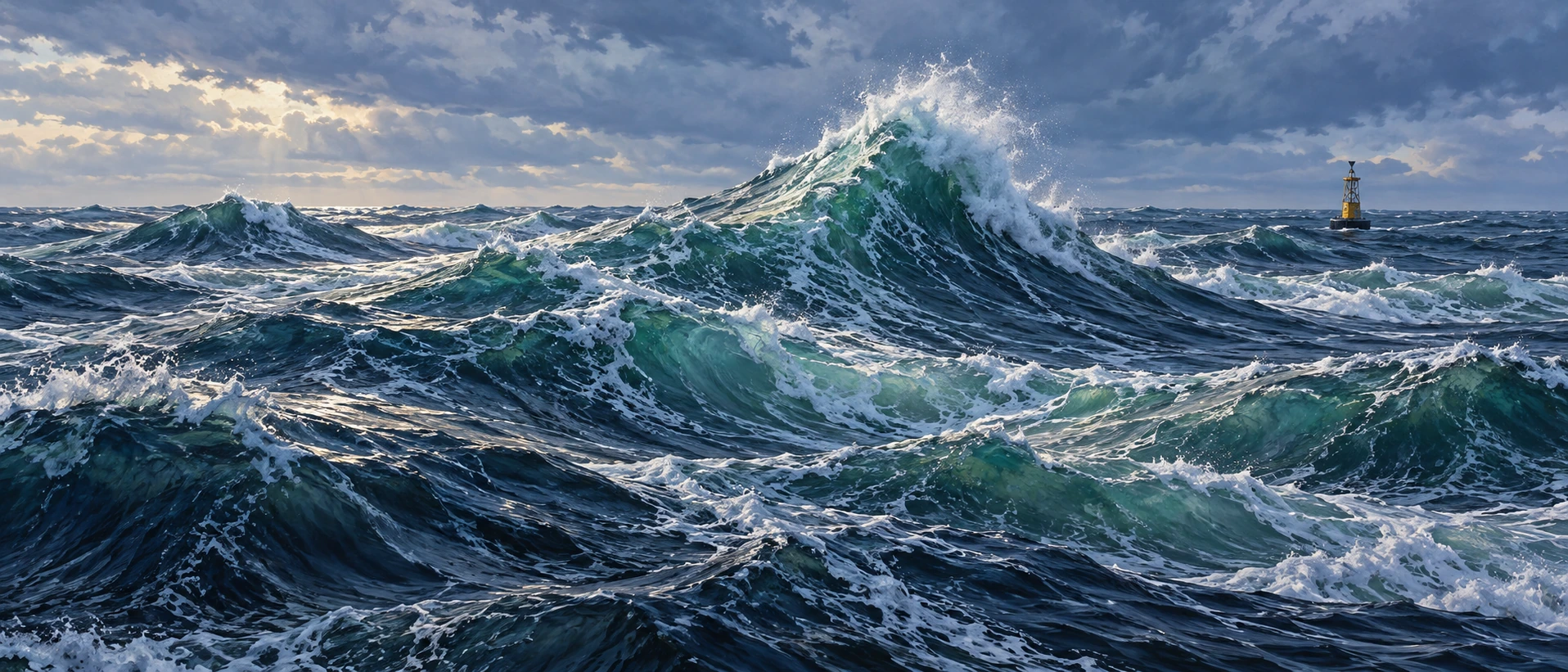
Researchers commonly use a wave-height threshold relative to the significant wave height of the record. Significant wave height describes the scale of the sea state; in a time-domain description it approximates the average height of the highest third of waves. It is not the height of every wave, and it is not a maximum.
The NOAA buoy-calculation explanation makes this distinction useful when reading a wave report. A rogue-wave threshold often used in research is a crest-to-trough height exceeding twice the significant wave height. Crest elevation above the mean surface is a different quantity.
Start with addition
Ordinary wave trains can reinforce or partly cancel one another. When several crests coincide, their contributions add. When a crest meets a trough, they can reduce the instantaneous displacement. NOAA’s overview describes constructive interference and focusing by currents among the mechanisms relevant to unusually large waves.
The model below isolates addition. It uses twelve sinusoidal components at one instant, each with an amplitude of one metre and a different wavelength. The sliders control phase: where each component sits in its cycle.
Twelve waves, one surface
Phase controls reveal linear addition with explicit limits; no rogue-wave probability is inferred.
Press “Align all crests at the centre.” At that position, twelve contributions of one metre produce a twelve-metre elevation above the mean. Spread their phases again and the central sum changes, even though no individual component’s amplitude has changed.
These are invented inputs. The display does not calculate a significant wave height, crest-to-trough height or probability. Calling its large central value a measured rogue wave would import a statistical claim that the toy model has not established.
The record that made the question concrete
The Draupner platform measured an exceptional North Sea wave on January 1, 1995. The frequently reported values are about 25.6 metres crest to trough in a sea state with a significant wave height around 12 metres. The value of an instrument record is that neighboring waves and the exceptional event can be evaluated together.
A study of linear-interference models and ocean time series examines how assumptions about component waves and phase-space behavior affect extreme-wave occurrence. Its conclusions belong to the specified model and datasets. They do not establish a universal number of component waves required by every real ocean event.
Direction changes how a crest breaks
A real sea has direction. Waves can meet at different angles, interact with currents and steepen until the simple linear picture fails. That creates a second question beyond “Can the contributions add?”: what limits or reshapes the resulting crest?
In Oxford and Edinburgh experiments recreating aspects of the Draupner wave, researchers varied the angle between crossing wave groups. The resulting breaking behavior differed from that of a simpler following-sea arrangement. The laboratory result helps test a possible mechanism rather than replaying a unique recovered movie of the 1995 ocean.
That is the useful relationship between a model and an event. Measurements constrain the target. Controlled experiments explore which physical combinations can reproduce important features. Neither removes all uncertainty about what happened beyond the instrument’s field of observation.
Five quantities worth finding in a rogue-wave report
- The event’s crest-to-trough height and, separately, its crest elevation.
- The record’s significant wave height and the interval used to estimate it.
- The instrument and its sampling limitations.
- Wave direction, crossing seas and relevant currents.
- Whether the quoted occurrence rate comes from observations or a model.
For example, a reported twenty-metre wave divided by a significant wave height of eight metres gives a ratio of 2.5. Dividing by twelve metres gives about 1.67. The arithmetic is elementary, but it changes the claim. The wave height must first be defined consistently in both cases.
The most interesting rogue-wave research keeps two ideas together. Addition can produce a striking crest without an exotic ingredient, while a dependable account of its rarity and breaking requires much more than a row of sine waves. The ocean’s ordinary ingredients can still create exceptional outcomes.
Sources and further exploration
- NOAA NDBC: How wave statistics are calculated
- NOAA Ocean Service: What is a rogue wave?
- Birkholz and colleagues: Linear interference and extreme waves
- Oxford Engineering: Laboratory recreation of the Draupner wave
Explore all 80 new articles · Browse the complete illustrated collection
Keep exploring at Incoprea.