Imagine a bright auroral oval with a much fainter mark hidden against it. When the oval shifts, the mark becomes distinguishable. That change can reveal a connection extending from a giant planet’s atmosphere to one of its moons.
Jupiter’s auroras are more than an enlarged version of Earth’s northern lights. The planet’s rapid rotation, its magnetic environment, its moons and disturbances arriving from the Sun all participate. A useful explanation must separate the source of energy from the process that delivers energetic particles to the atmosphere.
Three questions behind one glow
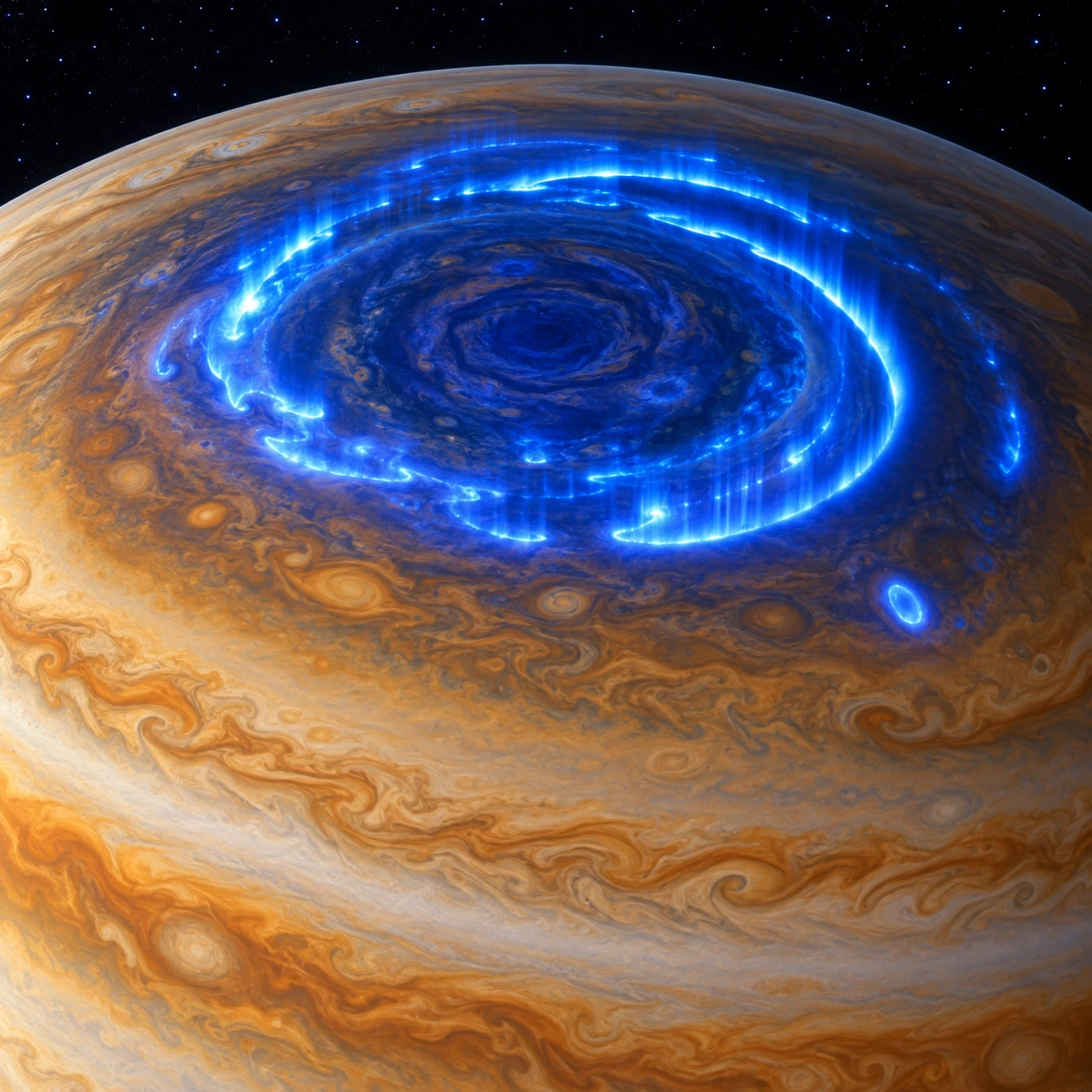
Start with the last step. Energetic electrons collide with gases in Jupiter’s upper atmosphere, producing auroral emissions. Juno’s ultraviolet instrument records radiation outside normal human vision. The bright colors in published ultraviolet maps encode information; they are not a prediction of the view through an ordinary window.
Now work backward. What accelerates the particles? What maintains the larger system that supplies their energy? These are different questions. Identifying a powerful accelerator does not by itself identify the ultimate reservoir that keeps the magnetosphere active.
JPL’s Juno background material emphasizes Jupiter’s roughly ten-hour rotation and the dominant role of rotation in powering its auroral system. A rotating magnetosphere interacts with plasma around the planet. Magnetic stresses and currents transfer energy and angular momentum through this system.
That description is a framework, not an instruction to subtract the Sun from every explanation. “Rotation dominated” means an energy budget differs from Earth’s familiar solar-wind-driven picture. It does not mean the solar wind has no access to the system.
One practical reading habit is to mark the noun in an aurora claim. An account may describe the energy source, a particle distribution, a current, an emitting region or an image feature. Two reports can sound contradictory while discussing different links in the same chain.
Juno found an accelerator that was not the whole answer
A 2017 study by Mauk and colleagues examined electron acceleration in Jupiter’s powerful auroras. It detected discrete acceleration associated with energies reaching hundreds of kiloelectronvolts. Yet the downward energy flux connected with these discrete processes was smaller than that associated with broader, more stochastic electron acceleration.
The distinction concerns the shape and energy content of the electron population. A relatively organized acceleration process can make a striking feature in a measurement. A more broadly distributed process can carry more total energy. The easiest signal to describe is not necessarily the largest contributor.
Here is an original accounting example, with invented numbers. Suppose one narrow feature contains ten energy units and a broad population contains ninety. The narrow feature could be unmistakable and scientifically important while supplying only a tenth of the total. Its clarity would not justify calling it the main power channel.
Real particle measurements require considerably more than that arithmetic. Instruments sample directions and energy ranges, and the spacecraft follows a particular path. The example simply prevents a memorable observation from silently becoming a complete energy budget.
The Sun can disturb a rotation-driven system
Gurnett and colleagues’ 2002 study used observations associated with Cassini and Galileo to connect changes in Jupiter’s radio and extreme-ultraviolet emissions with interplanetary shocks. A solar-wind disturbance can compress and reconfigure the magnetosphere, altering auroral behavior.
Think of this as a distinction between maintaining a system and changing its state. A reservoir can already contain energy when an outside disturbance changes where or how that energy is released. A visible response to an external trigger does not require every part of the response energy to have arrived in that trigger.
This is why auroral researchers compare several measurements in time. A brightening alone has no label naming its cause. Timing relative to upstream conditions, particle changes and magnetic signatures helps discriminate among explanations. A single dramatic image cannot supply that sequence.
A faint signature from Callisto
A 2025 Juno-team report described an auroral footprint connected with Callisto. The underlying encounter occurred in September 2019. The publication date and the spacecraft-observation date are different parts of the story.
Footprints linked with Io, Europa and Ganymede were already known. Callisto’s expected signature was difficult to distinguish near Jupiter’s bright main emission. During the relevant encounter, a dense solar-wind stream displaced that emission, helping reveal the faint feature. Juno combined remote imaging with local particle, wave and magnetic measurements near the relevant magnetic connection.
A footprint is not Callisto’s shadow cast onto a cloud deck. It is an atmospheric signature of an electrodynamic interaction linked through Jupiter’s magnetic environment. Its usefulness comes from the connection between a location in the aurora and a body far outside the atmosphere.
This case joins the larger themes without merging them. A moon supplies a particular interaction geometry; the rotating planetary environment supplies a broader context; an external solar disturbance can change visibility and conditions. “Which one causes the aurora?” is too small a question for all three roles.
Watch the observing conditions change
Open NASA’s Jupiter’s Southern Lights animation. Its eight false-color maps cover two hours after Juno’s February 2, 2017 close approach. Each frame combines about fifteen minutes of data, rather than freezing one instantaneous scene.
Try three passes. First follow recognizable structures without interpreting the colors. Next read the time information and consider how much change can be blended within a frame. Finally watch the apparent sharpness. NASA explains that Juno was moving farther from the aurora; the growing fuzziness is largely an observing-distance effect.
The red, green and white encoding also carries an altitude interpretation in the accompanying description. It should not be read as ordinary visible coloration or as a simple universal temperature scale.
That viewing exercise supplies a useful final discipline. Before interpreting a changing planetary light show, check whether the instrument’s distance, cadence, coverage or color mapping changed too. The aurora is a physical process, but the picture is a measurement assembled under particular conditions. Understanding both makes the scene richer.
Sources and further exploration
- JPL: Jupiter and its magnetic environment
- Mauk and colleagues: Discrete and broadband electron acceleration
- Gurnett and colleagues: Solar-wind control of Jupiter’s emissions
- NASA: Callisto’s auroral signature, reported in 2025
- NASA: Jupiter’s Southern Lights animation
Explore all 80 new articles · Browse the complete illustrated collection
Keep exploring at Incoprea.