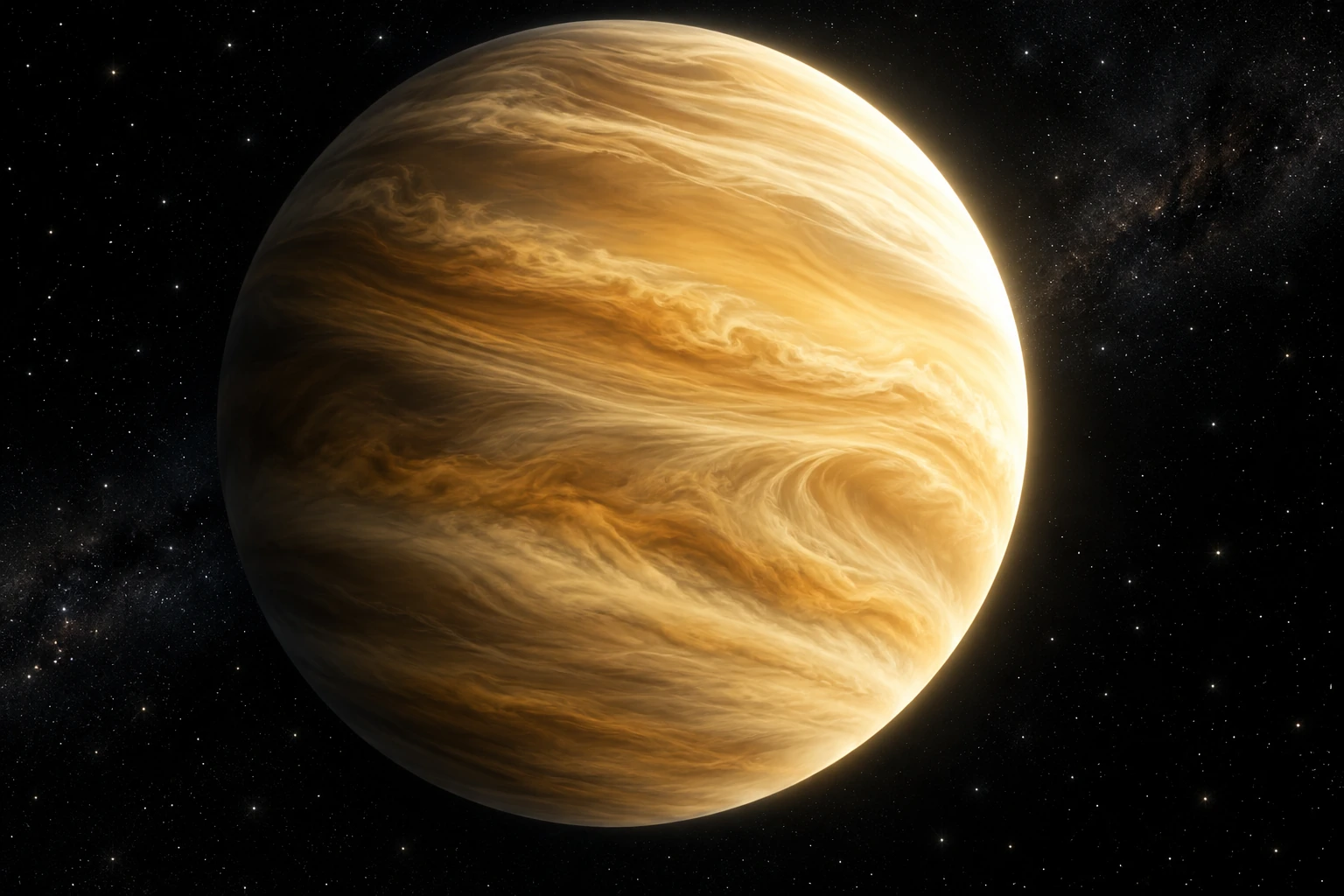
Place two imaginary marks on Venus: one attached to the solid planet and another carried around with the high clouds. The cloud mark can complete many circuits while the ground mark makes one turn. The atmosphere has a circulation whose speed cannot be read from the planet’s slow rotation alone.
This is atmospheric superrotation. On Venus, the puzzle is not merely why a strong wind exists at one place. It is how a persistent global circulation maintains its angular momentum despite processes that redistribute it. Answering that question requires measurements at different latitudes, heights and local times.
Check what “a turn” means before comparing speeds
NASA’s Venus facts distinguish a rotation relative to the stars, about 243 Earth days, from the roughly 117 Earth days between successive sunrises. Venus’s backward rotation and orbital motion make those intervals different. Mixing them would spoil a comparison before any atmospheric physics began.
JAXA’s explanation of Akatsuki’s superrotation research describes cloud-top motion around sixty times faster than the planet’s rotation. The comparison is especially striking because the solid planet is so slow. It does not imply that every layer or latitude shares one wind speed.
Make the scale tangible with an approximate calculation. Using the 6,052-kilometre radius listed in NASA’s Magellan fact sheet, the equatorial circumference is about 38,027 kilometres. Ignore cloud height for this exercise.
A four-Earth-day circuit of that circumference corresponds to about 110 metres per second. A 243-day circuit corresponds to about 1.8 metres per second. These are illustrative circumference-divided-by-time speeds, using rounded values; they are not a new pair of simultaneous wind measurements.
The calculation also reveals why a ratio can sound more exotic than its ingredients. The fast circulation is substantial, but the enormous ratio partly reflects the small speed of the slowly rotating surface. Always inspect both the numerator and the denominator.
Heat produces a tide in the atmosphere
A thermal tide is a large-scale atmospheric response to periodic heating, not an ocean pulled bodily around by the Sun. The day–night heating pattern produces pressure and motion variations. Those organized disturbances can transport angular momentum within an atmosphere.
The 2020 Akatsuki analysis described by JAXA examined this transport in Venus’s cloud layer. Near the equator, thermal tides supplied momentum that helped sustain superrotation against removal by the mean meridional circulation. Other waves and turbulence played different roles, including deceleration at low latitudes.
This is a budget rather than a single arrow labeled “wind.” A process can accelerate one latitude while redistributing momentum from another. Averaging over the wrong region can hide that exchange. The equatorial result is therefore not permission to say every atmospheric wave speeds the whole atmosphere up.
Consider an original bookkeeping example. One band gains five momentum units from a tide and loses four through another transport process. It gains one overall. A second band could lose the five units carried to the first. The circulation’s local maintenance and the planet-wide accounting are related but different questions.
The units in that example are deliberately abstract. It illustrates the logic of a balance, not the measured size of any Venusian flux. For actual numbers, researchers need the correlated winds, atmospheric structure and coverage needed to estimate the terms consistently.
Cloud patterns are tracers with conditions attached
Successive images offer a seemingly simple measurement: identify a cloud feature, find it later and divide its displacement by elapsed time. The difficulty lies in establishing what feature is being followed and which atmospheric level contributes to the image.
Brightness can change because a feature evolves, clouds become more or less transparent, viewing geometry changes, or a wave pattern moves. A recognizable pattern is not automatically a tagged parcel of gas. Researchers compare many features and use wavelength-dependent information to make the interpretation defensible.
A 2021 JAXA account of nightside cloud tracking describes methods developed to recover nighttime motions that had been harder to measure. The resulting meridional circulation differed between day and night, helping reveal a fuller thermal-tide pattern.
That result explains why a convenient daytime image set cannot automatically stand for the whole planet. A daily average needs information from both sides. Missing data can conceal a circulation reversal even when the main westward motion looks familiar.
A cloud wall supplies a useful counterexample
Another Akatsuki-team study reported a long-lived disruption in the deeper clouds. The feature could extend thousands of kilometres and recur on an approximately five-day circuit. Researchers found related appearances in older observations.
The team proposed a wave interpretation, while explicitly noting uncertainty about how the disruption was initiated and maintained. It occupied a different altitude region from the upper cloud tops usually invoked in the simplest superrotation comparison.
This is a helpful reminder that “a feature circling Venus” is not a complete physical description. A wave may propagate through a moving medium. Its apparent circuit period can differ from the material motion of that medium. Its altitude and relation to the background circulation matter as much as its dramatic outline.
| Check | Reason |
|---|---|
| Wavelength and atmospheric level | Different images can emphasize different cloud regions. |
| Day or night, latitude and sampling interval | A limited view can miss the circulation’s spatial and daily structure. |
| Material tracer or propagating pattern | Pattern speed need not equal the speed of individual air parcels. |
Use the table on the image sequences in the linked JAXA accounts. First describe only the visible pattern. Then state the inferred motion. Finally list what additional information turns that motion into a momentum-transport estimate. The exercise keeps an observation from expanding into a stronger claim unnoticed.
Venus’s fast clouds are compelling because they demand an explanation larger than a wind-speed record. Thermal tides, mean circulation and other waves interact in a moving atmosphere over a slowly turning world. The progress comes from measuring their balance, including the parts that were previously hidden on the night side.
Sources and further exploration
- NASA: Venus facts
- JAXA: Akatsuki uncovers how superrotation is maintained
- NASA: Magellan fact sheet
- JAXA: Nighttime cloud tracking reveals atmospheric circulation
- JAXA: Giant disruption in Venus’s lower clouds
Explore all 80 new articles · Browse the complete illustrated collection
Keep exploring at Incoprea.