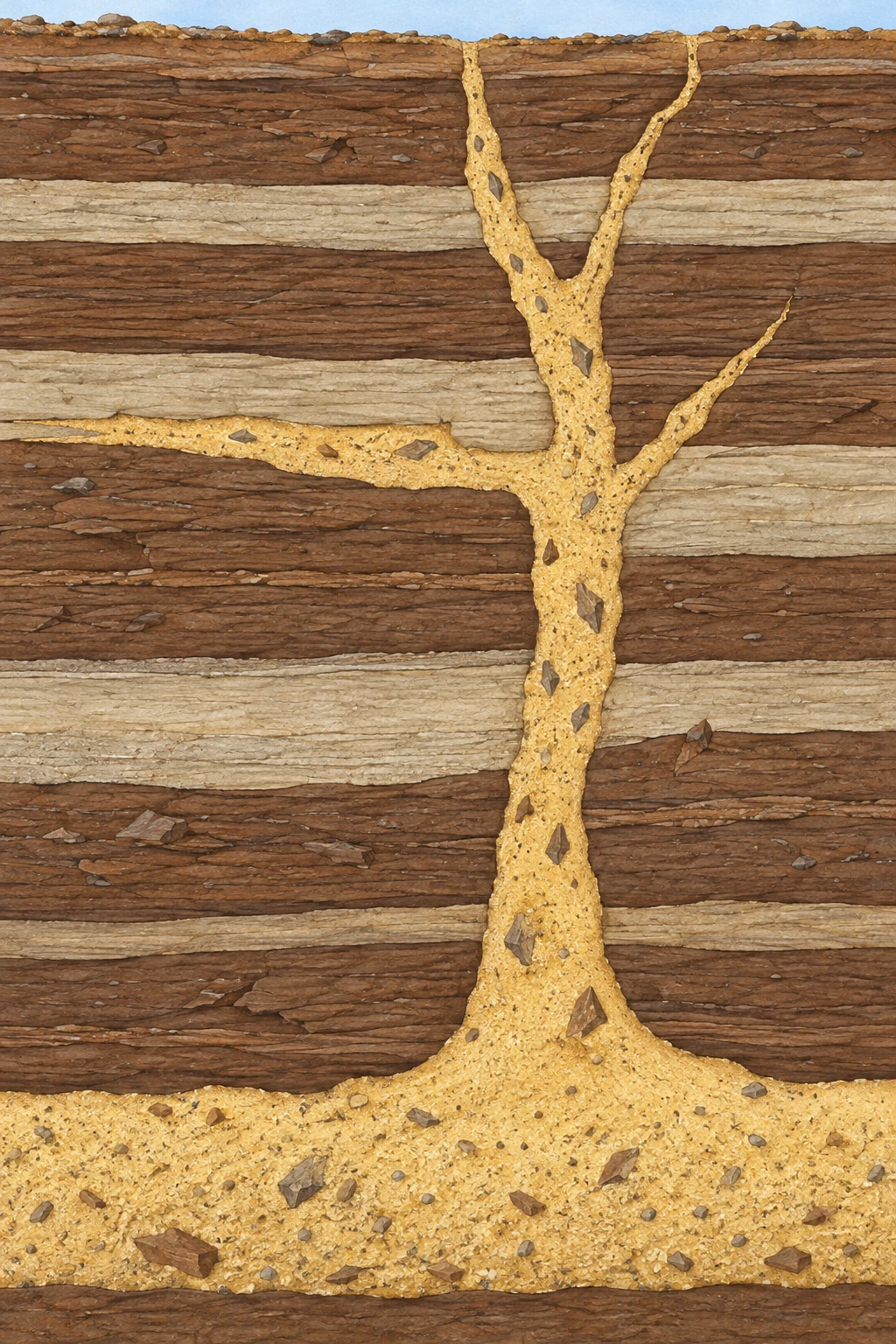
Start with the beds. Thin layers run across the outcrop, one above another. Then a pale sandstone body cuts through them almost vertically, branches, and spreads sideways. If every sandstone is read as an old beach or river deposit, this one seems to violate its surroundings.
It may be an injectite: sand that was mobilized by fluid and pushed through fractures in material already present. The intrusion later became rock. Its geometry preserves movement through the sediment pile rather than straightforward deposition on top of it.
Pressure changes what a pile of grains can do
Buried sand is a framework of grains with fluid in the spaces between them. If pore-fluid pressure becomes high enough, it can reduce the load carried at grain contacts. When a route opens, moving fluid can entrain grains and carry them as a sand-rich mixture.
The host material matters. Fine-grained beds may restrict fluid escape, allowing overpressure to accumulate. Fractures can provide a new pathway. An injectite therefore records a relationship among sediment properties, pressure and failure; it is not simply a vein filled by sand falling into an open crack.
Experiments on forced folds and wing-like sand intrusions investigate how overpressure can deform a cover and create branching pathways. They help explain why intrusion and deformation can evolve together. Their two-dimensional apparatus is a controlled analogue, not a complete reproduction of a buried basin.
Read a small, imaginary outcrop
The following sequence is an original exercise. The drawing is conceptual, and the letters name relationships rather than a real locality. Imagine that a vertical pale body crosses three dark beds. A thin pale sheet follows one bed boundary, and angular fragments of dark material sit inside the pale body.
- Observation A: the dark layers end abruptly against the pale body. The cut layers existed before the material occupying that cross-cutting pathway.
- Observation B: pieces resembling the dark host occur inside the pale material. This is consistent with fragmentation and entrainment during intrusion, though their identity needs petrographic checking.
- Observation C: the pale body connects with a pale buried bed. That bed is a candidate sand source, not proof of a connection extending indefinitely outside the exposed face.
- Observation D: a later narrow crack cuts both host and injectite. Its relative age is younger than both.
Notice what is absent: an exact calendar date, flow speed and trigger. Relative order can be strong even when those quantities remain unknown. A cross-cutting relationship does more reliable work than a dramatic label such as “ancient sand explosion.”
The motion can change as the structure forms
In water-driven experiments by Ross and colleagues, injection and extrusion developed through stages including void formation, infiltration horizons, rupture and piping. Some pipes stayed in place; others migrated. Deposits produced by moving conduits could resemble material that had been fluidized more broadly.
This makes interpretation a genuine inverse problem. Researchers see a final arrangement and ask which histories could have produced it. Different processes sometimes leave overlapping signatures. Watching an experiment helps identify that ambiguity instead of assuming a preserved shape has only one possible origin.
The paper’s supporting-information section includes two short experimental videos. Their useful subject is the changing pathway: follow whether the active vent stays put and whether sand begins moving in neighboring regions. The laboratory dimensions belong to that apparatus, not to the natural structures it helps interpret.
A sandstone has texture as well as outline
A study of California’s Yellow Bank Creek complex examined grain-scale evidence and dewatering after emplacement. The authors interpreted a history involving water-rich and hydrocarbon-rich sand mixtures, followed by changing flow and compaction. Their account drew information from subtle fabrics that a distant landscape photograph would miss.
That case also explains why these structures attract attention below ground. A sand-filled pathway can connect permeable bodies across less permeable layers. Whether a specific structure acts as a conduit, a reservoir or a partly cemented barrier still depends on its continuity and later mineral history.
Three questions to take to a museum slab or a field photograph
Which contacts are actually visible? What feature establishes the proposed order of events? Which interpretation would change if the pale body were disconnected behind the exposed face? These questions keep a two-dimensional view from quietly becoming a complete underground map.
A good injectite story begins with something modest: sand is present where a depositional layer should not be. Following that inconsistency reveals a subsurface landscape in which fluids rearranged grains, broke boundaries and left the evidence in the rock.
Sources and further exploration
- Warsitzka and colleagues: Forced folds and wing-like sand intrusions
- Ross, Peakall and Keevil: An integrated model of extrusive sand injectites
- Sherry and colleagues: Emplacement and dewatering at Yellow Bank Creek
Explore all 80 new articles · Browse the complete illustrated collection
Keep exploring at Incoprea.