In a specimen drawer, a fulgurite may look like an unpromising root: rough, branching and coated with grains. A broken end reveals the surprise. Inside is glass, sometimes lining an irregular hollow passage. The object records an electrical event by preserving what happened to the ground.
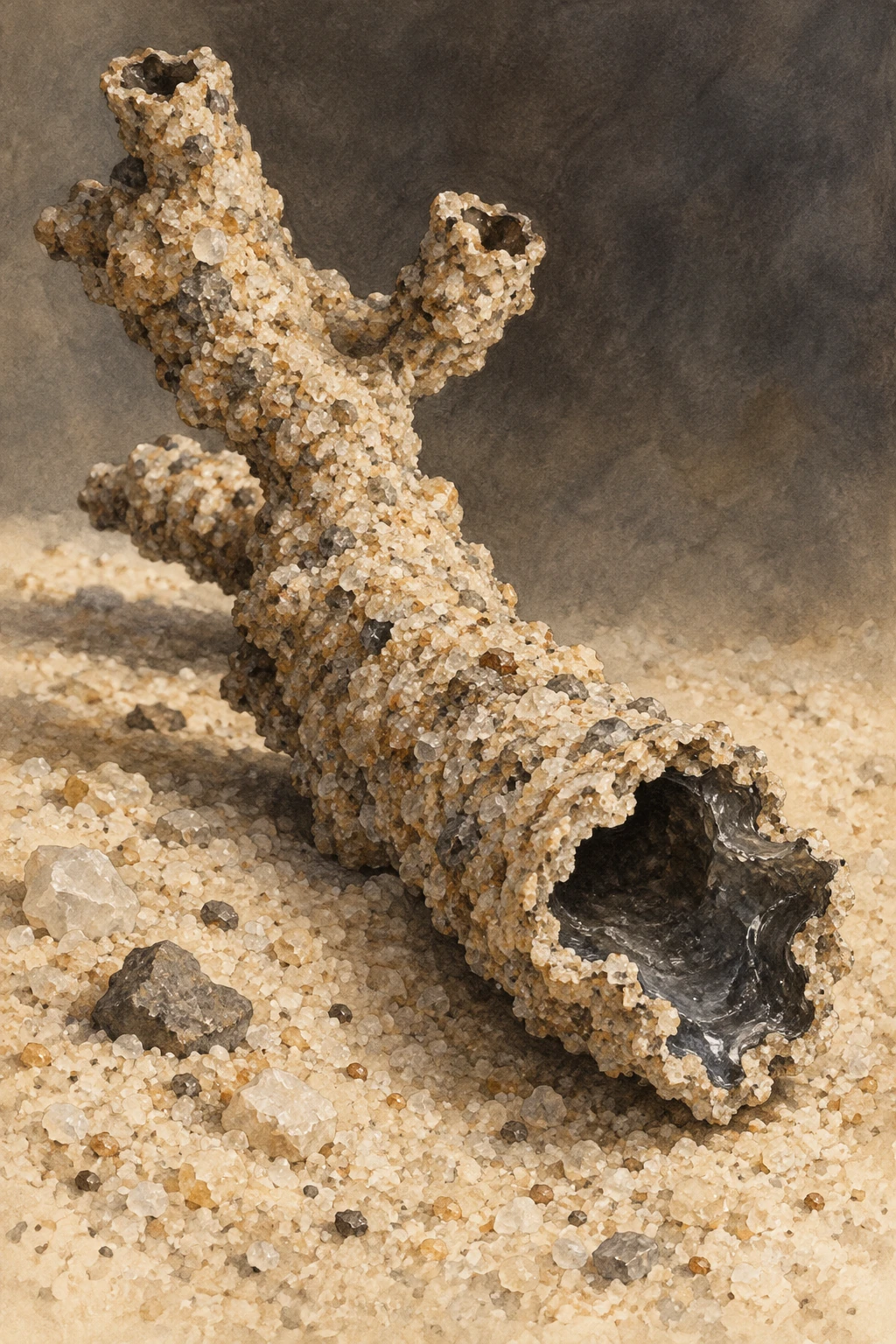
Cloud-to-ground lightning can heat suitable material rapidly enough to melt part of it. Rapid cooling then arrests that melt as glass. The result depends on the material struck, how current travels through it, and how much energy is transferred over time. A fulgurite is therefore a physical record with local conditions built into it.
There is more than one kind of lightning glass
The familiar hollow sand tube is only one member of the family. A classification study by Pasek and colleagues distinguishes forms made in sand, clay, caliche and rock. Sand examples can have thin glass walls, while clay-rich targets can produce much thicker, melt-rich structures. Rock fulgurites may occur as glass associated with unmelted surrounding rock.
This variety changes how a specimen should be read. A thick wall is not automatically evidence of a stronger strike than a thin wall from a different substrate. The starting mixture’s mineralogy and physical arrangement also affect melting, heat transfer and the pathway available to current.
A strike has a duration as well as a peak
Experiments designed around realistic lightning discharges separated a short high-current impulse from a longer continuing-current phase. In those tests, the impulse alone produced limited melting; adding continuing current allowed fulgurite bodies to form in the tested materials.
The lesson is not that one laboratory result describes every strike. It is that a peak value cannot tell the whole energy story. A brief enormous current and a lower current sustained for longer can transfer heat differently. Material composition, porosity and the contact between grains complicate that comparison further.
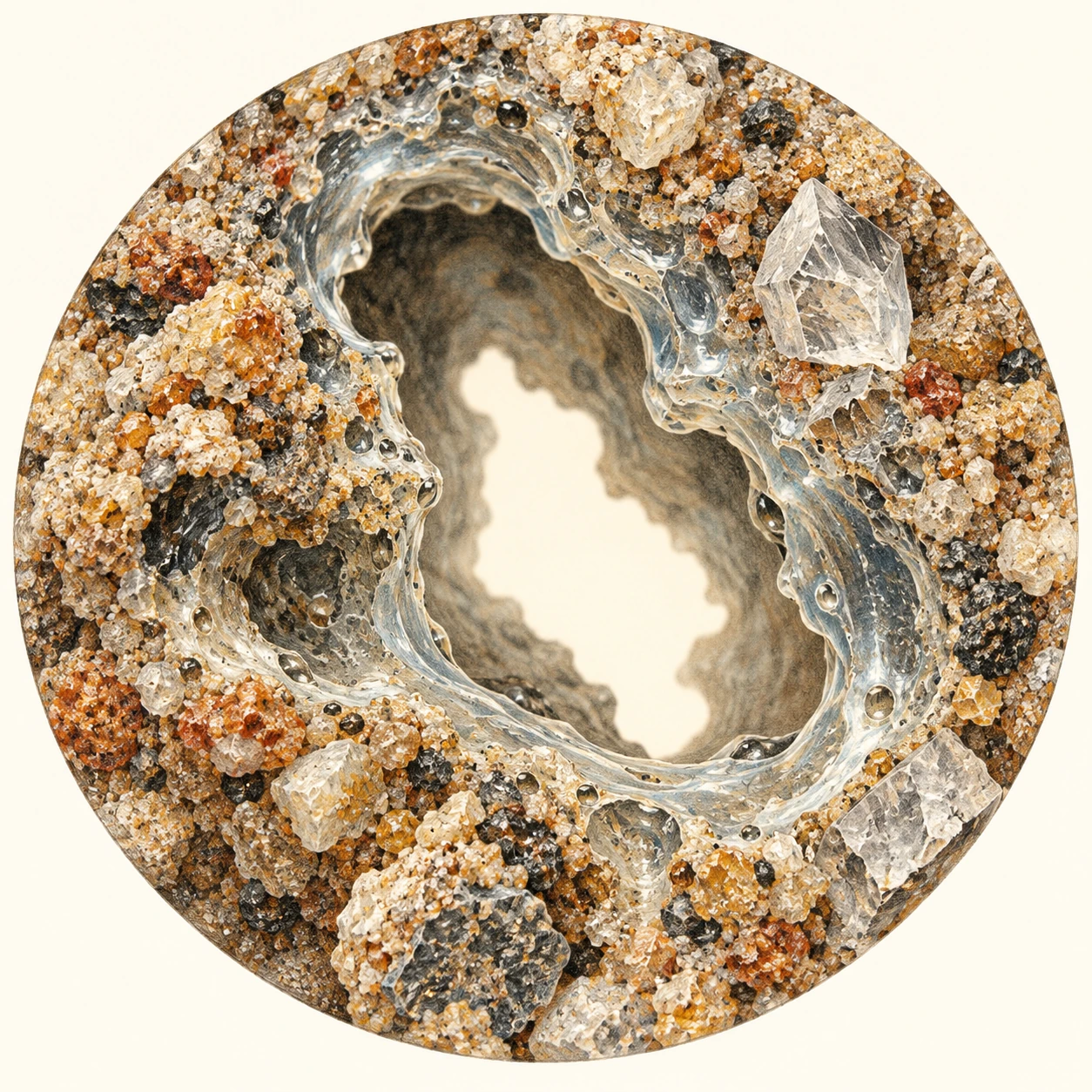
Read the wall before reading the weather
Use the conceptual section as a reading exercise. The central cavity, glassy lining and partly incorporated grains belong to different parts of the thermal history. They should not be treated as equally heated material with identical cooling rates.
- Trace the boundary. Where does smooth glass give way to recognizable grains? This is a question about material transformation, not just color.
- Keep the host in view. Compare the object with the sediment or rock in which it formed. An isolated tube loses information about that setting.
- Ask about measurement. Diameter, wall thickness, mineral identification and chemical analysis are different observations. A photograph cannot substitute for all four.
- Separate origin from reconstruction. Identifying a likely fulgurite is not the same as recovering the exact current waveform or the precise date of the storm.
This sequence is an original guide to evaluating evidence. It is not an identification key for an unknown object, and it does not ask readers to seek lightning strikes or excavate fragile specimens.
How much of the energy remains legible?
A 2016 study of Florida sand-mine fulgurites used morphology to estimate energy deposited per unit length. Its population had a geometric mean near one megajoule per metre under the study’s assumptions. That unit is important: it is not the total energy of an entire atmospheric flash.
The method connects a preserved material outcome with a model of heating and vaporization. Its usefulness rests on knowing the target and the assumptions. It should not become a universal ruler applied to every glass tube in a collection, especially when the host composition or preservation history is unknown.
The chemistry can change, too
Some fulgurites preserve reactions that require strongly reducing conditions. A study of a clay-rich Illinois fulgurite identified iron phosphide and examined how lightning could create chemically reduced phosphorus from more oxidized starting material.
The relevance to early-Earth chemistry is specific. Such a reaction offers a possible route to forms of phosphorus different from ordinary phosphate minerals. It does not show that a lightning strike created life, nor that every fulgurite has the same compounds. The researchers connected the outcome to the particular composition and reducing environment of their sample.
A fulgurite’s appeal is the mismatch between timescales. The heating event is brief; the fragile product may persist long enough to enter a geological collection. Reading it well means resisting a single dramatic story and instead following the glass, the grains and the chemical products separately.
Sources and further exploration
- Pasek and colleagues: Fulgurite Morphology
- Scientific Reports: Experimental generation under realistic lightning conditions
- Pasek and Hurst: A Fossilized Energy Distribution of Lightning
- Hess and colleagues: Lightning and prebiotic phosphorus reduction
Explore all 80 new articles · Browse the complete illustrated collection
Keep exploring at Incoprea.