Two pieces of fabric look like a good match in a shop. Beside a window, one seems greener. Under another lamp, the agreement returns. It is tempting to say that one of the colors has changed its mind. The more useful explanation asks what light each surface sends to your eye.
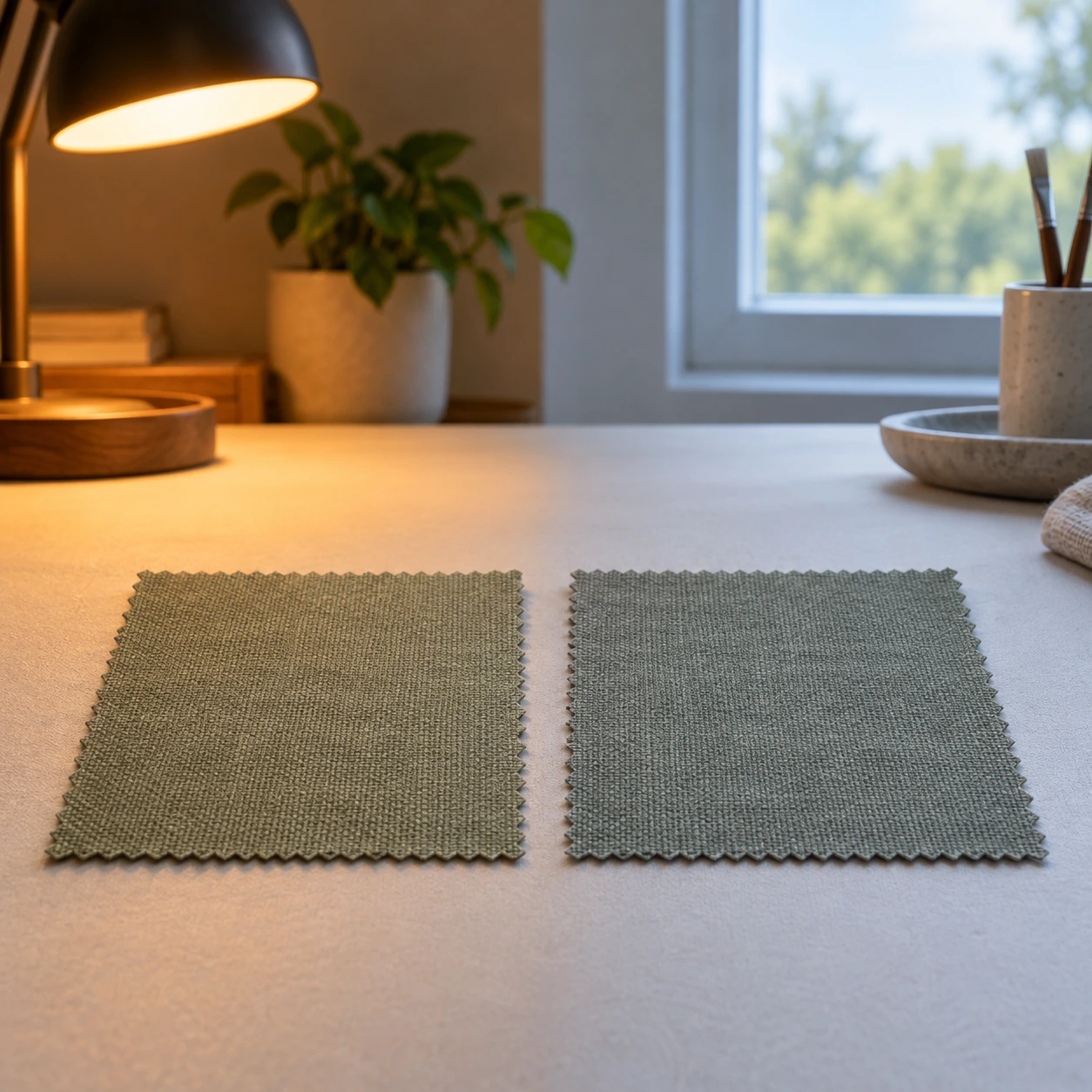
A color match is an observation made under conditions. It involves the illuminating spectrum, the object's reflectance, the viewing arrangement, and the observer. A label such as gray, navy, or cream compresses that situation into a convenient word. The compression is useful until two materials expose what it leaves out.
Different spectra can lead to a similar result
NIST's metamerism definition describes colors perceived as matching despite different spectral profiles, with differences often becoming visible under changed illumination. The important point is not merely that warm lighting makes things look warmer. Two materials can respond differently to the same lighting change.
Imagine two teams whose total scores are equal, even though the points came from different events. Change how events are weighted, and their totals may separate. In color, the spectrum of incoming light changes which parts of each surface's reflectance matter to the light reaching the eye. The analogy explains conditional agreement; it is not a color-calculation method.
Change one condition on purpose
Find two ordinary physical items that already appear similar in color. You do not need to buy samples. Compare them adjacent to one another under a diffuse daylight source, then under a room lamp. Keep both at similar angles and move them together. Avoid direct sun, glare, and looking into lamps.
Before moving them, predict which one will become warmer, cooler, lighter, or unchanged relative to the other. Write the prediction. After moving, describe the relationship rather than just each item alone. “The left sample now looks greener than the right” is a more reproducible note than “the blue looks odd.”
A compact color-match diary
Record the two objects, light source, time if using daylight, background, viewing angle, and your judgment. Swap their left-right positions. Repeat the observation after a short pause. Leave room for “no obvious difference.” A failed search for a dramatic mismatch is still an honest result.
Not every mismatch proves metamerism
The ISO introduction to metamerism indices distinguishes illuminant metamerism from observer and field-size effects. A difference caused mainly by glare, texture, direction-dependent appearance, or a changed background is not automatically the same phenomenon.
Turn one sample slightly while leaving the other still. If a shiny highlight dominates the difference, you have found a reason to control geometry before interpreting the match. Then return both to the same orientation. Good observation often starts by eliminating a more ordinary explanation.
Likewise, do not diagnose a material from a phone photograph. The camera's sensors, white balance, processing, and the display add another chain of transformations. A side-by-side image can document your setup, but it cannot automatically preserve the original spectral relationship.
A screen cannot reproduce the whole demonstration
The illustration above suggests a possible mismatch; it is not a measured pair of metameric samples. Both displayed patches are being made by your screen. Changing an illustrated lamp within a picture changes rendered pixels, not the physical illumination of two different fabric reflectance spectra.
This limitation is useful. It explains why a convincing online color preview may still leave an unanswered question about physical materials. If the final experience involves paper, cloth, or paint under a particular light, that setting is part of the evaluation.
Possibility does not mean constant dramatic failure
In a 2018 study, Akbarinia and Gegenfurtner examined many reflectance spectra under natural and artificial illuminants. They found metamers relatively infrequent in their tested scenarios, with extreme mismatches especially rare. That result limits a common overreaction: metamerism is real, but every small color disagreement should not become a spectacular spectral mystery.
Return to your own pair. Can you say only that it looked different, or did it match under one condition and separate under another controlled comparison? The second statement is stronger because it preserves the relationship between conditions. You may still need spectral measurement to quantify it.
The pleasure here is discovering that an apparently simple visual agreement can carry a hidden dependency. Instead of asking which light shows the “real” color, ask under which conditions the match holds. That question respects what the eye actually does and gives a designer, maker, or curious observer something practical to investigate.
Sources and further exploration: NIST: metamerism; ISO 18314-4: types of metamerism; Akbarinia and Gegenfurtner: illuminant-space study.
Explore all 50 new articles · Browse the complete illustrated collection
Explore more art, ideas, and independent projects at Incoprea.


